
What mental health is, and how to notice it
Good mental health does not mean always happy. It means being able to handle normal stress, work or study, make decisions, care for oneself, and form meaningful relationships even when life is difficult.

1.1 Simple meaning of mental health
Mental health is about how we think, feel, behave, and relate to others in daily life. It includes our inner world (thoughts, emotions, memories, hopes, fears) and our outer world (family, friends, school, work, community). Good mental health does not mean “always happy.” It means being able to handle normal stress, work or study, make decisions, care for oneself, and form meaningful relationships, even when life is difficult.
Mental health exists on a continuum: at one end is strong wellbeing and resilience; at the other end are serious mental disorders that need professional care. Many people move along this continuum during their life depending on circumstances, support, and health.
A second definition
Mental health is how a person thinks, feels, behaves, copes with daily stress, relates to people, makes decisions, and finds meaning. It does not mean being happy every day. It means having enough balance and support to manage life, including difficult periods. Everyone has mental health, just like everyone has physical health. Mental health can improve or worsen over time depending on circumstances, support, treatment, and lifestyle.
Key points
- Mental health exists on a continuum from strong wellbeing to serious disorders.
- Everyone has mental health, just like physical health.
- Mental health can improve or worsen over time.
- Support, treatment and lifestyle changes can help.
- Early intervention leads to better outcomes.
A tighter clinical definition
The World Health Organization describes mental health as a state of wellbeing in which a person realizes their own abilities, can cope with the normal stresses of life, can work productively, and can contribute to their community. ICD-11 and DSM-5-TR then define specific disorders as clinically significant disturbances in cognition, emotion regulation, or behaviour that reflect dysfunction in psychological, biological, or developmental processes, usually with distress or impairment.
Example. A student who weeps the night before an exam, sleeps, sits the paper, and recovers is having a hard week. A student who cannot leave bed for three weeks, misses every paper, and believes nothing will ever change is in a different place on the same continuum. The first needs support. The second needs assessment.
Āyurveda’s old definition of a healthy person (svastha) is also larger than mood: balanced doṣas and digestion, plus a mind, senses, and self that are prasanna — clear, not crushed. The standing verse is Suśruta Saṃhitā, Sūtrasthāna 15.41 (15.48 in some printed editions): sama-doṣaḥ samāgniś ca sama-dhātu-mala-kriyaḥ / prasannātmendriya-manāḥ svastha ity abhidhīyate. That is an Indic cousin of the WHO sentence: the inner instruments still work, even when life is difficult.
1.2 Mental health versus mental disorder
Mental health refers to overall psychological and emotional wellbeing. A person can have a diagnosed mental disorder and still work on improving their mental health through treatment, support, and self-care.
Mental disorder (or mental illness) is a clinically significant disturbance in thinking, emotion regulation, or behaviour, usually causing distress or problems in daily functioning. Examples include depression, anxiety disorders, bipolar disorder, schizophrenia, eating disorders, and others.
Having a mental disorder is not a personal failure. Like diabetes or heart disease, mental disorders are health conditions that can be understood, treated, and managed with proper care.
Diagnosis is a map, not a mirror
classification (DSM, ICD) is useful, political, and historically changing. A name can open care. It can also stigmatize. If you are matching yourself to a list at 2 a.m., stop and talk to a licensed clinician. Overlap is the rule. Grief can look like depression and still be grief — until it is both.
Example. Two people hear “you have depression.” One hears a door to medicine and sick leave. The other hears a life sentence. The diagnosis did not change. The story around it did. Good care treats the condition and the story.
Religious example. In the Mahābhārata, even a prince on a battlefield is allowed to tremble and drop his bow. The text does not call Arjuna “mad” or “weak.” It calls the moment a crisis of seeing, then gives him a conversation. Illness is not a moral failure. Collapse can be the start of teaching.
1.3 Why mental health matters
Mental health affects:
- Learning, memory, concentration, and decision-making.
- Work performance and income.
- Relationships with family, friends, and colleagues.
- Physical health: sleep, appetite, pain, immunity, heart health.
- Ability to cope with stress, loss, and change.
- Risk of substance use, accidents, and self-harm.
Poor mental health can reduce quality of life and increase the risk of physical illness. Good mental health supports resilience, creativity, and social connection.
The body keeps the same books
Depression and chronic anxiety raise risk for heart disease, diabetes complications, and slower recovery after surgery. Pain conditions raise risk for depression. This is not “all in the mind” and not “all in the body.” The immune system, sleep architecture, and inflammatory messengers (such as cytokines discussed later in Chapter 21) sit on both sides of the sentence. Treating only one side is incomplete medicine.
Household example. A man who calls every chest tightness “only tension” and never checks blood pressure is not being more spiritual. He is skipping both dharma to the body and ordinary medicine. Sevā begins at home with the body you were given.
1.4 Common myths and stigma
List A
|
Myth |
Fact |
|---|---|
|
Mental health problems are just weakness or laziness. |
Mental disorders involve complex interactions of biology, psychology, and environment. They are not caused by simple laziness or lack of willpower. |
|
Only “mad” people have mental health issues. |
Anxiety and depression are very widespread and can affect anyone. Most people with mental disorders do not look “obviously ill.” |
|
Medicines for mental health are always dangerous or addictive. |
Many psychiatric medicines are safe and effective when prescribed and monitored. Some have side effects or dependence risk — which is why supervision is essential. |
|
Talking about problems makes them worse. |
Sharing with trusted people and professionals often reduces burden and helps find solutions. Silence and isolation can worsen distress. |
List B
|
Myth |
Fact |
|---|---|
|
Mental illness is rare. |
About 1 in 4 people will experience a mental health condition in their lifetime. |
|
People with mental illness are dangerous. |
Most people with mental illness are not violent and are more likely to harm themselves than others. |
|
Mental illness is a personal weakness. |
Mental illnesses are medical conditions with biological, psychological and social causes. |
|
You can just “snap out of it.” |
Mental health conditions require proper treatment, support, and time to heal. |
|
Only adults get mental illness. |
Conditions can affect people of all ages, including children and teenagers. |
Stigma — negative attitudes and discrimination — often stops people from seeking help. Education, respectful language, and personal stories can reduce stigma and encourage early support.
Religious example. When a family hides a daughter’s panic attacks so that a marriage proposal will not “break,” they are protecting a name and risking a person. Dharma in that house is not secrecy. It is care that can be spoken.
How stigma sounds in an Indian household
“Log kya kahenge.” “Shaadi kaise hogi.” “Pagal ho gaya hai.” “Bas tension hai, ghum ke aa.” These sentences are not small. They delay the first appointment. They teach a child that pain must be hidden to keep the family’s name clean. Respectful language is a public-health tool: say “he lives with bipolar disorder,” not “he is bipolar and finished.” Say “she is in treatment,” not “she has gone mad.”
1.5 Signs of good mental health
No one feels perfect all the time. Common signs of reasonably good mental health include:
- Ability to experience a range of emotions without being completely overwhelmed.
- Capacity to work, study, or manage daily responsibilities most of the time.
- Ability to form and maintain at least some supportive relationships.
- Some flexibility to adapt to change and solve problems.
- Basic self-care: sleeping, eating, hygiene, and seeking help when needed.
- A sense of meaning, purpose, or connection — to family, work, faith, nature, or service.
These signs can vary by culture, age, and life situation.
In more depth
A quiet farmer who sleeps, works the field, and sits with neighbours at dusk may be well. A talkative executive who never stops performing may not be. Do not import extraversion as the picture of health. In children, look at play and friendship. In older adults, look at whether they still want tomorrow’s tea.
1.6 Early warning signs of mental distress
Early signs that mental health may be under strain include:
- Persistent sadness, emptiness, or irritability.
- Loss of interest in usual activities.
- Excessive worry, fear, or panic.
- Major changes in sleep (too much or too little).
- Major changes in appetite or weight.
- Constant fatigue or loss of energy.
- Difficulty concentrating or making decisions.
- Withdrawing from family and friends.
- Increased use of alcohol, tobacco, or other substances.
- Frequent physical complaints (headache, stomach pain, body pain) without clear medical cause.
- Thoughts of hopelessness, guilt, or worthlessness.
- Thoughts of self-harm or that life is not worth living.
If several of these signs last for weeks and affect daily life, talk to a trusted person and consider professional support.
Indic example of warning signs in story, not as diagnosis: Daśaratha after Rāma’s exile cannot rest, cannot eat with peace, and dies of grief in Vālmīki Rāmāyaṇa, Ayodhyā Kāṇḍa, sargas 40–42 and 64 (death in sarga 64 in many southern recensions; numbering shifts by recension — northern and critical editions place the death late in Ayodhyā Kāṇḍa). The Rāmāyaṇa is not a psychiatry manual. It is honest that grief can take the body. When sleep, food, speech, and hope all leave together for weeks, the epic and the clinic agree on one thing — do not call it stubbornness.
1.7 Levels of impact: mild, moderate, severe, emergency
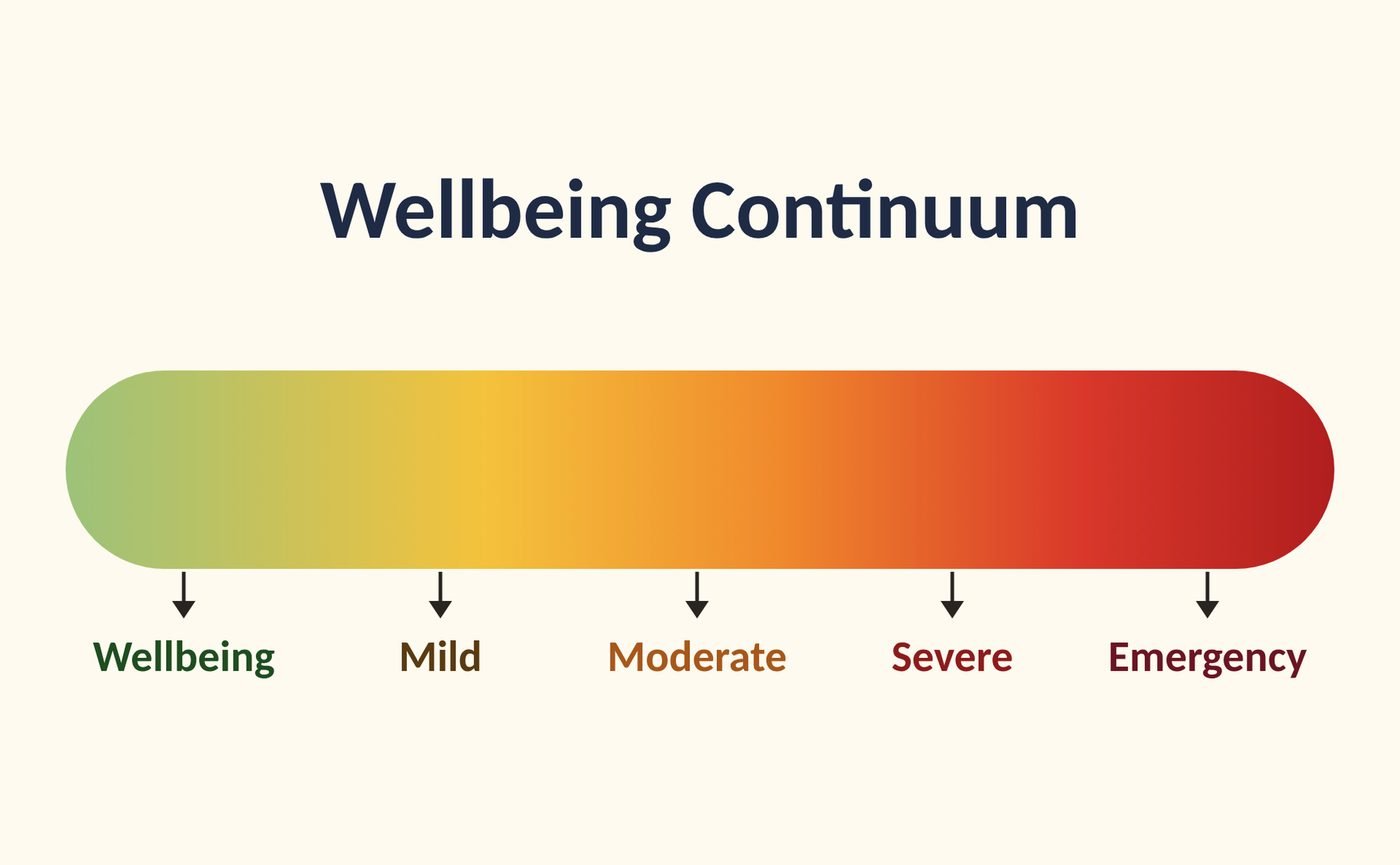
This book’s four levels drawn as a continuum. People move. A level is a snapshot, not a caste.
|
Level |
What it looks like |
What may help |
|---|---|---|
|
Mild |
Symptoms present; most daily tasks still possible |
Family, friends, lifestyle changes, or brief counselling |
|
Moderate |
Work, study, relationships, or self-care clearly affected |
Assessment by counsellor, psychologist, or psychiatrist; therapy; sometimes medicines |
|
Severe |
Major difficulty functioning; possible inability to work or study; strong distress; possible risk behaviours |
Prompt psychiatric evaluation and structured treatment; family support; possibly hospital-based care |
|
Emergency |
Immediate risk of self-harm, suicide, harm to others, or inability to meet basic needs (not eating, not drinking, not sleeping for days, severe confusion) |
Urgent medical and psychiatric help, emergency services, or hospital care |
A worked example of the same person
January: Kavya is tired after a project. She still cooks and jokes. Mild. March: she misses two deadlines and stops returning calls. Moderate. May: she cannot get out of bed and her mother finds uneaten food. Severe. One night she says she does not want to be here tomorrow. Emergency. The person did not become a different species. The level changed. Care should change with it.
Kurukṣetra as a map of levels, held lightly: Arjuna’s dry mouth, trembling, and dropped bow are written in Bhagavad Gītā 1.28–1.30 (sīdanti mama gātrāṇi, mukhaṃ ca pariśuṣyati, gāṇḍīvaṃ sraṃsate hastāt). Kṛṣṇa does not say “snap out of it.” Teaching begins in earnest from 2.11. That sequence is dharma in an emergency of the mind: presence first, framework second, never mockery. If the modern emergency is suicide risk or four days without food or sleep, the first “Kṛṣṇa” in the room may be an emergency doctor. The Gītā can come with you into the ward. It should not keep you from the ward.
1.8 Factors that influence mental health
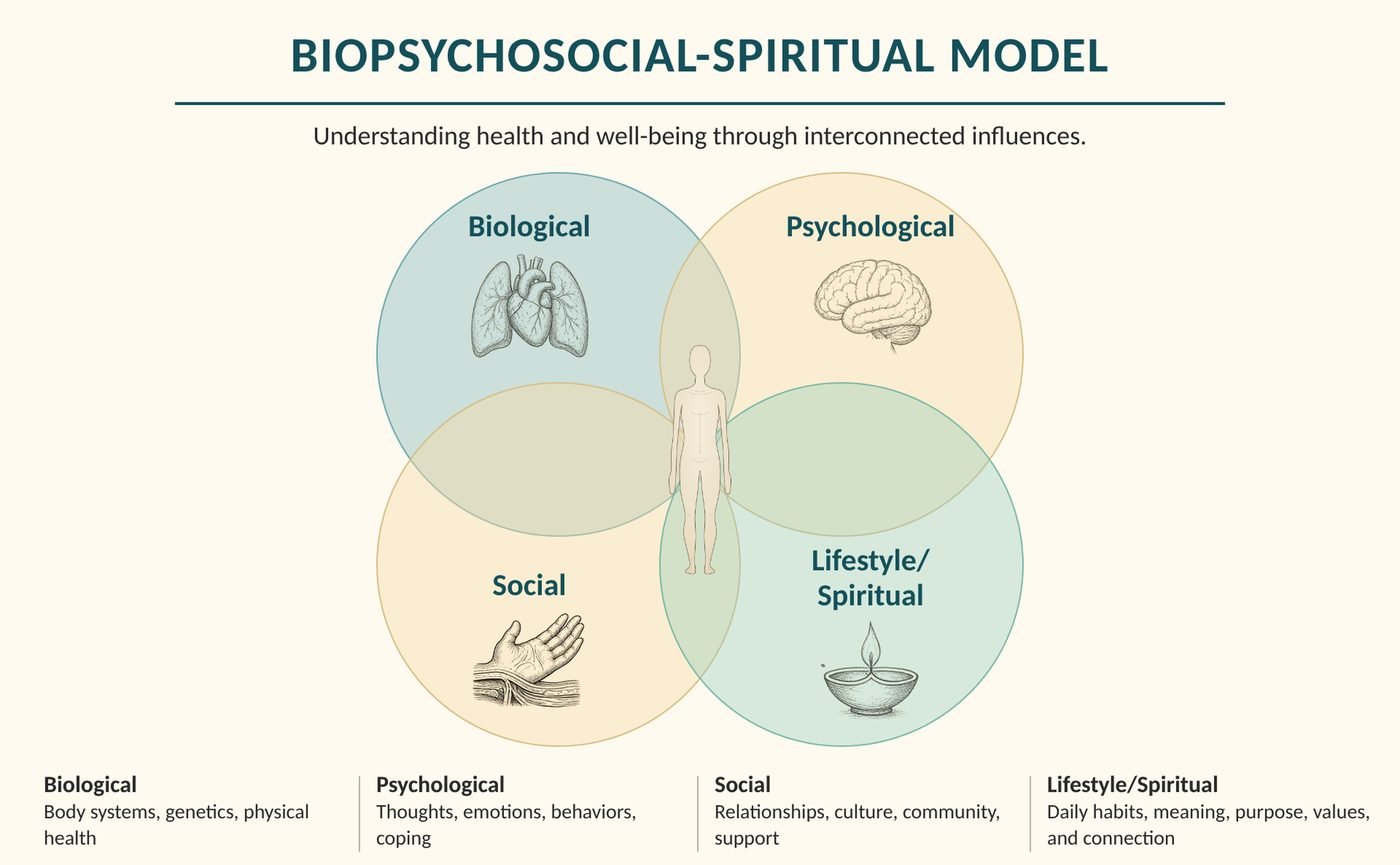
The four factor groups — biological, psychological, social-environmental, lifestyle — drawn so they cannot be separated.
Mental health is shaped by many factors. No single factor alone decides it. It is usually a combination.
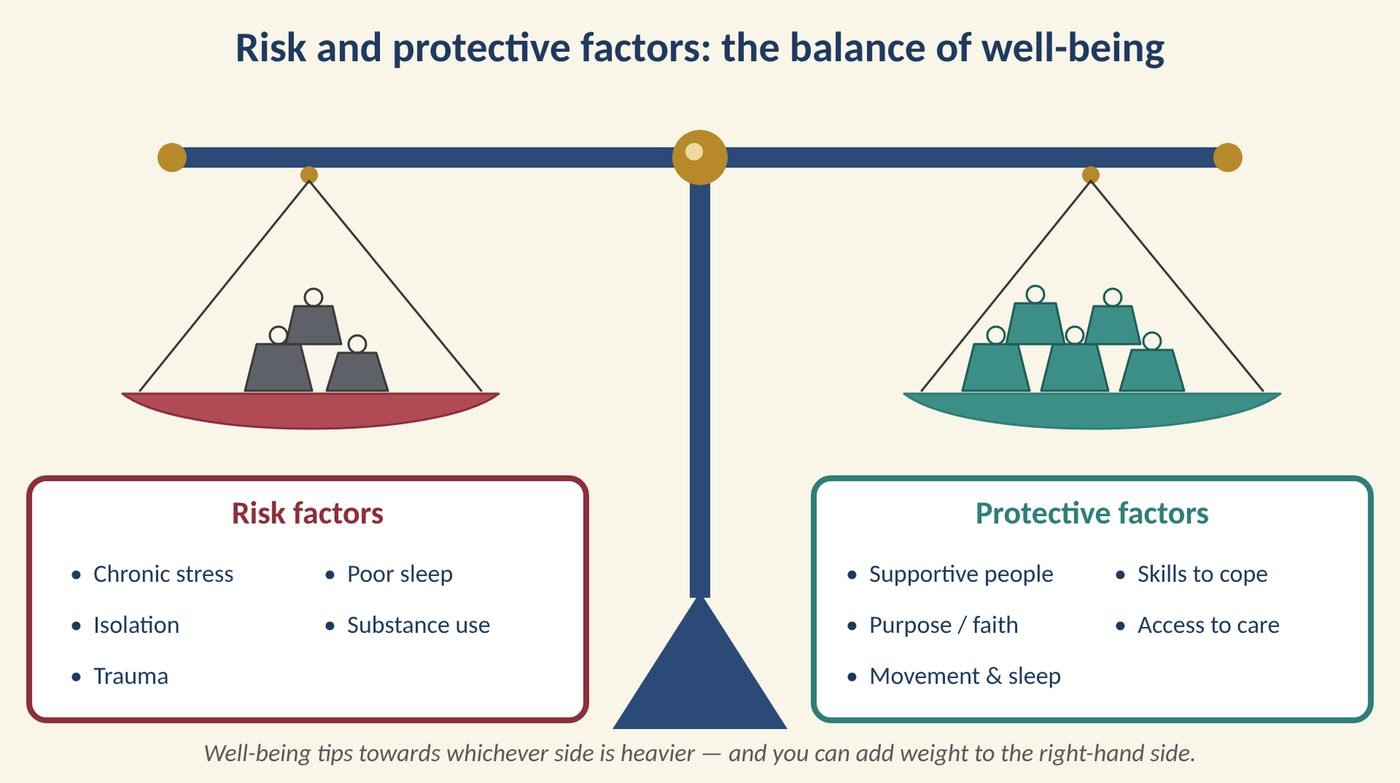
Figure 1.3 Risk and protective factors: well-being tips towards the heavier side.
|
Factor group |
Your list |
More detail |
|---|---|---|
|
Biological |
Genes, brain structure, brain chemicals, hormones, physical illnesses, injuries, substance use |
Also thyroid, anaemia, B12, sleep debt, inflammation, head injury, some medicines such as steroids |
|
Psychological |
Personality, coping styles, thinking patterns, past trauma, self-esteem, beliefs |
Temperament, attachment style, cognitive distortions (Chapter 5), meaning |
|
Social and environmental |
Family, friendships, school or work, poverty, discrimination, violence, displacement, disasters, war |
Caste and gender violence, migration, social media, overcrowding, unemployment |
|
Lifestyle |
Sleep, food, physical activity, routine, screen time, substance use, spiritual or community practices |
Daylight, caffeine timing, isolation versus satsang — practices help; they do not replace acute care |
1.9 The aims and levels of psychology
Four aims of psychology
Psychology is the scientific study of mind and behaviour. Mind covers private events we infer — thoughts, feelings, memories, motives. Behaviour covers public ones we can observe. The word comes from Greek psychē (breath, soul, mind) and logos (study). Psychology became a laboratory science in 1879 when Wilhelm Wundt opened a lab at Leipzig.
|
Aim |
What it means in this chapter |
|---|---|
|
Describe |
Name the state without insult: “three weeks of low mood,” not “I am useless.” |
|
Explain |
Hold more than one cause: sleep, loss, thyroid, money, a harsh inner voice. |
|
Predict |
Early signs often come before collapse. Prediction here means notice, not fate. |
|
Influence |
A walk, a sentence said aloud, an appointment — small acts change the next week. |
Three levels of analysis
Any psychological event can be read at more than one scale. A panic attack is a storm of autonomic arousal (biological), a cascade of catastrophic thoughts (psychological), and often a story about threat, attachment, or culture (social).
|
Level |
Focus |
|---|---|
|
Biological |
Genes, brain, hormones, evolution, sleep, inflammation |
|
Psychological |
Learning, cognition, emotion, personality, meaning |
|
Social-cultural |
Other people, norms, history, power, language, ritual |
A further Indic map, not a replacement for the four factors: the three guṇas of Sāṃkhya — sattva (clarity), rajas (restless drive), tamas (heaviness, fog). Used as weather-language they help a family say “the mind is heavy” or “the mind will not sit” without insult. Used as destiny they become another stigma. Keep them as a vocabulary of proportion, the way the classical texts use sāmya — health as balance, not as a mood.
1.10 Mental health across life stages
In childhood, early problems in mental health may show as early problems in mental health may show as excessive fear, behaviour change, play that stalls, friendship trouble, aggression, withdrawal, or developmental delays. Childhood mental health affects learning, behaviour, play, friendships, and family life.
Adolescents: rapid physical and emotional changes, peer pressure, academic stress, identity questions, and social media can affect mental health. Adolescence is a key time for prevention and early support.
Adults: work stress, relationships, parenting, financial pressures, and health issues play a major role.
Older adults: loneliness, chronic illness, loss of loved ones, cognitive decline, and dependence can affect mental health. Dementia and depression are important concerns.
Each stage needs age-appropriate understanding and support. (Full treatment of ages is Chapter 12 — nothing from that chapter is being discarded; it is expanded there.)
Hindu social teaching already thinks in stages — the āśramas of student, householder, forest-dweller, and renunciant. The point for mental health is simple: a sixteen-year-old’s storm is not a seventy-year-old’s loneliness, and a householder crushed by debt is not failing brahmacarya. Dharma is duty-in-context. Care must be age-in-context too.
One picture per age
A seven-year-old with stomach-aches every Monday may be anxious, not “dramatic.” A sixteen-year-old whose grades collapse and who lives online at 3 a.m. may be depressed, not “lazy.” A forty-year-old who drinks to sleep may be treating insomnia and shame at once. A seventy-year-old who stops eating after a spouse’s death may have grief and depression together. Same continuum. Different doors.
1.11 Culture, faith and mental health
Culture and faith shape how people understand emotions, suffering, and healing. In many traditions, including Hinduism, the mind (manas), intellect (buddhi), ego (ahamkara), and soul (atman) are discussed in depth. Practices like prayer, meditation, chanting, seva (service), satsang (good company), and ethical living can support mental wellbeing for many people.
However, serious mental disorders still need medical and psychological care. Spiritual practices can be a helpful part of recovery, but should not replace evidence-based treatment when it is needed.
Further practices your later chapters name, previewed here so faith is not postponed until Volume 6: morning namaskāra as a body-and-breath start; a short Gītā reading with an elder; offering food before eating as a pause that slows the rush; walking a temple courtyard as movement and daylight; sevā in a langar or hospital as behavioural activation by another name. Keep what helps. Add what science has earned. Forbid neither.
1.12 When to seek help
Seek professional help if:
- Symptoms last more than two weeks and affect daily life.
- Relationships, work, or studies are clearly suffering.
- There is heavy reliance on alcohol, drugs, or other substances to cope.
- There are thoughts of self-harm, suicide, or harming others.
- Family or friends express serious concern.
- The person feels stuck, hopeless, or unable to cope.
Help can come from: counsellors, clinical psychologists, psychiatrists, primary-care doctors, school counsellors, community health workers, and trusted elders or spiritual guides alongside professional care.
More signs that it is time to seek help
- Persistent sadness or anxiety lasting two or more weeks.
- Difficulty functioning at work or school.
- Relationship problems that do not improve.
- Substance abuse or dependence.
- Thoughts of self-harm or suicide.
- Major life transitions causing distress.
- Sleep or appetite changes.
- Loss of interest in activities you used to enjoy.
1.13 The three parts of well-being
Researchers often describe well-being as having three connected parts.
- Emotional well-being: how you feel. This includes your ability to experience joy, to calm yourself when upset, and to recover from disappointment.
- Psychological well-being: how you think and see yourself. This includes self-respect, a sense of purpose, personal growth, and the feeling that you have some control over your life.
- Social well-being: how you connect with others. This includes friendships, family bonds, a sense of belonging, and the ability to give and receive support.
These three parts influence each other. Someone who feels lonely (social) may begin to think badly of themselves (psychological) and feel low most days (emotional). In the same way, one small improvement, such as joining a walking group, can lift all three at once.
1.14 Risk factors and protective factors
Think of your mental health as a balance. On one side are things that add weight; on the other are things that give strength.
|
Risk factors (add weight) |
Protective factors (add strength) |
|---|---|
|
Long-term stress or overwork |
Supportive family and friends |
|
Trauma, abuse, or neglect |
Feeling safe and valued |
|
Loneliness and isolation |
Regular sleep and exercise |
|
Alcohol or drug misuse |
Skills for managing emotions |
|
Serious or chronic illness |
Hobbies and a sense of purpose |
|
Money worries, unemployment |
Access to help when needed |
|
Family history of mental illness |
Optimism and flexible thinking |
You cannot remove every risk, but you can often add protection. A big part of this book is about how.
A one-minute check-in
1.15 A simple story: Riya
More short stories
1.16 Across the Hindu world — mind, sorrow, company, and help
No single book holds Hindu civilization. Śruti and smṛti, itihāsa and purāṇa, saṃhitā and sūtra, and then the living tongues — Tamil, Telugu, Malayalam, Kannada, Odia, Assamese, Manipuri, Bengali, Marathi, Gujarati, Rajasthani, Hindi–Awadhi, Kashmiri, and the northeast namghars — all speak about manas, duḥkha, krodha, bhaya, lajjā, and the company that steadies a life. This section cannot quote every line in existence. It gathers verses and situations that belong to Chapter 1’s actual topic: what mental health is, what stigma does, why the body and the mind travel together, and why asking for help is not a fall from dharma.
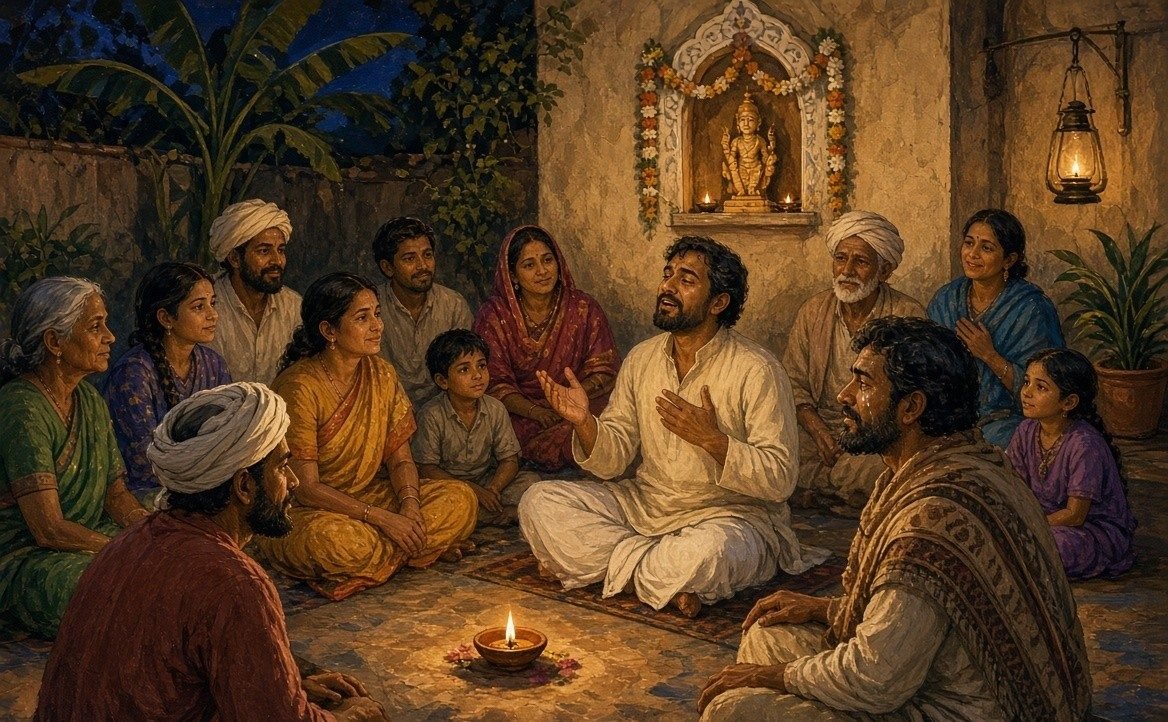
Most Hindu healing in real houses is not a rare manuscript. It is a lamp, a song, an elder, and a circle that does not shame.
The fuller map, region by region and tongue by tongue, is in Chapter 24, section 24.14.
Reflection activity — Chapter 1
- On a scale of 0–10, where is your mental health most days? (0 = very poor, 10 = very strong)
- Name two things that usually support your mental health (for example: sleep, friends, prayer, walk, music, study, work).
- Name one situation that often disturbs your mental peace. What is one small step you can take next time it happens?
- What helps you feel balanced and well?
- What drains your energy or causes stress?
- Who supports you during difficult times?
- What coping strategies work best for you?
Sources for this chapter
The backbone of this chapter is public health education: the World Health Organization’s mental-health pages and the World Mental Health Report, national mental-health institutes, emergency mental-health fact sheets and open public teaching resources. The full master list of sources is at the end of the book.
Educational guide. Not a diagnosis. Not a substitute for care.
This book is for education and general awareness. It does not replace diagnosis or treatment by a qualified professional. If anyone is in danger, contact your local emergency services.