
Three doors, one person
A room is not a method. The method is what happens between two people who agree to tell the truth slowly.

2.1 Psychology
PSYCHOLOGY is the scientific study of mind and behaviour. Psychologists study how people think, feel, and act in different situations. They use research methods to understand mental processes and behaviour patterns.
Clinical psychologists provide therapy and psychological testing but typically cannot prescribe medicines in most countries. They use approaches like Cognitive Behavioural Therapy (CBT), psychotherapy, and counselling techniques.
Definition and scope
Mind covers the private events we infer — thoughts, feelings, memories, motives. Behaviour covers the public ones we can observe. The field's wager is that both can be studied with measurement, comparison, and a willingness to be wrong.
The word comes from Greek psyche (breath, soul, mind) and logos (study). For most of history those were the business of philosophy and religion. Psychology became a laboratory science in 1879, when Wilhelm Wundt opened a laboratory at Leipzig.
Four aims of psychology
- Describe
- Explain
- Predict
- Influence
A good psychological claim does at least one of these with evidence, not with a slogan.
Three levels of analysis
- Biological: genes, brain, hormones, evolution, sleep, inflammation.
- Psychological: learning, cognition, emotion, personality, meaning.
- Social-cultural: other people, norms, history, power, language, ritual.
Any psychological event can be read at more than one scale. A panic attack is a storm of autonomic arousal (biological), a cascade of catastrophic thoughts (psychological), and often a story about threat, attachment, or culture (social).
Why the definition matters in a house
If psychology were only medicines, a sleepless student would be sent only to a tablet. If it were only talk, a thyroid that looks like sadness would be missed. If it were only culture, a treatable panic attack would be called a family curse. The three levels stop that narrowing.
Example. Two people weep after a job loss. One weeps, sleeps, updates a CV, and recovers in a month. One cannot rise, cannot eat, and believes nothing will ever change. Psychology studies both. Only the second is likely to need a clinic this month. The word 'psychology' covers the whole continuum; 'clinical psychology' is the door for the second.
2.2 Psychiatry
PSYCHIATRY is a medical specialty. Psychiatrists are medical doctors (MD) who specialize in mental health. They:
- Can diagnose mental health conditions.
- Provide therapy and counselling.
- Can prescribe medicines.
- Understand the biological aspects of mental illness.
- May specialize in areas like child psychiatry, geriatric psychiatry, or addiction.
Psychiatry and clinical psychology
Psychiatry is medicine: physicians who can prescribe and who may also do psychotherapy. Clinical psychology is typically talk and testing. Neither owns the whole of healing.
In more depth
A psychiatrist is the right first door when there is mania, psychosis, severe depression with no food or sleep, a first seizure-like event, a sudden personality change, or a need to review medicines. A psychologist is the right first door when the main work is testing, trauma work, CBT, or a talking plan. Many people need both, in sequence or together.
Example. A shopkeeper who has not slept for three nights and is spending the family's savings is not 'motivated.' That is a medical emergency until a psychiatrist says otherwise. A student who is sad after an exam and still attending class is not that emergency.
2.3 Counselling
COUNSELLING is structured supportive conversation that helps people manage life issues, emotions, choices and coping skills. Counsellors may have various levels of training and certification.
Counsellors help with:
- Relationship problems.
- Grief and loss.
- Career decisions.
- Stress management.
- Life transitions.
- Family conflicts.
A room is not a method
Counselling and psychotherapy overlap. In many places 'counselling' leans toward adjustment, identity, grief, and careers; 'clinical' toward disorder. The public does not owe us the distinction. A licensed clinician, a method with evidence for your problem, a relationship that feels workable after a few sessions, and a plan you can both describe — that is the one-line chooser.
Types of counselling and therapy
|
Type |
Names / notes |
|---|---|
|
Person-centered |
Rogers |
|
Psychodynamic |
Unconscious patterns, early relationships |
|
CBT / REBT |
Beck, Ellis |
|
Exposure / ERP |
Facing avoided cues with a plan |
|
DBT |
Linehan |
|
ACT |
Acceptance and commitment |
|
Trauma-focused |
PE, CPT, EMDR |
|
Family / couples |
The unit is the relationship |
|
Group |
Shared work |
|
Career / school |
Role and learning |
|
Motivational interviewing |
Ambivalence about change |
|
Pastoral / spiritual |
Faith language beside, not instead of, licence |
|
Integrative / multicultural |
Method fitted to person and culture |
What to look for
Ask: training and licence; supervision; confidentiality; fees; what method they use for your problem; what happens if you feel worse. Three sessions is a fair trial of fit. Shame is a reason to leave, not a technique.
2.4 When to seek help
Seek professional help if you experience:
- Persistent sadness or anxiety lasting 2+ weeks.
- Difficulty functioning at work or school.
- Relationship problems that don't improve.
- Substance abuse or dependence.
- Thoughts of self-harm or suicide.
- Major life transitions causing distress.
- Sleep or appetite changes.
- Loss of interest in activities you used to enjoy.
In more depth
Two weeks of stalled function is already long enough to knock. Thoughts of self-harm are enough to knock today. You do not need a perfect name first. A primary-care doctor is a valid first knock when you do not know which specialty door to use.
2.5 Types of mental health professionals
The professionals involved include:
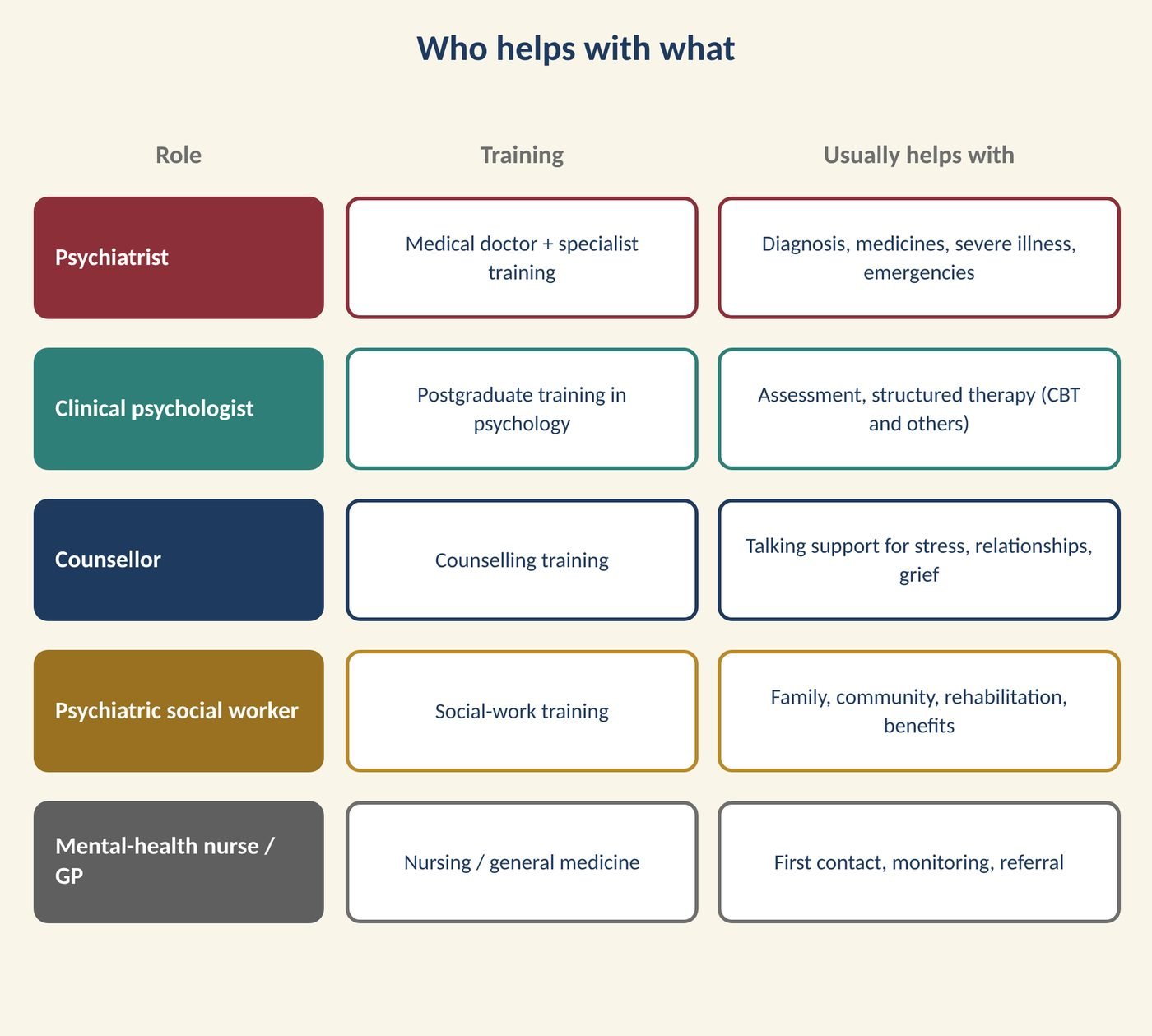
Figure 2.1 Who helps with what.
|
Professional |
Usual training |
Usual tools |
|---|---|---|
|
Psychiatrist |
Medical degree + psychiatry |
Diagnosis, medicines, some therapy, medical mimics |
|
Clinical psychologist |
Masters or doctorate in clinical psychology |
Testing and psychotherapy; typically does not prescribe |
|
Counsellor / psychotherapist |
Varies by licence in each country |
Structured talking for distress and change |
|
Psychiatric social worker |
Social work + mental health |
Family, benefits, community, therapy |
|
Primary-care / family doctor |
General medicine |
First filter, thyroid, sleep, referral |
|
School or workplace counsellor |
Education or organisational training |
Early support and referral |
2.6 How psychologists know
- Scientific method.
- Experiments and variables.
- Correlation versus causation.
- Case studies and surveys.
- Ethics after the scandals.
A scientific claim is one that could, in principle, be wrong. Experiments manipulate an independent variable, measure a dependent variable, and use random assignment so cause can be inferred. Correlations map how two things travel together — they are not a verdict about cause. Case studies go deep. Surveys go wide.
Ethics after Milgram, Stanford prison, and Little Albert require consent, the right to withdraw, and review. Knowledge that costs a person their dignity is not a triumph.
2.7 A short history of schools
|
School |
From this book |
|---|---|
|
Structuralism |
Wundt, Titchener |
|
Functionalism |
William James |
|
Psychoanalysis |
Freud, Jung, Horney |
|
Behaviorism |
Watson, Pavlov, Skinner |
|
Humanistic |
Rogers, Maslow |
|
Cognitive |
Miller, Neisser, Beck, Kahneman |
These are different questions asked of the same creature, not fashion houses. A modern clinic often borrows from more than one: learning from behaviourism, thoughts from the cognitive school, relationship from person-centered and psychodynamic work, meaning from the humanistic line.
2.8 The main branches of psychology
Psychology is a large field. Here are the major branches you are likely to meet.
- Clinical psychology: assessing and treating mental health problems, mainly through psychotherapy and psychological testing.
- Counselling psychology: helping people with life difficulties such as stress, career choices, relationships and grief.
- Developmental psychology: studying how people change from infancy to old age in thinking, emotions, and social skills.
- Social psychology: studying how people influence each other, including conformity, prejudice, persuasion, and group behaviour.
- Cognitive psychology: studying memory, attention, language, learning, and problem-solving.
- Neuropsychology: studying how brain injury or disease affects thinking and behaviour.
- Educational and school psychology: helping children learn, supporting teachers, and assessing learning needs.
- Industrial-organizational psychology: improving workplaces by studying hiring, motivation, leadership, and teamwork.
- Health psychology: exploring how thoughts, behaviour, and stress affect physical health and recovery.
- Forensic psychology: applying psychology to law, courts, and criminal investigation.
- Sports psychology: helping athletes with focus, confidence, and handling pressure.
Not every psychologist works with illness. Many work in schools, companies, hospitals, research laboratories, and sports teams.
2.9 Ideas from psychology you can use today
Psychology is not only theory. Here are some findings that people can apply in daily life.
1. Habits form through repetition and reward
A new habit sticks best when it is small, attached to something you already do, and followed by a small sense of reward. Instead of “I will exercise for an hour daily,” try “after brushing my teeth, I will walk for ten minutes.”
2. Thoughts are not facts
The mind constantly produces guesses and predictions. A thought like “I will fail” is a thought, not a prophecy. Learning to pause and ask “What is the evidence for this? Is there another way to see it?” is a powerful skill.
3. Memory is reconstructive
We do not store memories like video recordings. Each time we recall something, we rebuild it, and details can change. That is why two honest people can remember the same event differently. It is also why writing things down is so useful.
4. Multitasking is mostly a myth
The brain cannot do two demanding tasks at once. It switches rapidly between them, which costs time and increases mistakes. Doing one thing at a time usually leads to better results and less mental fatigue.
5. People need connection
Decades of research show that strong relationships are one of the best predictors of health and happiness. Even short moments of kind contact, such as a smile or a short chat, improve mood.
6. Small wins build motivation
Motivation often follows action rather than coming before it. Starting a task for just five minutes often creates the energy to continue.
2.10 Psychology in everyday life: three short stories
Exam stress. Meera, a college student, freezes before every exam. A counselling psychologist teaches her slow breathing and helps her notice the thought “If I fail, my life is over.” Together they replace it with a more accurate thought: “This exam matters, but I can recover from a bad result.” Her anxiety falls from overwhelming to manageable.
A team in conflict. An office team keeps arguing. An organizational psychologist finds that unclear roles, not bad character, are the cause. Once duties are clarified and meetings are changed, the tension eases.
Learning difficulties. A child struggles with reading. A school psychologist tests him and finds he has dyslexia, a difference in how the brain processes written words. With the right teaching methods, he improves, and his confidence returns.
In each case, psychology helped people understand a problem and change something practical.
2.11 Branches of psychiatry
Just as general medicine has specialties, psychiatry has areas of focus.
- General adult psychiatry: common conditions in adults.
- Child and adolescent psychiatry: conditions in young people, such as ADHD, autism, anxiety, and depression, always involving parents or carers.
- Geriatric psychiatry: mental health in older adults, including depression and dementia-related changes.
- Addiction psychiatry: substance use problems and dual diagnosis.
- Forensic psychiatry: the link between mental illness and the law.
- Consultation-liaison psychiatry: supporting patients in general hospitals whose illness affects mental health.
- Perinatal psychiatry: mental health during pregnancy and after childbirth.
2.12 How psychiatrists think about the causes of mental illness
Modern psychiatry rejects the idea that mental illness has one simple cause. Instead, it uses the biopsychosocial model introduced in Chapter 1. It also pays attention to the brain.
The brain in brief
The human brain contains roughly 86 billion nerve cells, called neurons. Neurons communicate by sending tiny chemical messengers called neurotransmitters across gaps called synapses. Three of the best-known neurotransmitters in mental health are:
- Serotonin: involved in mood, sleep, appetite, and anxiety.
- Dopamine: involved in motivation, pleasure, movement, and attention.
- Noradrenaline (norepinephrine): involved in alertness, energy, and the stress response.
Many psychiatric medicines work by changing how these messengers are produced, released, or taken back up by cells.
A word of caution: you may have heard that depression is “just a chemical imbalance.” That is an oversimplification. Brain chemistry plays a part, but so do brain circuits, genes, hormones, stress, inflammation, relationships, and life events. Scientists are still learning how these pieces fit together. What matters for you is that the conditions are real, they have biological aspects, and they respond to treatment.
2.13 A short history of psychiatry
For centuries, people with mental illness were misunderstood, feared, or locked away in terrible conditions. Real progress began in the 1800s with humane reforms and accelerated in the 1950s with the discovery of the first effective medicines. Since then, treatment has moved from large institutions toward community care, rights-based approaches, and recovery-focused thinking, which holds that people with serious mental illness can build satisfying lives. Much work remains, especially in countries with few mental health professionals, but the direction is hopeful.
2.14 Your rights as a patient
Wherever you live, good mental health care should respect certain basic principles:
- You should be treated with dignity and respect.
- You should receive clear information about your diagnosis and treatment, in words you understand.
- You should be able to ask questions and, in most cases, take part in decisions.
- Your information should be kept private, except in limited situations required by law, such as serious risk of harm.
- You can ask for a second opinion.
Laws about involuntary treatment and consent differ from place to place. If you or someone you love is in this situation, ask the treating team to explain the local rules and your rights.
2.15 Each professional in detail
Psychiatrist
A medical doctor who specialises in mental health. They diagnose conditions, prescribe medicine, order tests, provide or arrange therapy, and treat emergencies. See a psychiatrist when symptoms are severe, complex, or may need medication.
Clinical psychologist
Trained in psychology to master’s or doctoral level, with supervised clinical practice. Clinical psychologists carry out detailed assessments (including tests of memory, intelligence, personality, or attention), diagnose conditions, and provide psychotherapy. Their strength is understanding why patterns occur and teaching skills to change them.
Counselling psychologist and counsellor
Counsellors help people face life challenges: relationship problems, grief, stress, career choices, self-esteem, and adjustment to change. Training varies widely. Some hold advanced degrees and are licensed; in some places the title is not protected, so it is wise to check credentials. Counselling tends to be shorter-term and focuses on support and problem-solving.
Psychotherapist and therapist
These are broad terms for professionals who provide “talking treatments.” A psychotherapist may be a psychologist, psychiatrist, counsellor, social worker, or someone trained in a specific method such as CBT or family therapy. Because the words are used loosely, always ask about the person’s qualification, registration, and the type of therapy they offer.
Psychoanalyst
A therapist trained in psychoanalysis, the approach started by Freud. Sessions may be several times a week and last for years, exploring dreams, memories, and unconscious patterns. It is a specialised form of treatment and is less common today than shorter therapies.
Psychiatric nurse
Nurses with special training in mental health care. They work in hospitals, clinics, and communities, administer medicines, monitor progress, and offer practical and emotional support. In some countries, advanced practice nurses can diagnose and prescribe.
Social worker
Clinical and psychiatric social workers connect mental health with real-life circumstances such as housing, money, family conflict, school, or employment. They provide counselling, arrange community services, and support families. Many people recover faster when practical problems are solved too.
Occupational therapist
Occupational therapists help people rebuild the skills of everyday life, such as routines, work habits, self-care, and social participation, after illness or injury.
Neurologist and neuropsychologist
These are often confused with mental health professionals. A neurologist is a doctor who treats diseases of the nervous system: epilepsy, stroke, Parkinson’s disease, migraine, multiple sclerosis. A neuropsychologist is a psychologist who studies how brain damage or disease affects memory, attention, and behaviour. Both may work with psychiatrists when mental and brain-related problems overlap.
Family doctor (general practitioner)
Your family doctor is often the best place to start. They can rule out physical causes, treat common conditions such as mild to moderate depression and anxiety, prescribe medicine, and refer you to specialists.
Other helpers you may meet
- Peer support workers: people with their own experience of recovery who support others.
- Art, music, and drama therapists: use creative activities to help people express feelings.
- Psychiatric pharmacists: advise on medicines, doses, and interactions.
- School counsellors: support students with learning, behaviour, and emotional needs.
- Pastoral and spiritual counsellors: offer guidance based on faith or personal values. They can be a deep source of comfort, and they work best alongside health professionals when illness is present.
2.16 What is the difference between a “therapist” and “counsellor”?
Honestly, it depends on the country. In some places “counsellor” is used for shorter, problem-focused help and “therapist” for deeper work; in others they mean the same thing. The best approach is not to worry about the title but to ask these questions:
- What is your training and qualification?
- Are you registered or licensed with a professional body?
- What kind of problems do you usually work with?
- What type of therapy do you use, and how long does it usually take?
- What are your fees, and how do cancellations work?
A good professional will answer these openly.
2.17 How to choose the right person
Use this simple decision guide as a starting point. It is not a substitute for professional judgement.
|
Your situation |
A good first choice |
|---|---|
|
Everyday stress, grief, relationship difficulties, life transitions |
Counsellor or psychologist |
|
Ongoing anxiety or low mood affecting work or relationships |
Psychologist or family doctor |
|
Severe symptoms, thoughts of self-harm, loss of touch with reality |
Psychiatrist or emergency services |
|
Not sure what is wrong |
Family doctor, who can guide next steps |
|
Concerns about learning, attention, or development in a child |
Pediatrician, school psychologist, or child psychologist |
|
Memory problems or confusion in an older person |
Family doctor, then neurologist or geriatric specialist |
|
Alcohol or drug problems |
Family doctor, addiction service, or addiction psychiatrist |
|
Practical life problems alongside emotional ones |
Social worker plus counsellor |
Warning signs of an unsuitable helper
Most professionals are caring and ethical. But be cautious if someone:
- Promises a guaranteed “cure” or “instant results”
- Discourages you from seeing doctors or from taking prescribed medicine
- Asks for large payments in advance for long programmes
- Breaks confidentiality without good reason
- Behaves in a way that makes you feel uncomfortable, pressured, or unsafe
- Has no clear qualifications or refuses to share them
You are always free to stop and find another helper. A good “fit” matters: research shows that the relationship between you and your therapist is one of the strongest predictors of success.
2.18 How the team works together
Imagine a young woman named Anita who has been feeling hopeless for two months. Here is how care might unfold.
- She sees her family doctor, who finds nothing physical and screens for depression. The doctor refers her to a psychiatrist because her symptoms are severe.
- The psychiatrist confirms major depression, starts an antidepressant, and asks her to come back in two weeks.
- A psychologist begins weekly CBT sessions to work on negative thinking and restore daily activity.
- A social worker helps with a work leave letter and a family meeting.
- After three months she feels much better. The psychiatrist reviews her medicine; the psychologist helps her plan for relapse prevention.
No one professional did everything. The strength of the team was that each person did what they were trained to do.
2.19 Costs and access
Cost and availability differ greatly between and within countries. Options include:
- Public or government clinics and hospitals
- Insurance-covered services
- Private practice
- University and training clinics (often lower cost, supervised by experts)
- Non-profit organisations and community centres
- Employer assistance programmes
- Telehealth (online or phone sessions), which can widen access
- Peer support groups, often free
If cost is a barrier, say so. Many professionals know of sliding-scale fees or low-cost options.
2.20 One story
2.21 Two companion verses — not a second subject
These two lines belong here because this chapter is about asking for help and doing the next skillful act. They do not replace a licence.
Reflection
- Which door did your family last use — priest, GP, counsellor, psychologist, or psychiatrist — and was it the door that was on fire?
- Name one problem in your life that is mainly biological, one mainly psychological, and one mainly social.
- What three questions would you ask a new helper before the second session?
This book is for education and general awareness. It does not replace diagnosis or treatment by a qualified professional. If anyone is in danger, contact your local emergency services.