
Maps, thinkers and a guide to reading

35.1 How to read this series
Psychology for Everyone is an educational guide. From first principles to the living brain — with a field guide to distress, counselling, the five senses and five elements, and Indic healing arts.
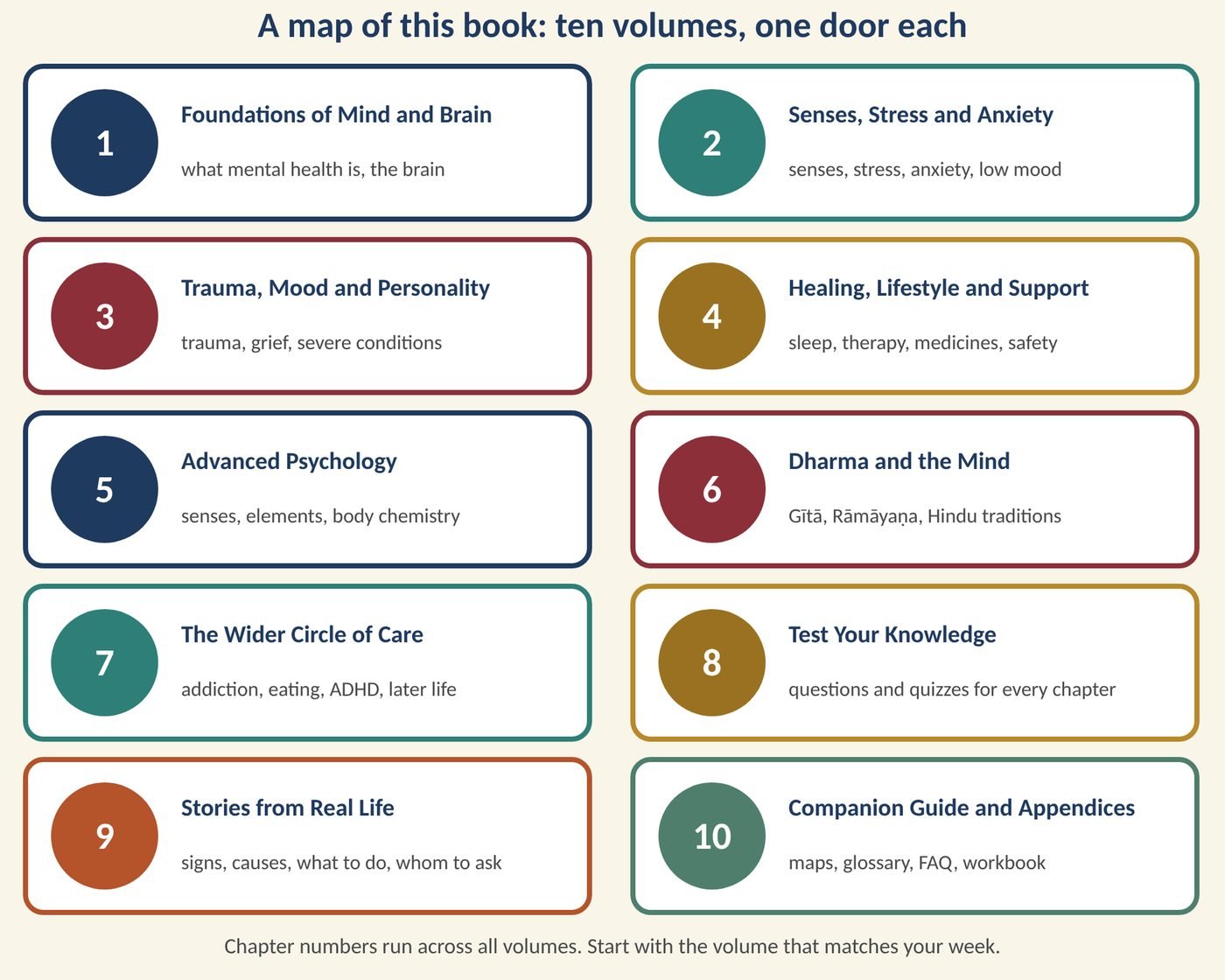
Figure 35.1 A map of this book: ten volumes, one door each.
Nothing here can tell you what you have. Overlap is the rule. If distress is heavy or safety is in question, seek professional and emergency help.
This book is written only to spread awareness and basic understanding. It is not a medical book for self-diagnosis, self-treatment, or changing any medicine. It does not replace advice, diagnosis, counselling, psychotherapy, treatment, or medicines from a qualified psychiatrist, physician, or psychologist.
Healthy food, regular sleep, physical activity, family support, spiritual practices, and counselling may support wellbeing. They must not be treated as substitutes for professional care when a disorder is present.
The series title is Psychology for Everyone: Mental Well-Being Series. Quote: Take care of mind and mood. Living edition: psychologyforeveryone.com. Feedback and corrections are welcome at myadvisorfriend@gmail.com.
Trusted information
- NIMH: nimh.nih.gov. WHO mental health: who.int/health-topics/mental-health. APA: apa.org.
35.2 Four reading paths
Your living edition was planned as a site with articles, a brain atlas, glossary, quizzes, a Big Five sketch, thinkers, and studies with ethics attached. The four paths:
- First principles — what the field is, how it began, how it knows (Chapters 1–2).
- The living brain — nerves, cells, lobes, senses, sleep (Chapters 3–4, 6, 13, 19, 21).
- A person among people — learning, memory, development, personality, social mind (Chapters 5, 12, 17).
- When the mind hurts — emotion, disorders, therapy (Chapters 7–11, 14–15, 18, 22).
Dharma and healing techniques sit in Chapters 20, 23 and 24.
Volume 7 (Chapters 25–34) is the wider circle of care: addiction, eating, neurodiversity, digital life, work and study, pregnancy and birth, later life, rights, assessment and relationships.
Volume 8 is Test Your Knowledge.
Volume 9 is Stories from Real Life: several stories for every chapter, each with signs to notice, causes, what to do, whom to consult and how to talk.
Volume 10 is this companion guide. This chapter is the lookup drawer.
35.3 Founding figures and schools
Psychology became a laboratory science in 1879. Names below are your back-matter list, written so a student can place a chapter against a person. Influence is not sainthood. Little Albert and some obedience work would not pass today's ethics boards.
Psychoanalytic tradition
Sigmund Freud (1856–1939)
- Founded psychoanalysis; unconscious, dreams, psychosexual development.
- Id, ego, superego; defense mechanisms; Oedipus complex.
- Works: The Interpretation of Dreams (1900); The Psychopathology of Everyday Life (1901); Three Essays on the Theory of Sexuality (1905).
Carl Gustav Jung (1875–1961)
- Broke from Freud; analytical psychology.
- Collective unconscious, archetypes, introversion/extraversion, types.
- Works: Psychological Types (1921); The Archetypes and the Collective Unconscious.
Alfred Adler (1870–1937)
- Individual psychology; inferiority complex, birth order, social interest.
- Work: Understanding Human Nature (1927).
Karen Horney (1885–1952)
- Challenged Freud on women; neurotic needs; culture and personality.
- Works: The Neurotic Personality of Our Time (1937); New Ways in Psychoanalysis (1939).
Erik Erikson (1902–1994)
- Eight psychosocial stages; identity crisis.
- Work: Childhood and Society (1950).
Behaviourism and social learning
John B. Watson (1878–1958)
- Founded behaviourism; rejected introspection; Little Albert (1920) — historically important and ethically condemned now.
- Work: Psychology from the Standpoint of a Behaviorist (1919).
B. F. Skinner (1904–1990)
- Operant conditioning; reinforcement schedules.
- Works: The Behavior of Organisms (1938); Walden Two (1948); Beyond Freedom and Dignity (1971).
Albert Bandura (1925–2021)
- Social learning / social cognitive theory; Bobo doll (1961); self-efficacy; reciprocal determinism.
- Works: Social Learning Theory (1977); Self-Efficacy (1997).
Humanistic and existential
Carl Rogers (1902–1987)
- Person-centred therapy; unconditional positive regard, empathy, genuineness.
- Works: Client-Centered Therapy (1951); On Becoming a Person (1961).
Abraham Maslow (1908–1970)
- Hierarchy of needs; self-actualisation.
- Works: Motivation and Personality (1954); Toward a Psychology of Being (1962).
Rollo May (1909–1994)
- Existential psychology.
- Works: The Meaning of Anxiety (1950); Love and Will (1969).
Cognitive psychology
Ulric Neisser (1928–2012)
- Coined "cognitive psychology"; Cognitive Psychology (1967).
George Miller (1920–2012)
- "The Magical Number Seven, Plus or Minus Two" (1956); working-memory capacity.
Aaron T. Beck (1921–2021)
- Cognitive therapy; cognitive distortions; Beck Depression Inventory.
- Works: Depression: Causes and Treatment (1967); Cognitive Therapy and the Emotional Disorders (1976).
Albert Ellis (1913–2007)
- REBT; Reason and Emotion in Psychotherapy (1962).
Daniel Kahneman (1934–2024) and Amos Tversky (1937–1996)
- Heuristics, biases, prospect theory. Kahneman: Thinking, Fast and Slow (2011). Nobel in Economics 2002 (Kahneman).
Developmental psychology
Jean Piaget (1896–1980)
- Four stages of cognitive development. Works: Language and Thought of the Child (1923); Construction of Reality in the Child (1937).
Lev Vygotsky (1896–1934)
- Zone of proximal development; scaffolding; Thought and Language (1934).
John Bowlby (1907–1990) and Mary Ainsworth (1913–1999)
- Attachment theory; Strange Situation; secure / avoidant / resistant styles.
- Bowlby: Attachment and Loss trilogy (1969–1980).
Harry Harlow (1905–1981)
- Contact comfort in rhesus monkeys — historically important; ethics would not permit the same design today.
Lawrence Kohlberg (1927–1987)
- Moral development stages, extending Piaget.
Social psychology
Solomon Asch (1907–1996)
- Conformity experiments (1950s).
Stanley Milgram (1933–1984)
- Obedience studies (1960s) — ordinary people obey authority; ethics now far stricter.
Philip Zimbardo (1933–2024)
- Stanford Prison Experiment (1971); The Lucifer Effect (2007). Situation power — and a caution about method.
- Robbers Cave; realistic conflict theory.
Leon Festinger (1919–1989)
- Cognitive dissonance (1957); social comparison.
Stanley Schachter (1922–1997)
- Two-factor theory of emotion, with Singer.
Clinical and counselling
Marsha Linehan (1943–)
- DBT; originally for borderline personality disorder; CBT plus mindfulness.
- Conjoint family therapy (1964).
Salvador Minuchin (1921–2017)
- Structural family therapy; Families and Family Therapy (1974).
Irvin Yalom (1931–)
- Existential and group therapy; Love's Executioner (1989).
Neuroscience, memory, biological
Roger Sperry (1913–1994)
- Split-brain; Nobel 1981.
Eric Kandel (1929–)
- Learning and memory; Nobel 2000; In Search of Memory (2006).
Antonio Damasio (1944–)
- Somatic marker; Descartes' Error (1994).
Joseph LeDoux (1949–)
- Amygdala and fear; The Emotional Brain (1996).
Elizabeth Loftus (1944–)
- Eyewitness memory; malleability of memory.
Endel Tulving (1927–2023)
- Episodic vs semantic memory.
Alan Baddeley (1934–)
- Working-memory model (1986).
Women pioneers
Mary Whiton Calkins (1863–1930)
- First woman president of APA; denied a Harvard PhD despite completing requirements; paired-associate technique.
Margaret Floy Washburn (1871–1939)
- First woman to receive a PhD in psychology; The Animal Mind (1908).
Mamie Phipps Clark (1917–1983)
- Racial identity and doll studies; evidence used in Brown v. Board of Education.
Leta Stetter Hollingworth (1886–1939)
- Challenged gender-difference claims; gifted children; clinical psychology.
Anna Freud (1895–1982)
- Child psychoanalysis; The Ego and the Mechanisms of Defense (1936).
Melanie Klein (1882–1960)
- Object relations; play therapy.
35.4 Psychiatrists and contemporary figures
Emil Kraepelin (1856–1926)
- Modern classification; dementia praecox vs manic-depressive illness.
Eugen Bleuler (1857–1939)
- Coined schizophrenia; concept of autism; Dementia Praecox or the Group of Schizophrenias (1911).
Kurt Schneider (1887–1980)
- First-rank symptoms; Clinical Psychopathology (1959).
Viktor Frankl (1905–1997)
- Logotherapy; Man's Search for Meaning (1946) — already in Chapter 23.
John Cade (1912–1980)
- Lithium's mood-stabilising effect (1949).
Henri Laborit (1914–1995)
- Chlorpromazine and the psychopharmacology turn.
Nathan Kline (1916–1983)
- MAOIs and early antidepressant research.
David Burns (1942–)
- Feeling Good (1980) — public CBT.
Thomas Szasz (1920–2012) and R. D. Laing (1927–1989)
- Critics of diagnosis and asylum practice. Read as argument, not as a reason to refuse a ward when risk is high.
Contemporary influential figures
- Martin Seligman — positive psychology; learned helplessness; Learned Optimism; Flourish.
- Mihaly Csikszentmihalyi — flow; Flow (1990).
- Carol Dweck — mindset; Mindset (2006).
- Angela Duckworth — grit (2016).
- Daniel Goleman — Emotional Intelligence (1995).
- Bessel van der Kolk — The Body Keeps the Score (2014); trauma-informed body work (Chapter 24).
- Gabor Maté — addiction and trauma; In the Realm of Hungry Ghosts (2008).
- Robert Sapolsky — stress; Why Zebras Don't Get Ulcers; Behave.
- Oliver Sacks — The Man Who Mistook His Wife for a Hat (1985); Awakenings (1973).
35.5 Indic and related sources
- Patañjali, Yoga Sūtras — citta, vṛtti, kleśas, aṣṭāṅga (Chapter 24).
- Bhagavad Gītā (Mahābhārata) — duty, action without fruit-tyranny, sthitaprajña.
- Śaṅkara — Advaita; nature of self (use with the clinic, not instead of it).
- Caraka Saṃhitā, Suśruta Saṃhitā, Aṣṭāṅga Hṛdaya — unmāda, apasmāra, sattvavajaya.
- Sāṃkhya Kārikā of Īśvarakṛṣṇa — puruṣa, prakṛti, three guṇas.
- Upaniṣads; Taittirīya pañca kośa.
- Buddhist Abhidhamma — mental factors and mindfulness as a parallel psychology, named in your list.
35.6 Big Five sketch (educational)
Personality is a relatively stable pattern of thinking, feeling, and acting. The Big Five are scales, not a soul, not a hiring test.
|
Trait |
High end (plain) |
Low end (plain) |
|---|---|---|
|
Openness |
Curious, imaginative |
Prefers the familiar |
|
Conscientiousness |
Organised, persistent |
Flexible, sometimes chaotic |
|
Extraversion |
Seeks people and stimulation |
Needs quiet to recover |
|
Agreeableness |
Cooperative, trusting |
Sceptical, blunt |
|
Neuroticism |
Easily stirred by threat |
Even keel (not the same as "no feelings") |
A high Neuroticism score is not a disorder. A low Extraversion score is not a disease. Chapter 5 and 12 hold the living person.
35.7 A short timeline
- c. 800–200 BCE — Upaniṣads; early Sāṃkhya and Yoga streams.
- c. 400 CE (traditional dating varies) — Yoga Sūtras compiled.
- Caraka / Suśruta / Vāgbhaṭa — Ayurvedic mind-body medicine across centuries.
- 1879 — Wundt's laboratory, Leipzig; psychology as a named lab science.
- 1900 — Freud, Interpretation of Dreams.
- 1913–1920s — Watson behaviourism; Little Albert.
- 1950s–70s — chlorpromazine, lithium, CBT, attachment research, social-psych experiments.
- 1980s–present — DSM revisions, neuroscience of emotion and memory, trauma-informed care, positive psychology.
35.8 Quick cards: brain, elements, therapies
D — Brain (lookup only)
Frontal — planning, inhibition. Temporal — hearing, memory, language. Parietal — touch, space. Occipital — vision. Limbic — emotion and memory. Brainstem — arousal and life support. Full plate lives in Chapters 3 and 19; not repeated here.
E — Five elements (lookup only)
Earth–smell, water–taste, fire–sight, air–touch, space–hearing. A sensory-diet language, not a blood test. Full table lives in Chapter 20.
F — Therapy types (lookup only)
CBT, IPT, behavioural / exposure, psychodynamic, person-centred, DBT, family/couples, group, trauma-focused (TF-CBT, EMDR), MBSR/MBCT. Full chapter is 14. Alliance first. Technique second.
This book is for education and general awareness. It does not replace diagnosis or treatment by a qualified professional. If anyone is in danger, contact your local emergency services.