Gita, Ramayana and Hindu Traditions on the Mind
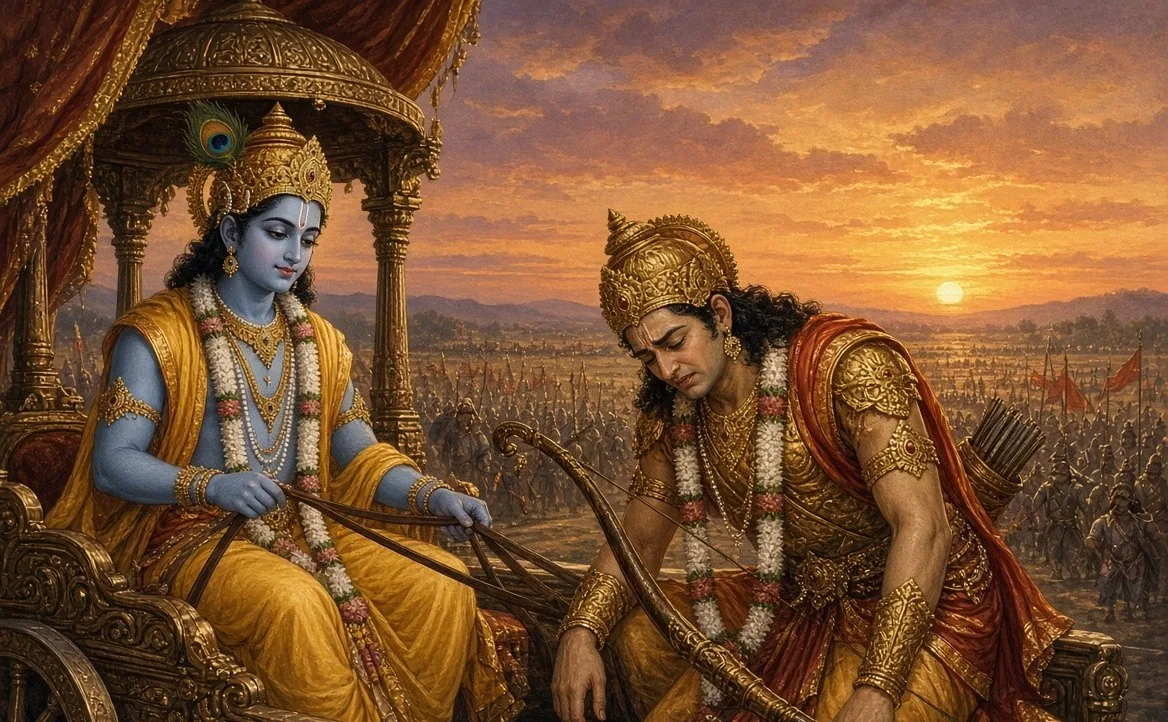
Living texts beside a clinic, never instead of one - Krishna does not mock Arjuna. He listens, then guides. That is still the first clinical move.
24.1 Why look at Hindu scriptures for mental health?
Hindu religious and philosophical texts are not modern psychology textbooks, but they explore many of the same questions: the mind (manas), intellect (buddhi), ego (ahamkara) and self (atman); feelings such as grief, fear, anger, desire, jealousy, devotion and compassion; patterns of behaviour, duty (dharma), attachment and letting go; and suffering (duhkha) and the paths to relief and meaning.
For many people in India and across the world, these texts are living guides. They offer language, stories, and practices that help make sense of mental struggles and support healing.
The Sanskrit verses come from texts that are many centuries old. The English translations are simple renderings prepared for this book and checked against several published translations. Hindu thought has always welcomed debate. Psychology can learn from it without taking it over. Karma means our actions and the traces they leave. Dharma means doing what is right for our role and situation. In psychology, these ideas are close to living by our values and caring for the next generation. They do not mean our fate is fixed.
24.2 The Bhagavad Gita: a dialogue on crisis, duty and the mind
The Bhagavad Gita is part of the Mahabharata (Bhishma Parva). It is a conversation between Arjuna and Krishna on the battlefield of Kurukshetra.
In psychological terms, Arjuna is in a moral and emotional crisis. He is overwhelmed by grief and confusion and cannot fight, even though it is his duty as a warrior. He has physical signs of stress: trembling, a dry mouth, and his bow slipping from his hand. Krishna's teaching on duty, wisdom, devotion and self-control offers a way back to mental balance.
Arjuna's breakdown — a psychological view
At the start of the Gita (Chapter 1), Arjuna shows signs of acute stress and moral conflict.
| Domain | From this book |
|---|---|
| Physical | Limbs giving way, dry mouth, trembling, bow slipping from the hand |
| Emotional | Deep compassion mixed with confusion and despair; inability to see any good in killing teachers and relatives |
| Cognitive | Confusion about dharma; catastrophic thinking ("It would be better if I were killed unarmed") |
Modern terms might describe this as a crisis of conscience with an acute stress reaction, not cowardice. Krishna does not mock him; he listens, then guides.
24.3 Key Gita teachings on the mind
Equanimity is yoga — Gita 2.48
Sanskrit Text:
योगस्थः कुरु कर्माणि सङ्गं त्यक्त्वा धनञ्जय ।
सिद्ध्यसिद्ध्योः समो भूत्वा समत्वं योग उच्यते ॥
Pronunciation: yogasthah kuru karmani sangam tyaktva dhananjaya | siddhy-asiddhyoh samo bhutva samatvam yoga ucyate ||
Translation: Established in yoga, perform action, abandoning attachment, equal in success and failure. Equanimity is called yoga.
Practical Meaning for Daily Health: balanced engagement without being ruled by outcomes. Reduces anxiety about results and fear of failure. Resonates with acceptance of uncertainty and values-based action. This is not indifference; it is engaged but non-obsessive action.
Reference — Bhagavad Gita 2.48
The ladder of disturbance — Gita 2.62–2.63
Sanskrit Text:
ध्यायतो विषयान्पुंसः सङ्गस्तेषूपजायते ।
सङ्गात्सञ्जायते कामः कामात्क्रोधोऽभिजायते ॥
Pronunciation:
dhyayato visayan pumsah sangas tesupajayate |
sangat sanjayate kamah kamat krodho 'bhijayate ||
Translation: Dwelling on objects, attachment arises. From attachment, desire; from desire, anger.
Practical Meaning for Daily Health: Thousands of years ago, this verse mapped out the exact psychological cycle of emotional dysregulation and behavioural addiction. It shows how a simple thought cascades into a destructive emotional storm.
When the mind keeps fixing on something, such as other people's perfect lives on social media, a rigid career goal or an addictive substance, it builds a strong attachment. That attachment soon turns into intense craving (kama). When life blocks the craving, the mind reacts with burning anger and frustration (krodha).
In modern therapy, learning to manage your anger or your addictions means realising you cannot usually stop the storm at the final step of krodha (anger). You must catch the mind at the very first step: noticing what you are choosing to fixate on, and gently shifting your focus before the attachment takes root.
Reference — Bhagavad Gita 2.62
Sanskrit Text:
क्रोधाद्भवति सम्मोहः सम्मोहात्स्मृतिविभ्रमः ।
स्मृतिभ्रंशाद् बुद्धिनाशो बुद्धिनाशात्प्रणश्यति ॥
Pronunciation:
krodhad bhavati sammohah sammohat smrti-vibhramah |
smrti-bhramsad buddhi-naso buddhi-nasat pranasyati ||
Translation: From anger, delusion; from delusion, memory of values slips; from that, discernment is destroyed; from destroyed discernment, the person falls.
Practical Meaning for Daily Health: This verse completes the psychological cascade started in the previous text, perfectly outlining the modern clinical models of addiction, impulse-control problems, and severe emotional dysregulation.
Once krodha (strong anger or frustration) takes over, it brings sammohah (confusion, or a narrow, tunnel-like focus). In this state a person suffers smriti-vibhramah: they forget their values, the people they love and their long-term goals, such as staying sober or saving their marriage.
When the memory of what truly matters is blocked, clear thinking (buddhi) shuts down. Without it acting as a steering wheel or brake, the person acts on impulse and harms themselves (the 'fall'). Recovering from addiction or anger problems means learning to break this chain early, before clear thinking is lost.
Reference — Bhagavad Gita 2.63
The person of steady wisdom (sthitaprajna) — Gita Chapter 2
Krishna describes a person of steady wisdom: not shaken by adversity; free from excessive attachment, fear, and anger; balanced in pleasure and pain; able to withdraw the senses like a tortoise drawing in its limbs.
Psychologically, this is an ideal of emotional resilience and self-mastery, not emotional numbness. Feel emotions without being enslaved by them. Act from clarity and values, not compulsion. Therapeutic goals it can inspire: emotion regulation, distress tolerance, values-based living.
24.4 The Ramayana: grief, duty, and relational psychology
The Ramayana, said to be written by Valmiki, is about family and duty, grief and loss, loyalty and betrayal, and leading under pressure. Many scenes show strong feelings we still recognise today. Verse numbers differ between editions, so the scenes matter more than the numbers.
Dasharatha's grief and attachment
When Rama is sent into exile, King Dasharatha is overwhelmed and cannot accept the separation. His past actions (the accidental killing of Shravana Kumar) and his attachment to Kaikeyi add to the crisis. The Ayodhya Kanda describes his sorrow vividly: he cannot rest, thinks of Rama all the time, and finally dies of a broken heart.
Psychological themes: complicated grief; attachment and dependency (identity and happiness overly tied to one relationship); guilt and regret. The text portrays how unprocessed grief and guilt can destroy health and judgement.
Rama's response to loss and duty
When told of his father's death, Rama faints from shock, then regains consciousness; performs funeral rites with composure; continues to uphold dharma despite personal pain.
Themes: acute grief reaction followed by ritualised mourning; duty as structure — rituals contain overwhelming emotion; resilience — feeling pain and still fulfilling responsibilities. Rama is not unfeeling. He channels grief through dharma, ritual, and service (meaning-focused coping).
Sita's trials and trauma
Sita's life includes abduction and captivity in Lanka; public doubt and questioning of her purity; exile while pregnant; a final choice to return to the earth.
Through a trauma lens: violation and loss of safety; social stigma and humiliation; repeated separations; extreme stress and isolation. Her responses show strength and clarity in speech, endurance, and assertion of autonomy. For many readers the story validates the pain of women facing injustice and highlights the need for social support, justice, and respect for survivors. A verse is not a reason to return a person to harm.
Bharata, Lakshmana, and family systems
Bharata refuses to usurp the throne and places Rama's sandals on it. Lakshmana's devotion is fierce and sometimes impulsive. Kaikeyi's fear and manipulation, driven by insecurity and past promises, ruptures the family. Kausalya bears loss with restraint.
This maps to family systems theory: one person's choices affect the whole; roles shape behaviour; unresolved fears and secrets create generational pain. Loyalty, duty, and fear can create both nobility and tragedy.
24.5 Upanishads: self-knowledge and freedom from fear
The Upanishads explore atman and brahman; liberation (moksha) from ignorance (avidya) and fear. Much suffering comes from misidentification (with body, roles, or ego). Self-knowledge reduces existential anxiety and fear of death. Shravana, manana, and nididhyasana are forms of cognitive and contemplative training.
Sanskrit Text:
ईशावास्यमिदं सर्वं यत्किञ्च जगत्यां जगत् ।
तेन त्यक्तेन भुञ्जीथा मा गृधः कस्यस्विद्धनम् ॥
Pronunciation:
isavasyam idam sarvam yat kinca jagatyam jagat |
tena tyaktena bhunjitha ma grdhah kasya svid dhanam ||
Translation: All this is inhabited by the Lord. Enjoy by letting go. Do not covet anyone's wealth.
Practical Meaning for Daily Health: In modern mental health, chronic anxiety is very often driven by our desperate need to control and possess things, status, or specific outcomes. This famous verse introduces the profound psychological tool of aparigraha (non-possessiveness). It teaches that true enjoyment of life only happens when you stop gripping it so tightly.
But there is an important limit. Letting go is an inner attitude that reduces anxiety; it does not mean giving up your responsibilities. Non-attachment does not stop you earning a fair wage for your family, and it is never a reason to stop prescribed treatment or refuse a doctor's care.
Reference — Isha Upanishad 1
The Katha Upanishad chariot: body = chariot; senses = horses; mind = reins; intellect = charioteer; self = rider. A well-guided chariot reaches the goal; an uncontrolled one leads to danger. This is a model of self-regulation.
24.6 Yoga Sutras of Patanjali
Sanskrit Text:
योगश्चित्तवृत्तिनिरोधः ॥
Pronunciation:
yogas citta-vrtti-nirodhah ||
Translation: Yoga is the stilling of the turnings of the mind-stuff.
Practical Meaning for Daily Health: the mind is filled with vrittis—a constant, spinning whirlpool of thought patterns, sudden emotions, perceptions, and memories. When this whirlpool spins out of control, we experience severe anxiety, endless rumination, and stress.
The ultimate goal of yoga (and modern psychological mindfulness) is nirodhah: the intentional stilling of these restless fluctuations. However, there is a crucial clinical distinction. Stilling the mind means patiently training your attention so that the whirlpool slows down, and you can see reality clearly. It does not mean completely erasing your thoughts, harshly suppressing your emotions, or becoming numb to your own life.
Reference — Patanjali Yoga Sutra 1.2
Sanskrit Text:
अभ्यासवैराग्याभ्यां तन्निरोधः ॥
Pronunciation:
abhyasa-vairagyabhyam tan-nirodhah ||
Translation: That stilling comes through practice and non-clinging.
Practical Meaning for Daily Health: This sutra provides the ultimate, two-part formula for calming the chaotic whirlpool of the mind (matching the exact advice given to a struggling Arjuna in Bhagavad Gita 6.35).
The first part is abhyasa (consistent practice). In daily mental health, this means keeping the "hinge of the day." Whether you feel motivated or not, you maintain your core stabilising routines—waking up at the same time, taking a short walk, or swallowing your prescribed medication. You do the necessary work.
The second part is vairagya (non-clinging or letting go). This is the psychological flexibility to drop the rigid demand that your day, your mood, or your recovery must be absolutely perfect. If you have a stressful afternoon or a sudden wave of anxiety, you do not cling to the failure and declare the whole week ruined. You simply let the bad moment go and return quietly to your practice.
Reference — Patanjali Yoga Sutra 1.12 (Matching Bhagavad Gita 6.35)
Sanskrit Text:
अविद्या क्षेत्रमुत्तरेषां प्रसुप्ततनुविच्छिन्नोदाराणाम् ॥
Pronunciation:
avidya ksetram uttaresam prasupta-tanu-vicchinna-udaranam ||
Translation: Ignorance is the field of those that follow — whether dormant, thin, interrupted, or fully out.
Practical Meaning for Daily Health: Mental struggles move through four distinct states:
Dormant: Deeply asleep until a specific cue or trigger wakes it up.
Weakened: Reduced because of consistent practice or therapy.
Interrupted: Cut off for a while, only to unexpectedly return.
Active: Fully dominating your day.
Takeaway: If an addictive craving, depressive wave, or trauma response suddenly returns, it is not a moral failure or a sign you are broken. Your struggle has simply shifted states. Drop the shame and gently resume your practice to weaken it once again.
Reference — Patanjali Yoga Sutra 2.4
Klesha 1 — Avidya (ignorance)
Sanskrit Text:
अनित्याशुचिदुःखानात्मसु नित्यशुचिसुखात्मख्यातिरविद्या ॥
Pronunciation:
anityasuci-duhkhanatmasu nitya-suci-sukhatma-khyatir avidya ||
Translation: Avidya is taking the impermanent as permanent, the impure as pure, pain as pleasure, and non-self as self.
Practical Meaning for Daily Health: Avidya (ignorance) has absolutely nothing to do with lacking formal education or a university degree. It is a fundamental cognitive distortion—four specific "mis-seeings" that drive human psychological suffering.
First, we take the impermanent as permanent: a temporary depressive mood or wave of panic is treated as if it will last forever. Second, we take the impure as pure: a deeply harmful, toxic relationship or environment is treated as sacred and necessary. Third, we take pain as pleasure: a self-destructive, numbing habit or addiction is treated as genuine emotional relief. Fourth, we take the non-self as the self: a temporary social role, a fleeting emotion, or a clinical diagnosis is treated as the absolute entirety of a person.
In modern Cognitive Behavioural Therapy (CBT), these mis-seeings map perfectly to deeply rooted core beliefs and severe overgeneralisations. True recovery begins when we correct our internal vision and finally see our thoughts, habits, and identities exactly as they are.
Reference — Patanjali Yoga Sutra 2.5
Klesha 2 — Asmita (I-making)
Sanskrit Text:
दृग्दर्शनशक्त्योरेकात्मतेवास्मिता ॥
Pronunciation:
drg-darsana-saktyor ekatmata ivasmita ||
Translation: Asmita is as if the power of seeing and the power of what is seen were oneself.
Practical Meaning for Daily Health: Asmita (ego or "I-making") occurs when the seer collapses into the seen. It is the illusion that the pure power of awareness is identical to the temporary objects, emotions, or thoughts it is observing.
Psychologists call this "fusion". A person stops saying, "I am experiencing anger," and instead deeply believes, "I am this anger." You become completely fused with your temporary job title, your clinical illness, or your social media like-count. When the ahamkara (the ego-maker) hardens in this way, it creates profound suffering, because any threat to those temporary things feels like a literal threat to your existence. The goal of mindful therapy is not to shame the person, but to gently loosen this fusion, restoring the healthy, safe distance between the one who sees and the temporary conditions being seen.
Reference — Patanjali Yoga Sutra 2.6
Klesha 3 — Raga (attachment / clinging)
Sanskrit Text:
सुखानुशयी रागः ॥
Pronunciation:
sukhanusayi ragah ||
Translation: Raga is that which trails after pleasure.
Practical Meaning for Daily Health: Raga (attachment) is the hook that follows pleasure. When something feels good, it leaves a strong impression, and the mind starts looking for the next dose: a certain person's attention, a social media like, a drink or a perfect grade. This matches the chain described in Bhagavad Gita 2.62. In modern terms, it is how craving and reward loops drive addiction. Pleasure itself is not wrong; the danger is when it becomes a rigid hook that runs your life.
Reference — Patanjali Yoga Sutra 2.7
Klesha 4 — Dvesha (aversion)
Sanskrit Text:
दुःखानुशयी द्वेषः ॥
Pronunciation:
duhkhanusayi dvesah ||
Translation: Dvesha is that which trails after pain.
Practical Meaning for Daily Health: When something hurts you, it leaves a mental "flinch." You instinctively avoid things, get angry, or build walls to protect yourself—even when you are completely safe now.
Takeaway: In modern therapy, this is called a trauma response or fear conditioning. Your brain is just trying to protect you. However, you should never force yourself to face deep trauma alone without a professional to guide you.
Reference — Patanjali Yoga Sutra 2.8
Klesha 5 — Abhinivesha (clinging to life / fear of ending)
Sanskrit Text:
स्वरसवाही विदुषोऽपि तथारूढोऽभिनिवेशः ॥
Pronunciation:
sva-rasa-vahi viduso 'pi tatharudho 'bhinivesah ||
Translation: Abhinivesha flows by its own juice; it is established even in the learned.
Practical Meaning for Daily Health: This is a deep, existential anxiety—the fear of death, the fear of an illness returning, or the fear of being a "nobody" if you lose your job or role. Being highly intelligent does not make you immune to it. It is a natural human instinct, not cowardice.
Takeaway: In modern psychology, this is known as death anxiety or a severe intolerance of uncertainty.
Reference — Patanjali Yoga Sutra 2.9
Healing the Mind (Yoga Sutras 2.10–2.11): Deep, subtle struggles are resolved by tracing them back to their root. Active, noisy struggles are calmed through gentle, chosen meditation (dhyana)—never by force.
The Cycle of Karma (Yoga Sutra 2.12 & Gita 2.62–63): In mental health terms, karma is simply a behavioural loop. If you feed a negative mental habit (an affliction) today, it plants a seed that will grow into a repeating pattern tomorrow.
The Eight Limbs System: Yoga's eight steps (from ethics and breathing to deep focus) are a complete mental and physical training system, very similar to modern holistic psychology.
Takeaway: While this ancient system is a powerful tool for daily health, it is not a substitute for modern medicine. Yoga and meditation do not replace mood stabilisers or specialised clinical therapies (like DBT or ERP) when you need professional medical care.
The Core of Yoga Psychology – The Working Model (Yoga Sutras 1.2–1.4):
The Mind (Chitta): Think of your mind as a lake.
The Thoughts (Vrittis): Every thought, emotion, or memory is a wave on that lake.
The Goal: Yoga is not about forcing your mind to be empty. It is about calming the stormy waves, so they stop hijacking the rider (a concept also found in the Katha Upanishad chariot metaphor).
The Takeaway: When the lake of your mind is stormy, you take the shape of the chaotic waves (Yoga Sutra 1.4). But when the waves finally calm down, the water becomes clear, and you can see who you truly are underneath all the noise (Yoga Sutra 1.3).
Sanskrit Text:
वृत्तयः पञ्चतय्यः क्लिष्टाक्लिष्टाः ॥
प्रमाणविपर्ययविकल्पनिद्रास्मृतयः ॥
Pronunciation:
vrttayah pancatayyah klista-aklistah ||
pramana-viparyaya-vikalpa-nidra-smrtayah ||
Translation: The turnings are fivefold, afflicted or unafflicted: valid knowing, error, fantasy, sleep, and memory.
Practical Meaning for Daily Health: Not every thought is a problem. The mind has five basic types of activities, and they can either help you or hurt you:
Pramana (Valid Knowing): Grounding yourself in actual facts and good evidence.
Viparyaya (Error): Misjudging reality. In modern therapy, this is a cognitive distortion.
Vikalpa (Fantasy): Creating stories in your head about things that do not exist or haven't happened.
Nidra (Sleep/Dullness): A heavy, dull wave of mental blankness (different from healthy physical rest).
Smriti (Memory): Recalling the past. This can be healing, but it becomes a mental prison if it traps you in a trauma loop without professional help.
Takeaway: Your thoughts are just one of these five waves. Identifying exactly which wave you are experiencing helps you step back and observe your mind, rather than getting swept away by it.
Reference — Patanjali Yoga Sutra 1.5–1.6
Sanskrit Text:
मैत्रीकरुणामुदितोपेक्षाणां सुखदुःखपुण्यापुण्यविषयाणां भावनातश्चित्तप्रसादनम् ॥
Pronunciation:
maitri-karuna-muditopeksanam sukha-duhkha-punyapunya-visayanam bhavanatas citta-prasadnam ||
Translation: The mind becomes clear by cultivating friendliness toward the happy, compassion toward the suffering, joy toward the good, and steadiness toward the unhelpful.
Practical Meaning for Daily Health: To keep your mind clear in a chaotic world, you must actively train four specific social responses:
Friendliness: Toward those who are happy (which stops jealousy).
Compassion: Toward those who are suffering.
Joy: Toward those doing good things.
Steadiness (Upeksha): Toward negative or harmful behaviour.
Takeaway: In modern therapy, this is social-emotion training (similar to "opposite action"), not just simple politeness. It is a tool to break exhausting loops of envy and anger. Upeksha (steadiness) is not about being cold or uncaring—it simply means choosing not to feed a fire you cannot put out today.
Reference — Patanjali Yoga Sutra 1.33
Sanskrit Text: स्थिरसुखमासनम् ॥
Pronunciation: sthira-sukham asanam ||
Translation: Asana is a seat that is steady and easeful.
Practical Meaning for Daily Health: In Patanjali, asana is first a stable seat for attention, not a performance. Pain-as-virtue is not this sutra. After trauma, steady and easeful includes the right to stand up and leave.
Reference — Patanjali Yoga Sutra 2.46
The eight limbs of yoga can be read as training for the nervous system: yama and niyama (ethics towards others and oneself); asana (a posture the body can hold); pranayama (breathing that calms the body); pratyahara (turning down input such as screens and noise); dharana (holding attention on one point); dhyana (that attention becoming steady); and samadhi (deep calm). Go only as far as feels manageable this week.
Sanskrit Text:
युक्ताहारविहारस्य युक्तचेष्टस्य कर्मसु ।
युक्तस्वप्नावबोधस्य योगो भवति दुःखहा ॥
Pronunciation: yuktahara-viharasya yukta-cestasya karmasu | yukta-svapnavabodhasya yogo bhavati duhkha-ha ||
Translation: For one measured in food and movement, measured in work, measured in sleep and waking — yoga becomes the destroyer of sorrow.
Practical Meaning for Daily Health: Gita yoga psychology is a dose. Too little or too much practice is not more holy. Balanced sleep, food and daily routine are the heart of this verse.
Reference — Bhagavad Gita 6.17
24.6 Bhagavata Purana and devotional psychology
The Bhagavata Purana teaches bhakti: love and trust in God. Its stories turn love, longing and grief towards Krishna, and singing together (kirtan) calms and bonds people. Devotees such as Prahlada, Draupadi and Mirabai stay strong through cruelty and loss. For many people, bhakti gives comfort, meaning and belonging.
24.7 Regional traditions across India
Hinduism is not monolithic. Several regional expressions that add psychological richness and provide culturally embedded narratives and rituals for grief, fear, hope, and joy.
Tamil — Alvars and Nayanars
Their Tamil hymns are raw expressions of longing, guilt, surrender, and divine love. They validate intense emotion as part of spiritual life.
Original Text: அகரம் முதல எழுத்தெல்லாம் ஆதி பகவன் முதற்றே உலகு.
Pronunciation: akaram mutala ezhuttellam ati pakavan mutarre ulaku.
Translation: As A is first among letters, the Primordial One is first in the world.
Practical Meaning for Daily Health: Companion, not a substitute for your Alvar note: a first principle can steady a week. Tirukkural is ethical Tamil; Alvar hymns carry the longing the text names.
Reference — Tirukkural 1 (Tiruvalluvar)
Original Text: அடக்கம் அமரருள் உய்க்கும் அடங்காமை ஆரிடத்து உய்த்து விடும்.
Pronunciation: atakkam amararul uykkum atangamai aridattu uyttu vidum.
Translation: Restraint lifts one high; lack of restraint throws one anywhere.
Practical Meaning for Daily Health: Self-control as mental hygiene — same family as yama and as emotion regulation, not as humiliation of a panic attack.
Reference — Tirukkural 121
Marathi — Dnyaneshwar, Tukaram, Eknath
These saints teach humility, acceptance and seeing God in ordinary life, and they gave support for common people facing poverty, caste oppression, and personal suffering.
Original Text: जे का रंजले गांजले । त्यासी म्हणे जो आपुले ।
Pronunciation: je ka ranjale ganjale | tyasi mhane jo apule |
Translation: Whoever calls the afflicted and crushed their own...
Practical Meaning for Daily Health: Family care and seva (selfless service). Not a licence to lecture or to hide a hospital.
Reference — Tukaram Gatha; cite by first line (Marathi Varkari tradition)
Bengali — Chaitanya and kirtan
This tradition uses ecstatic devotion, kirtan and community as healing spaces. Group rhythm plus belonging is a social-regulation technology.
Kannada — Basava
Original Text: ಕಾಯಕವೇ ಕೈಲಾಸ.
Pronunciation: kayakave kailasa.
Translation: Work itself is Kailasa.
Practical Meaning for Daily Health: Meaningful work and activity support mental health. Work is not a reason to skip sleep or a ward.
Reference — Basavanna, Vachana tradition (Kannada)
Telugu and Malayalam bhakti
Annamacharya's keertanas and Malayalam works such as Poonthanam's Jnanappana place the restless mind before a name of Krishna. Use them as this book uses Gita 6.34: name restlessness without shame, then practise.
Gujarati
Original Text: વૈષ્ણવ જન તો તેને કહિયે જે પીડ પરાઈ જાણે રે।
Pronunciation: vaisnava jana to tene kahiye je pida parai jane re |
Translation: Call that person a Vaishnava who knows the pain of another.
Practical Meaning for Daily Health: Empathy is the first skill a family needs. Knowing pain is not diagnosing from the corridor.
Reference — Narsinh Mehta, Vaishnava jana to (Gujarati)
Gujarati, Rajasthani, Punjabi, Kashmiri, Northeast
These regions have local deities, festivals and stories that address fertility, protection, harvest, war, and loss. In Assam, Sankardev's kirtan-ghar tradition works like satsanga — company that regulates. In Kashmir Shaiva language, awareness itself is trained. Use the local form you already trust. Do not import a verse to win an argument at a funeral.
24.8 Hindu practices as mental-health supports
Mantra, chanting and prayer
Mantra, chanting and prayer can work like focused-attention meditation. They bring breathing regulation; reduced rumination and anxiety; increased connection and meaning; structured time for reflection.
Rituals, puja and festivals
Daily puja, aarti, lamps, offering food. Routine and structure; meaning-making; social support that reduces isolation. Ritualised processing: Durga Puja as victory over inner demons (anger, greed, ego); Diwali as light after difficulty; Shraddha as structured grieving and remembrance.
Pilgrimage
Break from routine; physical effort and discipline; shared identity; a narrative of purification and renewal.
Ethics as mental hygiene
Satya (truthfulness), ahimsa (non-harming), brahmacharya as moderation, asteya (not stealing), aparigraha (not grasping). Living in line with these can reduce guilt and shame from harmful actions; conflict in relationships; inner fragmentation ("I say one thing, do another"). Integrity and self-respect are protective.
Techniques used for healing
-
Asana, pranayama, dhyana, yoga nidra.
-
Mantra / japa (repeating a sacred word or phrase), bhakti (devotion), seva (selfless service), satsanga (good company), svadhyaya (self-study).
-
Yama / niyama; Ayurvedic dinacarya; panca kosa (five sheaths) as a layered model of a person.
-
Kleshas (afflictions of the mind); abhyasa (steady practice) and vairagya (letting go).
These are supports. They work alongside healthy sleep, food, movement and daily routine. They do not replace a visit to a psychiatrist.
24.9 Ancient Indian medical texts on mind
Ayurveda, the classical medicine of India, already names the mind as a clinical object, and its daily-routine texts (*dinacarya*) and the five-sheath model (*panca kosha*) speak directly to wellbeing. These books are not DSM, and they are not a licence to skip a psychiatrist. Read them as an older language for the same house.
Caraka Samhita — what unmada is
Sanskrit Text: उन्मादं पुनर्मनोबुद्धिसञ्ज्ञाज्ञानस्मृतिभक्तिशीलचेष्टाचारविभ्रमं विद्यात् ॥
Pronunciation: unmadam punar mano-buddhi-sanjna-jnana-smrti-bhakti-sila-cesta-acara-vibhramam vidyat ||
Translation: Know unmada as derangement of mind, intellect, consciousness, knowledge, memory, inclination, character, activity and conduct.
Practical Meaning for Daily Health: This is a whole-person description of severe mental illness, not a moral insult. It reads more like a medical description than a sermon. Five types are named: vata, pitta, kapha, sannipata, and agantu (external/trauma-like). Weak sattva plus rajas-tamas plus unwholesome diet and excess passion, anger, fear or grief are listed as risk.
Reference — Caraka Samhita, Nidana Sthana 7.5; types at Nidana 7.3
Sanskrit Text: धीविभ्रमः सत्त्वपरिप्लवश्च पर्याकुला दृष्टिरधीरता च । अबद्धवाक्त्वं हृदयं च शून्यं सामान्यमुन्मादगदस्य लिङ्गम् ॥
Pronunciation: dhi-vibhramah sattva-pariplavas ca paryakula drstir adhirata ca | abaddha-vaktvam hrdayam ca sunyam samanyam unmada-gadasya lingam ||
Translation: Perverted intellect, agitation of sattva, restless eyes, impatience, incoherent speech, and a vacant heart-mind — these are the common marks of unmada.
Practical Meaning for Daily Health: Compare with thought disorder, agitation, and emptiness in modern psychosis chapters. Caraka also writes apasmara (Nidana 8; Chikitsa 10) as episodic loss of memory/consciousness with frightening movements — closer to seizure than to everyday forgetfulness. Do not self-label either.
Reference — Caraka Samhita, Chikitsa Sthana 9.6
Sattvavajaya — definition
Sanskrit Text: त्रिविधमौषधमिति— दैवव्यपाश्रयं, युक्तिव्यपाश्रयं, सत्त्वावजयश्च । तत्र ... सत्त्वावजयः— पुनरहितेभ्योऽर्थेभ्यो मनोनिग्रहः ॥
Pronunciation: trividham ausadham iti — daiva-vyapasrayam, yukti-vyapasrayam, sattvavajayas ca | tatra ... sattvavajayah — punar ahitebhyo 'rthebhyo mano-nigrahah ||
Translation: Medicine is of three kinds: daiva-vyapasraya (ritual and meaning), yukti-vyapasraya (reasoned diet and drug), and sattvavajaya. Sattvavajaya is restraint of the mind from unwholesome objects.
Practical Meaning for Daily Health: Sattva here is the mind (and its clear quality). Avajaya is winning it back. Ahita-artha are the objects, news, comparisons, and inner pictures that feed rajas and tamas. Mano-nigraha is not suppression of feeling; it is refusing to keep feeding the object that is making the week worse.
Reference — Caraka Samhita, Sutra Sthana 11.54
Sanskrit Text: मानसो ज्ञानविज्ञानधैर्यस्मृतिसमाधिभिः ।
Pronunciation: manaso jnana-vijnana-dhairya-smrti-samadhibhih |
Translation: Disorders of the mind are met with knowledge, skilled knowing, courage, memory, and collectedness.
Practical Meaning for Daily Health: The commentator Chakrapani names five inner tools: self-knowledge (jnana), learning and science (vijnana), steady courage (dhairya), memory of what we have lived through (smriti) and focused calm (samadhi).
Reference — Caraka Samhita, Sutra Sthana 1.58
The five tools — technique by technique
Jnana — insight. "I am the panic" becomes "a wave is passing through a person who also slept and was loved." Kin: psychoeducation, decentering. Not spiritual bypassing. In psychosis, the clinic comes first.
Vijnana — skilled, testable knowing. Name the condition, the sleep debt, the thyroid, the thought error. Explain how the illness works in simple terms. Kin: collaborative empiricism in CBT. Know kula, kala, desha, bala — family, time, place, strength — before advising.
Dhairya — courage that stays. Capacity to remain while a feeling peaks and falls (Gita 2.14). Kin: distress tolerance, ERP's sitting with uncertainty, a friend who does not flee. Ashvasana and santvana: assurance and consolation by a trusted person, not slogans.
Smriti — memory used as medicine. Recall what helped last time, who you are besides the episode, the values anger wiped (Gita 2.63). Kin: a coping card, a safety plan, a grandmother's voice. It is not "delete trauma and paste joy."
Samadhi — collected attention. Turn the mind from the unwholesome object and rest it: one chosen breath, a name, a walk. Kin: attention training, MBCT. Not dissociation dressed as peace. If trauma is still raw, go slowly, offer choices and stop if distress rises.
Inner sequence of the mind
Objects of manas in the texts: what the mind thinks about (chintya), weighs up (vicharya), reasons out (uhya), focuses on (dhyeya) and decides (sankalpa). Sattvavajaya walks that sequence on purpose.
-
Chintya: notice the thought without becoming it.
-
Vicharya: examine — fact, fear, or habit?
-
Uhya: test a kinder, truer hypothesis.
-
Dhyeya: hold one aim (sleep, one meal, one call).
-
Sankalpa: decide one next act. Fruit is not guaranteed (Gita 2.47).
Asatmyendriyartha-samyoga — unwholesome sense-object contact — is a named cause: too much, too little, or the wrong input. Changing what we see, hear and take in every day is part of care.
Pratidvanda — pairing an opposite
The old texts treat some strong emotions by gently encouraging the opposite feeling: comfort after loss, a small safe joy after frozen grief, cooling after anger. Modern therapy does something similar. Go slowly, one small step at a time. Never surprise someone who has been through trauma.
What the physician and the family actually do
-
Ashvasana / santvana: a trusted person speaks slowly, names the real, stays.
-
Trivarga-anveshana: dharma, artha, kama as a life larger than the episode.
-
Tadvidya-seva: go to people trained in this illness.
-
Atma-jnana: self-knowledge at a pace the nervous system can hold.
HISTORICAL METHODS THAT MUST NOT BE COPIED
Some classical lists include frightening, confinement, or assault as ways to startle a mind. Those lines are history. They are not trauma-informed, not ethical now, and not part of this book as practice. Keep consolation, courage, knowledge, routine, and a hospital.
Ashtanga Hridaya — medicine for mental doshas
Sanskrit Text: धीधैर्यात्मदिविज्ञानं मनोदोषौषधं परम् ।
Pronunciation: dhi-dhairya-atma-adi-vijnanam mano-dosausadham param |
Translation: Discernment, courage, and knowledge of the self are the highest medicine for disorders of the mind.
Practical Meaning for Daily Health: Dhi is closer to prefrontal pause than to a slogan. Dhairya is staying in the wave. Atma-vijnana is not a ban on an SSRI. Vagbhata also names rajas and tamas as the two mental doshas; sattva is the healthy tilt.
Reference — Vagbhata, Ashtanga Hridaya, Sutra Sthana 1.26 (standard edition numbering)
Sushruta Samhita (Uttara Tantra, unmada chapters) places manas at the hridaya and describes similar derangements. Use these books as maps of observation. Prescriptions, shodhana lists, and collyriums belong with a qualified Vaidya plus a modern physician — not with a downloaded verse.
24.10 Trauma-informed yoga
Trauma-informed care and yoga can work together, but carefully: yoga after trauma is not "stretch until you surrender." Trauma Center Trauma-Sensitive Yoga (TCTSY; Emerson, Turner, and colleagues at the Trauma Center associated with van der Kolk) adapts hatha so choice and interoception come before form.
Why ordinary class cues can harm
Trauma often took away choice over the body. A command ("Raise your left arm. Close your eyes. I will adjust you.") can replay that loss. Bound or inverted poses, heat, darkness, forced silence, or a teacher who cannot be refused can push a person out of the window of tolerance into freeze or panic.
Principles (SAMHSA care + TCTSY)
-
Safety: predictable room, lights that stay on if needed, exits visible, no surprise touch.
-
Choice and agency: invitational language — "You might..." / "If you like..." / "You can stop." Opting out is success, not failure.
-
Interoception over appearance: notice weight in the feet, not whether the pose looks correct.
-
Present moment: no forced recall of the event. Sensation now, then a choice.
-
Effective action: if a sensation is too much, change the shape, open the eyes, stand, leave.
-
Collaboration and trust: teacher is not a guru-controller. Preview what comes next.
-
Cultural, historical, and gender respect: no spiritual bypassing; no claiming the pose will "release stored trauma" as a guarantee.
A cautious practice menu (not a class plan to force)
-
Sit or stand with both feet or sit-bones finding the floor. Notice contact. Leave if noticing floods you.
-
Unforced breath: longer out-breath only if it stays kind. Do not hold the breath as a test.
-
Slow walk or mountain shape. Look around the room. Orientation is regulation.
-
Hand on the chest or belly if that is chosen — a simple grounding practice.
-
Duration: minutes, not a heroic hour. Stop while still inside the window of tolerance.
Pair this with a trauma-trained therapist when PTSD, dissociation, or self-harm is active. Yoga can support treatment. It does not replace trauma therapy or hospital care.
24.11 More bhakti voices
This section names Alvars, Nayanars, Varkari saints, Chaitanya, Mira and regional festivals. These extra lines stay inside that frame: longing, surrender and company as emotion regulation, never as a test of faith.
Sanskrit Text: सर्वधर्मान्परित्यज्य मामेकं शरणं व्रज । अहं त्वां सर्वपापेभ्यो मोक्षयिष्यामि मा शुचः ॥
Pronunciation: sarva-dharman parityajya mam ekam saranam vraja | aham tvam sarva-papebhyo moksayisyami ma sucah ||
Translation: Leaving all rigid duties, take refuge in Me alone. I will free you. Do not grieve.
Practical Meaning for Daily Health: Bhakti as a place to put impossible load. It is not permission to abandon a child's safety or a prescribed tablet.
Reference — Bhagavad Gita 18.66
Sanskrit Text: अद्वेष्टा सर्वभूतानां मैत्रः करुण एव च । निर्ममो निरहङ्कारः समदुःखसुखः क्षमी ॥
Pronunciation: advesta sarva-bhutanam maitrah karuna eva ca | nirmamo nirahankarah sama-duhkha-sukhah ksami ||
Translation: Unhating toward beings, friendly and compassionate, without possessiveness or I-making, equal in pain and pleasure, forbearing.
Practical Meaning for Daily Health: A character sketch of regulation, not a demand that a depressed person smile.
Reference — Bhagavad Gita 12.13
Sanskrit Text: भज गोविन्दं भज गोविन्दं गोविन्दं भज मूढमते ।
Pronunciation: bhaja govindam bhaja govindam govindam bhaja mudha-mate |
Translation: Worship Govinda, worship Govinda, O foolish mind.
Practical Meaning for Daily Health: Shankara's refrain is a call to drop frantic acquisition. Use it as a rumination interrupt, not as an insult to someone already crushed.
Reference — Shankara, Bhaja Govindam 1
Original Text: पायो जी मैंने राम रतन धन पायो।
Pronunciation: payo ji maine rama-ratana dhana payo |
Translation: I have found the jewel-wealth of Rama.
Practical Meaning for Daily Health: Mirabai names a possession that cannot be seized by a court or a husband. Longing becomes a container. It does not ask a woman to stay in harm.
Reference — Mirabai pada; cite by first line (Rajasthani / Braj bhakti)
Original Text: कस्तूरी कुंडल बसै, मृग ढूँढै वन माहि।
Pronunciation: kasturi kundala basai, mrga dhundhai vana mahi |
Translation: Musk lives in the deer's own navel; the deer searches the forest.
Practical Meaning for Daily Health: Kabir on looking outside for what is already near. Psychologically: rumination that hunts elsewhere. Sant tradition; use as image, not as a diagnosis.
Reference — Kabir; commonly cited couplet, first line
Original Text: மார்கழித் திங்கள் மதிநிறைந்த நன்னாளால் ।
Pronunciation: markazhit tingal madi-nirainda nannalal |
Translation: In the month of Margazhi, on the full-moon good day...
Practical Meaning for Daily Health: Andal's Tiruppavai opens a shared seasonal practice — rhythm plus belonging, the same social regulation this book named in kirtan.
Reference — Andal, Tiruppavai 1 (Tamil)
Original Text: जगदोधरण दाशरथी राम राम ।
Pronunciation: jagadodharana dasarathi rama rama |
Translation: O Rama, Dasharatha's son, upholder of the world.
Practical Meaning for Daily Health: Purandara Dasa (Kannada) and Tyagaraja (Telugu) both return a restless mind to a name and a tala. Rhythm plus devotion is regulation. It is not a substitute for ERP.
Reference — Purandara Dasa / Tyagaraja keertana tradition; cite by refrain
Ramprasad Sen (Bengali) speaks to the mind as a farm that will not be tilled; Chaitanya's kirtan uses group voice as a nervous-system event. Keep the local form you already trust.
24.12 Integrating scripture with modern care
Hold both perspectives respectfully.
| Scriptures offer | Modern psychology and psychiatry offer |
|---|---|
| Meaning, values, identity, practices | Evidence-based therapies and medicines |
| Language for suffering and growth | Diagnostic frameworks and safety protocols |
| Community and ritual support | Research on brain, behaviour, and treatment |
They can work together. A person with depression may be helped by medicine and therapy, and also by prayer, satsang (spiritual gathering) and reading the Gita. A trauma survivor may be helped by trauma therapy, and also by rituals, pilgrimage or devotion. A family in conflict may be helped by family therapy, and also by praying together, festivals and thinking about what is right (dharma).
Problems arise when severe mental illness is treated only as lack of faith or possession, delaying medical care — or when spiritual practices are dismissed as superstition, ignoring their real psychosocial benefits. A balanced approach respects both science and tradition.
24.13 Across the Hindu world — mind, sorrow, company, and help
Translations below are working English for a reader, not a claim to be the only scholarly rendering. Where a line is famous in several wordings, the meaning is what this chapter needs.
HOW TO HOLD THIS WHOLE MAP
These texts are companions of meaning, ritual, and self-respect. They are not DSM chapters. A purana that helps you weep is data of a life. A child who has not slept in four days still needs a hospital. Regional devotion that forbids medicine is not more Hindu than the Gita’s yogah karmasu kaushalam — skill in the next act.
Shruti, smriti, sutra, samhita, purana — the classical shelf
The Upanishads already refuse the idea that a person is only today’s mood. The Katha Upanishad’s chariot — body as chariot, senses as horses, mind as reins, intellect as driver, the self as rider — is Katha Upanishad 1.3.3–1.3.9 (some editions mark the same block as 3.3–3.9 of the first adhyaya’s third valli). The Taittiriya Upanishad’s five sheaths (anna, prana, manas, vijnana, ananda) are Taittiriya 2.1–2.5 (Brahmananda Valli). When food and breath collapse, the mind sheath cannot be lectured into sattva.
Sanskrit Text: आत्मानं रथिनं विद्धि शरीरं रथमेव च । बुद्धिं तु सारथिं विद्धि मनः प्रग्रहमेव च ॥
Pronunciation: atmanam rathinam viddhi sariram ratham eva ca | buddhim tu sarathim viddhi manah pragraham eva ca ||
Translation: Know the self as the rider, the body as the chariot, the intellect as the driver, and the mind as the reins.
Practical Meaning for Daily Health: If the horses (senses and impulses) run, do not blame only the rider. Check sleep, food, company, and — when needed — a physician for the chariot itself.
Reference — Katha Upanisad 1.3.3–4
Yoga Vasishtha (the Laghu and the larger Yoga Vasishtha / Mokshopaya tradition) treats the mind as the workshop of bondage and freedom. Verse numbers jump by recension; the teaching that bondage and freedom are of the mind is repeated in the Utpatti and Nirvana prakaranas (see especially the Vasishtha–Rama dialogues collected in Book 3 Utpatti and Book 6 Nirvana). Ashtavakra Gita 1.4–1.13 speaks more sharply: you are awareness, not the passing storm. Neither book asks a person in psychosis to “realise” their way out of danger. They ask a recovering person not to fuse identity with a bad month.
Patanjali’s Yoga Sutra 1.2 defines yoga as citta-vritti-nirodhah. The kleshas — avidya, asmita, raga, dvesha, abhinivesha — are Yoga Sutra 2.3, unfolded in 2.4–2.9. That list is older than a CBT worksheet and rhymes with it. Narada Bhakti Sutra 1–2 calls bhakti parama-prema-rupa; psychologically it is attachment given a safe object and a community, which is why kirtana often lowers a pulse before any theory arrives.
The classical Ayurveda books have chapters on mental illness (unmada) and on daily routine. They say the purpose of Ayurveda is to protect health and treat disease. They describe health as balance in body, digestion, mind and senses, not as being "always happy". Health is a range, not just "ill" or "well".
Smriti literature warns that rage and grasping ruin a life. Manusmriti 7.45–52 lists the vyasanas (destructive addictions and passions) of a ruler, including mrigaya, dyuta, and the cluster around krodha and indriya-loss; Manusmriti 2.88 and 2.96–2.100 treat restraint of the senses; Manusmriti 4.138 asks for truth without cruelty (satyam bruyat priyam bruyat). Those lines neighbour emotion dysregulation and integrity. This chapter does not import smriti’s social hierarchies as health rules. A patient does not owe a caste verse their dignity. Take the inner discipline; leave the cage.
The Puranas teach through stories, not rules: Gajendra the elephant crying for help when his strength fails, the boy Prahlada staying brave, and the Goddess fighting demons that can stand for inner panic, rage and greed. These images can comfort, but a panic attack is an illness, not a demon, and it needs a doctor. A pilgrimage can rest a tired mind, but it is not medical treatment.
Tamil — Cankam ethic, Tirukkural, Shaiva and Vaishnava bhakti
Tirukkural treats a governed inner life as public health for a household and a kingdom. Numbered lines: Kural 121–130 (adakkam, self-restraint); Kural 129 (the wound of fire may heal, the wound of the tongue does not); Kural 160 (not harming); Kural 310 (anger as a weapon that wounds the angry); Kural 422 and 480 (a composed, discerning mind). Kaniyan Pungundranar’s Cankam line yadum ure yavarum kelir is Purananuru 192 — not the Kural — and stands against the isolation that stigma loves.
Tirukkural 129 teaches that a wound from fire heals, but a wound from harsh words does not.
Original Text: யாதும் ஊரே யாவரும் கேளிர்
Pronunciation: yadum ure yavarum kelir
Translation: Every place is home; everyone is kin.
Practical Meaning for Daily Health: A person in treatment is still of the same town. Isolation is the opposite of this line.
Reference — Purananuru 192, Kaniyan Pungundranar
Tirumandiram (Tirumular; 3,000 verses in the standard Tamil Shaiva numbering) and the Tevaram of Appar (Tirunavukkarasar), Sundarar, and Campantar speak of a mind that can be made a temple. Appar’s hymns are Tevaram, Fourth to Sixth Tirumurai. Manikkavacakar’s Tiruvacakam (Eighth Tirumurai) lets the devotee cry and still address Shiva as beloved — feeling is allowed. Antal’s Tiruppavai has 30 pasurams; the dawn communal vow is pasuram 1 (markazhi-t-tingal) through the month-long vow. Nammazhvar’s Tiruvaymozhi (part of the 4,000 Divya Prabandham) holds both soaring joy and viraha — a classical language for longing that modern clinics sometimes only call anxiety.
Telugu and Kannada — Vemana, Potana, Annamayya, Tyagaraja, vacanas
Telugu poets carry the same message. Vemana's short verses say that outward signs of holiness are cheap; the mind is what matters. Potana's Telugu Bhagavatam retells Gajendra's cry for help: when your strength ends, calling for help is still right. Annamayya's songs, and Tyagaraja's songs such as 'Manasa sancharare', speak directly to the mind. In 'Dudukugala', Tyagaraja admits his faults without falling into feeling worthless.
In Kannada, Basavanna’s kayakave kailasa is a vacana cited by that first phrase in the vacana-sangraha (numbers differ by editor; some school editions list it among the kayaka vacanas). Akka Mahadevi’s vacanas to Cenna Mallikarjuna are likewise cited by first line. Allama Prabhu’s vacanas cut identification with a restless mind. These are not licences to abandon a frightened person. They are licences to stop calling a woman’s distress “family honour.”
Malayalam — Ezhuttacchan, Puntanam, Narayana Guru
Ezhuttacchan’s Adhyatma Ramayanam (Kilippattu; Balakandam through Uttarakandam) brought Rama’s restraint and grief into the Malayalam house. Puntanam’s Jnanappana is a single poem of 360 couplets in common printed texts (line numbering 1–360). Narayana Guru’s “one caste, one religion, one God” is the inscription-teaching associated with the Aruvippuram / later motto oru jati oru matam oru daivam manushyanu; compassion as essence is unfolded in Atmopadesha Shatakam (100 verses) and in Jati-nirnayam. Humiliation makes people ill; dignity is preventive care.
Marathi — Jnaneshvar, Namdev, Eknath, Tukaram, the Varkari road
Original Text: जे का रंजले गांजले । त्यांसी म्हणेजो आपुले ॥
Pronunciation: je ka ranjale ganjale | tyansi mhanejo apule ||
Translation: Those who are wounded and crushed — call them your own.
Practical Meaning for Daily Health: If this book has one Marathi sentence worth pinning on a kitchen wall, it is this. Stigma says their problem. This abhang says our person.
Reference — Tukaram Gatha, abhang beginning je ka ranjale ganjale (compiler numbers differ; cite by first line)
Jnaneshvar’s Pasayadan is the closing prayer of Jnaneshvari (Bhavartha-dipika) adhyaya 18, concluding ovis (commonly printed as 18.1794–18.1802, numbering varies by edition). Eknath’s Eknathi Bhagavat on the eleventh skandha is cited by adhyaya. The Varkari pilgrimage to Pandharpur follows the seasonal wari custom rather than a single verse number. A depressed person may not be able to walk 200 kilometres. They may be able to sit for one bhajan without being told they have failed God.
Gujarati, Rajasthani, Hindi–Awadhi — Narsinh, Mira, Tulsi, Sur, Kabir
Narsinh Mehta’s Vaishnava jana to describes a true devotee as one who feels the pain of others.
Mira Bai was mocked, poisoned in story, and still sang “mere to Giridhar Gopal, dusaro na koi” (Mira Padavali; pad cited by first line, as critical numbers vary). For this chapter she is the patron of people whose families use honour to erase their inner life. That witness does not forbid a woman today from also seeing a counsellor.
Tulsidas named his epic Ramcaritmanas — a manasa, a lake for the mind. The title-frame is Balakanda, opening dohas; Hanuman’s ocean-crossing is Sundarakanda, from the first doha of that kanda through the Lanka landing (common vulgate Sundarakanda doha/chaupai sequence beginning “jamavanta ke bacana suhae”). Use it as courage, not as a demand that a panic attack “jump.” Surdas’s pads are Sursagar, numbered differently by edition; cite by first line. Kabir’s sakhi on the mind is given in full below; mann ke hare har hai, mann ke jite jit is a sakhi in the oral/printed Sakhi collections (Bijak and Guru Granth traditions preserve related Kabir lines under different numbers — cite by first line). The companion sakhi dukh mem sumiran sab kare, sukh mem kare na koya is the same Sakhi corpus. Rahim’s dohas are Rahim Dohavali, commonly numbered in school editions (for example the doha on trouble revealing friends). Ravidas pads are cited by first line in the Ravidas Padavali.
Original Text: मन के हारे हार है, मन के जीते जीत । कहत कबीर सोच समझ, मान करो न अनीति ॥
Pronunciation: man ke hare har hai, man ke jite jit | kahat kabir soch samajh, man karo na aniti ||
Translation: Lose the mind and the world is lost; steady the mind and the world is livable. Kabir says: think this through; do not take the unjust path.
Practical Meaning for Daily Health: The first line is the heart of this couplet: if we lose heart, we lose; if we steady the mind, we can cope. Caring for mental health means not letting a troubled, unexamined mind take charge of our whole life.
Reference — Kabir Sakhi tradition; cite by first line (Bijak / collected sakhis; numbers differ)
Original Text: दुख में सुमिरन सब करे, सुख में करे न कोय । जो सुख में सुमिरन करे, तो दुख काहे को होय ॥
Pronunciation: dukh mein sumiran sab kare, sukh mein kare na koye | jo sukh mein sumiran kare, to dukh kahe ko hoye ||
Translation: Everyone remembers the Name in pain; almost no one does in ease. If one remembered in ease, why would pain have to teach it?
Practical Meaning for Daily Health: Do not wait for collapse to begin care — sleep, company, prayer, or a clinic.
Reference — Kabir Sakhi tradition; cite by first line
Bengali — Caitanya, Ramprasad, Candi, Ramakrishna
Caitanya’s public nama-sankirtana is narrated in Krishnadasa Kaviraja’s Caitanya-caritamrita, Adi-lila 7 and Madhya-lila 7–13 (among other chapters). His later frailty is in Antya-lila. Ramprasad Sen’s song “Mon re krishi-kaj jano na” is cited by first line in the Ramprasadi padavali. Shri Ramakrishna’s Mother-teaching is recorded in Mahendranath Gupta’s Shri-Shri-Ramakrishna-Kathamrita (the Gospel), diary conversations rather than shloka numbers. Kali here is not a reason to refuse a ward. She is a reason not to hate the frightened part of yourself.
Devi Mahatmya (Markandeya Purana 81–93) and Bengali Candi-path in Navaratri give families a yearly language for fighting inner asuras. Keep the theatre. Add the appointment if the asura is not leaving after the ninth night.
Odia, Assamese, Manipuri, and the Northeast
Jagannatha of Puri is the living cult of the Skanda Purana / Purushottama-mahatmya layer and of Odia tradition; the Lord’s “unfinished” form is liturgical fact, not a verse number. Mahima poet Bhima Bhoi’s Stuti Chautisa and Stuti recited in Mahima gatherings include the compassion line cited by first phrase praninka arata duhkha (Odia padavali; line numbers differ by booklet).
In Assam, Shankaradeva’s Kirtan Ghosha is arranged in khandas / chapters by episode (for example the Adi Dashama material and the nama-dharma sections); Madhavadeva’s Nam Ghosha is printed as 1,000 ghara / verses in common editions (verse numbers 1–1000). The nam-ghar is the architectural form of that corpus. Manipuri Vaishnava rasa follows the Gaudiya–Manipur liturgical calendar rather than a single shloka index.
Kashmir and the far north
Lal Ded (Lalleshvari), the Kashmiri poet-saint, wrote short sayings (vakh) about steadying the restless mind; they are cited by first line because editions number them differently. Kashmir Shaiva teachers such as Utpaladeva and Abhinavagupta wrote about recognising one's true self. Use these teachings only once a person is safe, never to talk someone out of getting emergency help.
A map you can actually use
| Region or shelf | Voice | Use | |
|---|---|---|---|
| Upanishad / Yoga Vasishtha | Chariot, sheaths, mind as workshop | You are more than this week’s mood; still feed the body | |
| Yoga Sutra / Ayurveda | Kleshas, svastha, dinacarya | Affliction has structure; rhythm is treatment | |
| Smriti | Anger and greed ruin a life | Take discipline; do not take humiliation as dharma | |
| Bhagavata / Devi | Gajendra’s cry; inner asuras | Calling for help is allowed; demons are not a delay tactic | |
| Tamil | Kural, Antal, Appar, Nammazhvar | Shared dawn practice; tears allowed; isolation is not holiness | |
| Telugu / Kannada | Vemana, Tyagaraja, Basava, Akka | Speak to the mind; work as worship; shame is not care | |
| Malayalam | Puntanam, Narayana Guru | Mercy over pride; dignity as prevention | |
| Marathi | Tukaram, Varkari walk | The wounded are our own; walking and singing as company | |
| West and North | Narsinh, Mira, Tulsi, Kabir | Empathy defines the devotee; honour must not erase a woman | |
| Bengal | Caitanya, Ramprasad, Ramakrishna | Circle, song, Mother; the mind as a field to till | |
| Odia / Northeast | Jagannatha, Bhima Bhoi, nam-ghar | Unfinished forms can be holy; a house of the Name against loneliness | |
| Kashmir | Lal Ded, recognition | Shiva in the tired body; insight after safety | |
A STORY FROM ORDINARY LIFE — PANDHARPUR AND THE OFFICE CHAIR Sanjay could not join the vari. His legs were fine. His initiative was not. A friend did not say “then you are not a real Varkari.” He said, “Sit for the Friday bhajan. Eat the prasada. Let us walk to the end of the street only.” Three Fridays later Sanjay was still depressed. He was also no longer alone on Friday. Tukaram did not replace the psychiatrist. He made the week survivable enough to keep the appointment. |
|||
A STORY FROM ORDINARY LIFE — A NAM-GHAR AND A SCHOOL COUNSELLOR In Guwahati a boy stopped speaking in class. The family took him to the nam-ghar and also — after a teacher insisted — to a counsellor. The nam-ghar gave him a place where he did not have to answer questions. The counsellor found bullying and sleeplessness. Neither place mocked the other. Shankaradeva’s house of the Name and the school clinic shared the child. That is the method this chapter wants: many doors, one person, no pride of tool. |
|||
If your own language is missing a line here — Maithili, Konkani, Tulu, Bodo, Nepali, Santali, or a grandmother’s unwritten song — add it in the margin with book, chapter, and verse if it has them. The test is the same: does the line reduce shame, tell the truth about sorrow, and leave the hospital door open? If yes, it belongs in this book.
Reference register — every religious line used in this section
Where a tradition numbers verses, the number is given. Where bhakti songs are catalogued by first line, that is stated. Recensions differ; this is a working register for the reader, not a claim that every manuscript agrees.
| Line or teaching | Book | Place |
|---|---|---|
| Pleasure–pain, gain–loss | Bhagavad Gita | 2.38 |
| Arjuna’s trembling, dry mouth, slipping bow | Bhagavad Gita | 1.28–1.30 |
| Teaching begins | Bhagavad Gita | 2.11 |
| Sthita-prajna under sorrow | Bhagavad Gita | 2.56 |
| Yogah karmasu kaushalam | Bhagavad Gita | 2.50 |
| Approach by respect, question, service | Bhagavad Gita | 4.34 |
| Sama-darshana | Bhagavad Gita | 5.18 |
| Self as friend or enemy | Bhagavad Gita | 6.5 |
| Food and sleep in measure | Bhagavad Gita | 6.16–17 |
| Sattva, rajas, tamas bind | Bhagavad Gita | 14.5 |
| Mind as bondage and freedom | Amritabindu Upanishad | verse 2 |
| Chariot of body, mind, buddhi | Katha Upanishad | 1.3.3–1.3.9 |
| Five sheaths | Taittiriya Upanishad | 2.1–2.5 |
| Yoga = stilling of mind-turnings | Patanjali Yoga Sutra | 1.2 |
| Five kleshas | Patanjali Yoga Sutra | 2.3 (2.4–2.9) |
| Bhakti as highest love | Narada Bhakti Sutra | 1–2 |
| You are not the passing storm | Ashtavakra Gita | 1.4–1.13 |
| Mind as workshop of bondage | Yoga Vasishtha / Mokshopaya | Utpatti & Nirvana prakaranas; numbers vary |
| Svastha definition | Sushruta Samhita | Sutrasthana 15.41 (15.48 in some prints) |
| Purpose of Ayurveda | Caraka Samhita | Sutrasthana 1.42–43; 11.3–5 |
| Unmada treatment | Caraka Samhita | Cikitsasthana 9 |
| Dinacarya | Ashtanga Hridaya; Caraka | AH Sutrasthana 2; Caraka Sutrasthana 5, 7 |
| Vices, anger, sense-restraint, truthful speech | Manusmriti | 7.45–52; 2.88; 2.96–100; 4.138 |
| Gajendra’s cry | Bhagavata Purana | 8.2–8.4; stotra 8.3.2–8.3.29 |
| Prahlada | Bhagavata Purana | 7.5–7.9 |
| Devi Mahatmya / Candi | Markandeya Purana | 81–93 |
| Tirtha journeys | Skanda Purana; Mahabharata | Kashi Khanda; Vana Parva tirthayatra |
| Dasharatha’s grief and death | Valmiki Ramayana | Ayodhya Kanda, sargas ~40–42 and 64 (recensions differ) |
| Self-restraint, speech-wound, anger, composure | Tirukkural | 121–130; 129; 160; 310; 422; 480 |
| Yadum ure yavarum kelir | Purananuru | 192 |
| Dawn communal vow | Antal, Tiruppavai | pasurams 1–30 |
| Shaiva hymns | Tevaram; Tiruvacakam; Tirumandiram | Tirumurai 4–6; 8; 3,000 verses |
| Viraha and praise | Nammazhvar, Tiruvaymozhi | Nalayira Divya Prabandham |
| Manasa sancharare; Dudukugala | Tyagaraja | kritis cited by title; Dudukugala = Gaula pancaratna |
| Gajendra in Telugu | Potana, Bhagavatamu | retelling of BhP 8.3 |
| Kayakave kailasa | Basava vacana | cite by first line |
| Jnanappana | Puntanam | couplets 1–360 in common prints |
| One caste, one God; 100 verses | Narayana Guru | motto; Atmopadesha Shatakam 1–100 |
| Pasayadan | Jnaneshvari | adhyaya 18, closing ovis |
| Je ka ranjale ganjale | Tukaram Gatha | cite by first line |
| Vaishnava jana to | Narsinh Mehta | bhajan, line 1 |
| Mere to Giridhar Gopal | Mira Padavali | cite by first line |
| Hanuman crosses the ocean | Ramcaritmanas | Sundarakanda opening sequence |
| Mann ke hare har hai | Kabir Sakhi / Bijak tradition | cite by first line |
| Mon re krishi-kaj jano na | Ramprasad Sen | padavali, cite by first line |
| Caitanya’s kirtana and frailty | Caitanya-caritamrita | Adi 7; Madhya 7–13; Antya-lila |
| Mother-teaching | Ramakrishna-Kathamrita | diary conversations, not shloka numbers |
| Nam Ghosha | Madhavadeva | verses 1–1000 in common prints |
| Kirtan Ghosha | Shankaradeva | khandas by episode |
| Shiv chuy thali thali | Lal Ded, Lalla-vakh | cite by first line |
| Recognition | Utpaladeva | Ishvara-pratyabhijna-karika 1.1.1 ff. |
Rule used in this book: if a corpus numbers verses, print book + chapter + verse. If it is a song tradition, print author + work + first line. If recensions disagree, say so. Never invent a number.
24.14 A simple story
Anita had severe anxiety and insomnia. She was on medication and in therapy, but still felt empty. Her grandmother suggested reading the Gita together each evening.
They started with the Gita's second and sixth chapters. Verses about the restless mind and equanimity resonated. Anita began 10 minutes of Gita reading with her grandmother, short silent sitting afterwards, and used 2.48 as a reminder during work stress.
Over months her anxiety reduced, sleep improved, and she felt less alone. She said medicines calmed her body, therapy changed her thoughts, and the Gita gave her suffering a larger meaning.
Reflection
-
Which verse or story from this chapter named a state you already know in your body?
-
Where has "lack of faith" delayed care in a family you know?
-
What is one practice (reading, silence, seva, satsanga) you could add beside — not instead of — the care you already use?
IF TONIGHT IS DANGEROUS
A verse is not a delay. Emergency services first. Possession talk that blocks a hospital is harm.