How Five Senses Actually Work
Transduction before mood : A sense is a converter. Mood is what the converter feeds.
19.1 Overview
The five senses are sophisticated biological systems that convert external stimuli into neural signals the brain can process. Each sense has specialised receptors, neural pathways, and brain regions dedicated to processing specific information.
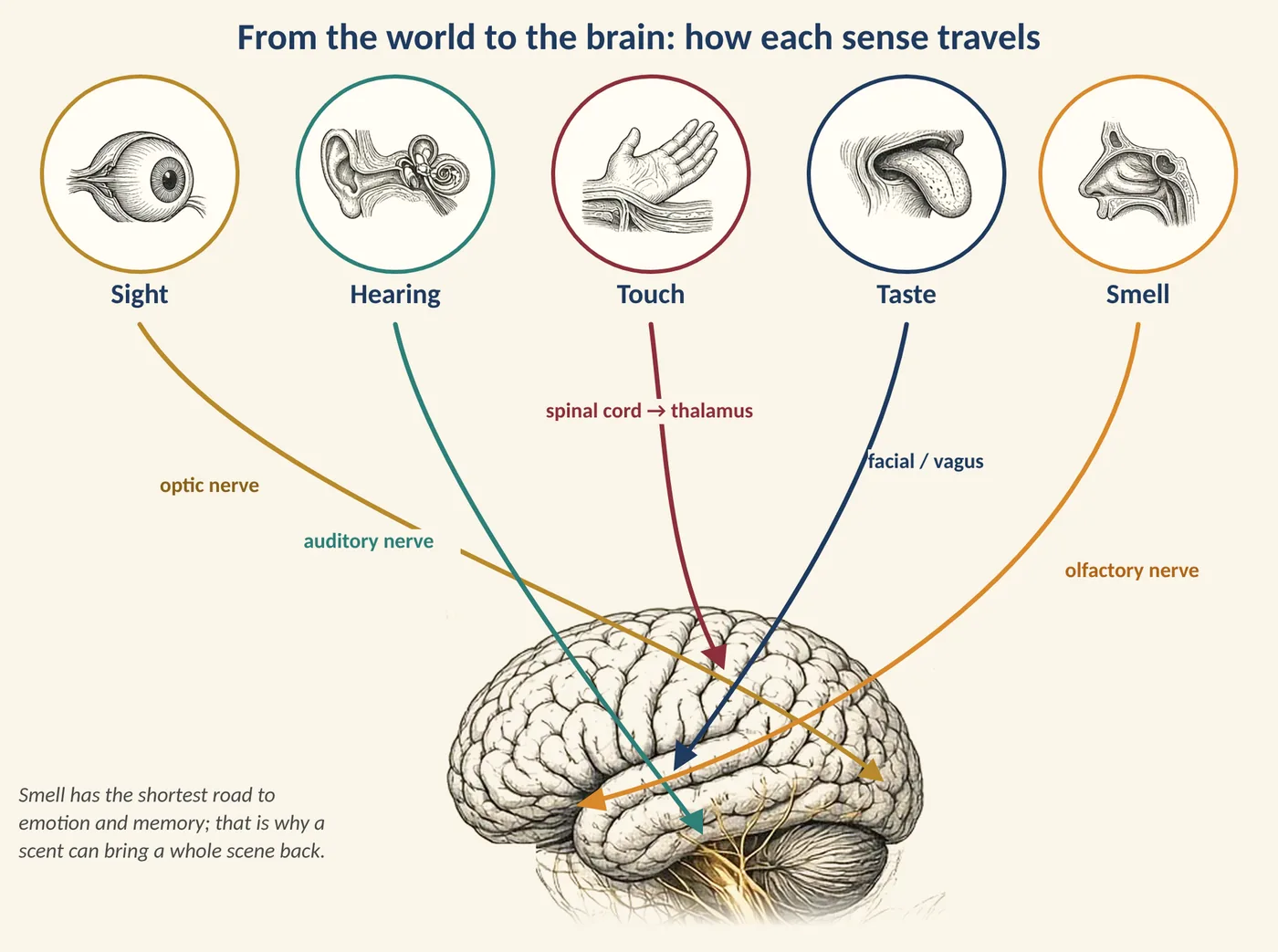
Figure 19.1 How each sense travels from the world to the brain.
Each sense turns something from the world into nerve signals, and the brain builds a picture from them. Sight: light enters the eye and the signal travels to the back of the brain. Hearing: sound reaches the inner ear and travels to the side of the brain. Touch: pressure on the skin travels to the top of the brain. Taste and smell: chemicals reach the tongue and nose, and smell links straight to the brain's emotion centre. We also sense our body's position, our balance, and inner signals such as hunger.
19.2 Sight (vision)
How it works
-
Light enters the eye through the cornea and pupil.
-
The lens focuses light onto the retina at the back of the eye.
-
Photoreceptors activate: rods detect light and dark and work in low light; cones detect colour (red, green, blue) and work in bright light.
-
Retinal cells convert light to electrical signals.
-
The optic nerve carries signals to the brain.
-
Visual cortex (occipital lobe) processes the information into images.
Key structures: cornea, pupil, lens, retina, optic nerve; occipital lobe.
Mental health connection
-
Vision loss can lead to depression, anxiety, isolation.
-
Seasonal changes in light affect mood (Seasonal Affective Disorder).
-
Visual hallucinations can occur in certain psychiatric conditions.
-
Eye contact and facial recognition are important for social connection.
19.3 Hearing (auditory)
How it works
-
Sound waves enter the outer ear (pinna and ear canal).
-
The eardrum vibrates.
-
Middle-ear bones amplify vibrations (malleus, incus, stapes).
-
The inner ear (cochlea) converts vibrations to neural signals.
-
Hair cells in the cochlea detect different frequencies.
-
The auditory nerve carries signals to the brain.
-
Auditory cortex (temporal lobe) processes sound.
Key structures: outer ear, eardrum, middle-ear bones, cochlea; auditory nerve; temporal lobe.
Mental health connection
-
Hearing loss is linked to social isolation, depression, and cognitive decline.
-
Auditory hallucinations occur in schizophrenia and other psychotic disorders.
-
Music therapy can improve mood and reduce anxiety.
-
Tinnitus (ringing in the ears) is associated with anxiety and depression.
19.4 Smell (olfactory)
How it works
-
Odor molecules enter the nose during breathing.
-
Olfactory receptors detect specific chemical compounds.
-
The olfactory bulb processes initial information.
-
Signals travel directly to the limbic system (amygdala, hippocampus).
-
Orbitofrontal cortex identifies and interprets smells.
Key structures: olfactory epithelium, olfactory bulb, limbic system, orbitofrontal cortex.
Unique feature: smell is the only sense that bypasses the thalamus and goes directly to the limbic system (emotion and memory centre). This is why smells can trigger powerful emotional memories instantly.
Mental health connection
-
Loss of smell (anosmia) is linked to depression.
-
Smell disturbances occur in schizophrenia, depression, and Alzheimer's.
-
Aromatherapy can reduce anxiety and improve mood.
-
Traumatic memories are often triggered by specific smells.
Clinic note. If a smell means last year's fire, work with a trauma-informed helper. Do not force the soap.
19.5 Taste (gustatory)
How it works
-
Food chemicals dissolve in saliva.
-
Taste buds detect five basic tastes: sweet, sour, salty, bitter, umami (savory).
-
Taste receptor cells send signals via cranial nerves.
-
Signals travel to the brainstem, then the thalamus.
-
Insula and frontal operculum process taste information.
Key structures: taste buds; cranial nerves (facial, glossopharyngeal, vagus); insula; frontal operculum.
Mental health connection
-
Taste changes are common in depression (food seems tasteless).
-
Eating disorders involve altered taste perception and reward processing.
-
Medications can cause taste disturbances affecting nutrition.
-
Comfort foods activate reward pathways (dopamine release).
19.6 Touch (somatosensory)
How it works
-
Sensory receptors in skin detect pressure, vibration, temperature, and pain. Different receptors for different sensations.
-
Signals travel via peripheral nerves to the spinal cord.
-
The spinal cord sends signals to the brainstem and thalamus.
-
Somatosensory cortex (parietal lobe) processes touch.
-
The brain creates a map of body sensations (homunculus).
Key structures: skin receptors, peripheral nerves, spinal cord; thalamus; somatosensory cortex.
Mental health connection
-
Touch deprivation is linked to anxiety, depression, and developmental issues.
-
Self-harm involves altered pain perception — this is a reason to seek care, not a method.
-
Mindfulness practices use body awareness and touch.
-
Therapeutic touch can reduce stress and anxiety.
-
Chronic pain is strongly associated with depression and anxiety.
19.7 Sensory integration
The brain does not process senses in isolation. Multisensory integration combines information from multiple senses.
-
Example: eating involves taste, smell, sight, touch (texture), and even sound (crunch).
-
Brain regions: superior colliculus and association cortices integrate sensory information.
-
Mental health: sensory processing issues in autism, schizophrenia, PTSD.
In brief: the Indic map pairs space with hearing, air with touch, fire with sight, water with taste, earth with smell. Combinations (fire + air as racing thought) are a sensory diet language, not a diagnosis.
19.8 A short clinic story
Two years after surviving a terrifying kitchen fire, forty-one-year-old Leela realised something strange was happening to her nervous system. Whenever she encountered the smell of a very specific brand of dish soap, her heart would instantly race, her chest would tighten, and she would be hit by an overwhelming wave of panic.
Because a bottle of soap is not actually dangerous, Leela felt deeply embarrassed. She kept her reaction a secret, harshly criticising herself and believing she was just being "dramatic" or weak for letting a simple household smell ruin her evening.
Eventually, the stress led her to a counsellor. The counsellor immediately removed Leela's shame by explaining a fascinating piece of human biology: the olfactory-limbic shortcut.
The counsellor explained that unlike our other senses, the human nose is wired directly into the brain’s survival and emotion centre (the limbic system). It completely bypasses the logical, thinking part of the brain. Because that specific soap was sitting next to the sink during the fire, her brain had linked the smell to a life-threatening event. When she smelled it two years later, her brain was not thinking; it was instantly sounding the survival alarm. She was not being dramatic—her nervous system was working exactly as it was designed to.
The treatment plan was gentle and trauma informed. The counsellor did not aggressively force her to smell the soap to "get over it." Instead, they worked on building a strong foundation. They focused on restoring her sleep so her nervous system wasn't so fragile. They taught her simple, grounding physical touches—like placing a firm hand over her own chest and breathing slowly—to physically signal to her body that she was safe in the present moment.
The Core Lesson
Therapy did not magically erase her memory, and it did not completely delete the brain's association. Even today, if Leela catches a whiff of that specific soap, the smell still arrives, and she might feel a brief spike of adrenaline. But the profound difference is that the panic no longer hijacks her brain or ruins her whole evening. Because she understands exactly what her brain is doing and has the tools to ground herself, she simply takes a breath, puts her hand on her chest, and moves on with her life.
19.9 One companion verse
Sanskrit Text:
श्रोत्रं चक्षुः स्पर्शनं च रसनं घ्राणमेव च ।
अधिष्ठाय मनश्चायं विषयानुपसेवते ॥
Pronunciation:
srotram caksuh sparsanam ca rasanam ghranam eva ca |
adhisthaya manas cayam visayan upasevate ||
Translation:
Presiding over ear, eye, touch, taste and smell, and over the mind, the person enjoys the objects.
Practical Meaning for Daily Health:
Thousands of years ago, this verse outlined the absolute foundation of human psychology: every single thing we experience in a day is filtered through our five physical senses and processed by our mind (manas). Your entire week is lived through this sensory network.
When you feel mentally overwhelmed, modern psychology teaches you to manage this exact system in two practical ways. First, change the input when you can. If your nervous system is exhausted, turn off the loud television, walk away from the stressful environment, or remove a triggering smell (just as Leela learned in the previous story). Second, change the interpretation when you must. When you cannot change the stressful environment around you, use psychological tools (like CBT) to change the story your mind is telling you about it.
But there is a clear limit. Managing what your senses take in, and how you think, is good daily care, but it cannot heal a badly injured nervous system. Deep breathing and a positive mindset do not replace a clinic for severe PTSD, or medicine for psychosis.
Reference — Bhagavad Gita 15.9
Reflection activity
-
Close your eyes and identify 5 different sounds around you.
-
Notice your breath — the sensation of air moving in and out.
-
Recall a smell that triggers a strong memory — notice the emotions.
-
Pay attention to textures you are touching right now.
-
Observe how senses work together in daily activities.