What Is Mental Health?
What mental health is, and how to notice it: Good mental health does not mean always happy. It means being able to handle normal stress, work or study, make decisions, care for oneself, and form meaningful relationships even when life is difficult.

1.1 Simple meaning of mental health
Mental health is about how we think, feel, behave, and relate to others in daily life. It includes our inner world (thoughts, emotions, memories, hopes, fears) and our outer world (family, friends, school, work, community). Good mental health does not mean “always happy.” It means being able to handle normal stress, work or study, make decisions, care for oneself, and form meaningful relationships, even when life is difficult.
Mental health exists on a continuum: at one end is strong wellbeing and resilience; at the other end are serious mental disorders that need professional care. Many people move along this continuum during their life depending on circumstances, support, and health.
A second definition
Mental health is simply your everyday inner weather. It is not just about whether you have a diagnosed illness; it is about how you handle a bad Tuesday, how you bounce back from a stressful argument, and how you find the energy to care for your loved ones. We all have mental health, just like we all have physical health. When we talk about having "good" mental health, we do not mean walking around with a permanent, forced smile. We mean having enough balance and support to keep moving forward, even when life feels heavy.
Key points
-
Mental health exists on a continuum from strong wellbeing to serious disorders.
-
Everyone has mental health, just like physical health.
-
Mental health can improve or worsen over time.
-
Support, treatment and lifestyle changes can help.
-
Early intervention leads to better outcomes.
A tighter clinical definition
The World Health Organization describes mental health as a state of wellbeing in which a person realises their own abilities, can cope with the normal stresses of life, can work productively, and can contribute to their community. Doctors use two official guidebooks (ICD-11 and DSM-5-TR) to name specific illnesses. An illness is named when problems with thinking, feelings or behaviour are serious enough to cause distress or get in the way of daily life.
Example. A student who weeps the night before an exam, sleeps, sits the paper, and recovers is having a hard week. A student who cannot leave bed for three weeks, misses every paper, and believes nothing will ever change is in a different place on the same continuum. The first needs support. The second needs assessment.
Sanskrit Text:
सुखदुःखे समे कृत्वा लाभालाभौ जयाजयौ ।
ततो युद्धाय युज्यस्व नैवं पापमवाप्स्यसि ॥
Pronunciation:
sukha-duhkhe same kritva labhalabhau jayajayau |
tato yuddhaya yujyasva naivam papam avapsyasi ||
Translation: Holding pleasure and pain, gain and loss, victory and defeat as equal, prepare for the work in front of you; thus, you will not incur wrong.
Practical Meaning for Daily Health: True well-being is not faking happiness. It is finding enough inner stillness to take the very next step in your day, regardless of whether you are facing a small victory or a deep disappointment.
Reference — Bhagavad Gita 2.38 (Mahabharata, Bhishma Parva)
Sanskrit Text:
समदोषः समाग्निश्च समधातुमलक्रियः ।
प्रसन्नात्मेन्द्रियमनाः स्वस्थ इत्यभिधीयते ॥
Pronunciation:
sama-doshah samagnish ca sama-dhatu-mala-kriyah |
prasannatmendriya-manah svastha ity abhidhiyate ||
Translation: One whose fundamental energies (doshas) and digestive fire are balanced, whose tissues and eliminations work well, and whose self, senses and mind are clear and content, is called healthy (svastha).
Practical Meaning for Daily Health: Ayurveda teaches us that physical health and mental clarity are completely intertwined. You cannot separate the mind from the body. Being healthy does not just mean your physical systems are working well; it means your mind feels bright, settled, and clear, rather than weighed down or crushed.
Reference — Sushruta Samhita, Sutrasthana 15.41 (15.48 in some printed editions)
Ayurveda’s old definition of a healthy person is larger than mood: it requires balanced physical energies and digestion, plus a mind, senses, and self that are clear, not crushed. The standing verse in the Sushruta Samhita states that a person is healthy when their fundamental energies and digestion are balanced, their body tissues and waste removal work well, and their soul, senses, and mind are clear and content. That is an ancient Indian cousin of the World Health Organization sentence: the inner instruments still work, even when life is difficult.
1.2 Mental health versus mental disorder
Mental health refers to overall psychological and emotional wellbeing. A person can have a diagnosed mental disorder and still work on improving their mental health through treatment, support, and self-care.
Mental disorder (or mental illness) is a clinically significant disturbance in thinking, emotion regulation, or behaviour, usually causing distress or problems in daily functioning. Examples include depression, anxiety disorders, bipolar disorder, schizophrenia, eating disorders, and others.
Having a mental disorder is not a personal failure. Like diabetes or heart disease, mental disorders are health conditions that can be understood, treated, and managed with proper care.
Diagnosis is a map, not a mirror
Psychiatric classification (DSM: Diagnostic and Statistical Manual of Mental Disorders, ICD: International Classification of Diseases) is useful, political, and historically changing. A name can open care. It can also stigmatise. If you are matching yourself to a list at 2 a.m., stop and talk to a licensed clinician. Overlap is the rule. Grief can look like depression and still be grief — until it is both.
Sanskrit Text:
उद्धरेदात्मनात्मानं नात्मानमवसादयेत् ।
आत्मैव ह्यात्मनो बन्धुरात्मैव रिपुरात्मनः ॥
Pronunciation:
uddhared atmanatmanam natmanam avasadayet |
atmaiva hy atmano bandhur atmaiva ripur atmanah ||
Translation: Lift the self by the self; do not let the self-sink. The self is the friend of the self, and the self is the enemy of the self.
Practical Meaning for Daily Health: Struggling with your mental health is never a personal failure. Just as you wouldn't blame yourself for having a medical condition like diabetes, you shouldn't let your inner voice blame you for an illness of the mind. Being a true "friend" to yourself means taking compassionate responsibility for your well-being—whether that means getting enough rest, leaning on a support system, or letting a doctor help you treat it with proper care.
Reference — Bhagavad Gita 6.5
Example: Two people hear “you have depression.” One hears a door to medicine and sick leave. The other hears a life sentence. The diagnosis did not change. The story around it did. Good care treats the condition and the story.
Religious example: In the Mahabharata, even a prince on a battlefield is allowed to tremble and drop his bow. The text does not call Arjuna “mad” or “weak.” It calls the moment a crisis of seeing, then gives him a conversation. Illness is not a moral failure. Collapse can be the start of teaching.
1.3 Why mental health matters
Mental health affects:
-
Learning, memory, concentration, and decision-making.
-
Work performance and income.
-
Relationships with family, friends, and colleagues.
-
Physical health: sleep, appetite, pain, immunity, heart health.
-
Ability to cope with stress, loss, and change.
-
Risk of substance use, accidents, and self-harm.
Poor mental health can reduce quality of life and increase the risk of physical illness. Good mental health supports resilience, creativity, and social connection.
The body keeps the same books
Your mind and body are completely connected. Long-lasting anxiety and depression increase the chances of heart disease, diabetes problems, and slower healing after surgery. At the same time, ongoing physical pain increases the risk of depression. These health issues are never just "all in your head" or "all in your body". Your immune system, your sleep patterns, and the chemicals that cause inflammation affect both your physical and mental health at the same time. Because of this, treating only the mind or only the body is incomplete medical care.
Sanskrit Text:
नात्यश्नतस्तु योगोऽस्ति न चैकान्तमनश्नतः ।
न चातिस्वप्नशीलस्य जाग्रतो नैव चार्जुन ॥
युक्ताहारविहारस्य युक्तचेष्टस्य कर्मसु ।
युक्तस्वप्नावबोधस्य योगो भवति दुःखहा ॥
Pronunciation:
natyashnatas tu yogo ’sti na caikantam anashnatah |
na catisvapnashilasya jagrato naiva carjuna ||
yuktahara-viharasya yukta-ceshtasya karmasu |
yukta-svapnavabodhasya yogo bhavati duhkhaha ||
Translation: Yoga is not for one who overeats or who starves, nor for one who sleeps too much or never sleeps. For the one whose food, movement, work, sleep and waking are measured, yoga becomes the destroyer of sorrow.
Practical Meaning for Daily Health: This verse shows exactly why physical habits are the foundation of mental health. What you do with your physical body—how much you eat, sleep, and move—directly controls how your mind feels. You cannot achieve mental peace if you neglect your basic physical needs. A steady, balanced daily routine is your strongest defense against stress and emotional sorrow.
Reference — Bhagavad Gita 6.16–17
Household example. A man who calls every chest tightness “only tension” and never checks blood pressure is not being more spiritual. He is skipping both dharma (duty) to the body and ordinary medicine. Seva (caring service) begins at home with the body you were given.
1.4 Common myths and stigma
| Myth | Fact |
|---|---|
| Mental health problems are just weakness or laziness. | Mental disorders involve complex interactions of biology, psychology, and environment. They are not caused by simple laziness or lack of willpower. |
| Only “mad” people have mental health issues. | Anxiety and depression are very widespread and can affect anyone. Most people with mental disorders do not look “obviously ill.” |
| Medicines for mental health are always dangerous or addictive. | Many psychiatric medicines are safe and effective when prescribed and monitored. Some have side effects or dependence risk — which is why supervision is essential. |
| Talking about problems makes them worse. | Sharing with trusted people and professionals often reduces burden and helps find solutions. Silence and isolation can worsen distress. |
| Mental illness is rare. | About 1 in 8 people in the world live with a mental health condition at any one time, and about 1 in 4 will have one at some point in their lives. |
| People with mental illness are dangerous. | Most people with mental illness are not violent and are more likely to harm themselves than others. |
| Mental illness is a personal weakness. | Mental illnesses are medical conditions with biological, psychological and social causes. |
| You can just “snap out of it.” | Mental health conditions require proper treatment, support, and time to heal. |
| Only adults get mental illness. | Conditions can affect people of all ages, including children and teenagers. |
Stigma — negative attitudes and discrimination — often stops people from seeking help. Education, respectful language, and personal stories can reduce stigma and encourage early support.
Sanskrit Text:
विद्याविनयसंपन्ने ब्राह्मणे गवि हस्तिनि ।
शुनि चैव श्वपाके च पण्डिताः समदर्शिनः ॥
Pronunciation:
vidya-vinaya-sampanne brahmane gavi hastini |
shuni caiva shva-pake ca panditah sama-darshinah ||
Translation: The wise see the same in a learned and humble brahmana, a cow, an elephant, a dog, and one who cooks a dog.
Practical Meaning for Daily Health: A truly wise person looks at everyone with equal respect and compassion. Someone who is struggling with a mental health condition or receiving treatment is never a lesser person. Stigma—judging someone for getting help—is the exact opposite of this wisdom. The fear of "what will people say" should never be more important than protecting a human life and getting the care you need.
Reference — Bhagavad Gita 5.18
Religious example. When a family hides a daughter’s panic attacks so that a marriage proposal will not “break,” they are protecting a name and risking a person. In that family, real duty (dharma) means caring openly, not hiding the illness.
How stigma sounds in an Indian household
“Log kya kahenge” (What will people say). “Shaadi kaise hogi” (How will they get married). “Pagal ho gaya hai” (He has gone mad). “Bas tension hai, ghum ke aa” (It is just stress, go take a walk). These sentences are not small. They delay the first appointment. They teach a child that pain must be hidden to keep the family’s name clean. Respectful language is a public-health tool: say “he lives with bipolar disorder,” not “he is bipolar and finished.” Say “she is in treatment,” not “she has gone mad.”
1.5 Signs of good mental health
No one feels perfect all the time. However, here are some common signs of good mental health:
Handling your feelings: You can feel sad, angry, or stressed without letting those emotions completely take over your life.
Managing daily tasks: You are able to handle your normal routines—like work, study, or household chores—most days.
Connecting with others: You can build and keep at least a few supportive relationships.
Adapting to change: You can adjust to unexpected shifts in life and figure out solutions to everyday problems.
Basic self-care: You take care of your basic needs, like eating, sleeping, staying clean, and asking for help when you need it.
Finding purpose: You feel connected to something meaningful, whether it is your family, your work, your faith, or nature.
These signs can vary by culture, age, and life situation.
In more depth
Remember, good mental health looks different depending on the person. A quiet farmer who works the fields and sits peacefully with neighbours at the end of the day might have excellent mental health. Meanwhile, a highly talkative, busy executive who never stops performing might be silently struggling. Being loud or outgoing does not automatically mean you are healthy.
You also have to look at the person's stage in life. For children, good mental health shows up in how they play and make friends. For older adults, it can be as simple as looking forward to tomorrow's cup of tea.
Sanskrit Text:
दुःखेष्वनुद्विग्नमनाः सुखेषु विगतस्पृहः ।
वीतरागभयक्रोधः स्थितधीर्मुनिरुच्यते ॥
Pronunciation:
duhkhesv anudvigna-manah sukhesu vigata-sprhah |
vita-raga-bhaya-krodhah sthita-dhir munir ucyate ||
Translation: The one whose mind is not overthrown in sorrow, who does not run after pleasure, who is free from grasping, fear and anger — that one is called a person of steady wisdom.
Practical Meaning for Daily Health: This verse gives us a lifelong goal to work toward, not a test you have to pass perfectly today. Being mentally healthy does not mean you never feel sad, angry, or afraid. Sorrow and pain are normal parts of life. True mental health is simply about feeling those difficult emotions without letting them permanently break or control you.
Reference — Bhagavad Gita 2.56
1.6 Early warning signs of mental distress
Early signs that mental health may be under strain include:
-
Persistent sadness, emptiness, or irritability.
-
Loss of interest in usual activities.
-
Excessive worry, fear, or panic.
-
Major changes in sleep (too much or too little).
-
Major changes in appetite or weight.
-
Constant fatigue or loss of energy.
-
Difficulty concentrating or making decisions.
-
Withdrawing from family and friends.
-
Increased use of alcohol, tobacco, or other substances.
-
Frequent physical complaints (headache, stomach pain, body pain) without clear medical cause.
-
Thoughts of hopelessness, guilt, or worthlessness.
-
Thoughts of self-harm or that life is not worth living.
If several of these signs last for weeks and affect daily life, talk to a trusted person and consider professional support.
An ancient Indian example of these warning signs is in the story of King Dasharatha, though it is not meant as a medical diagnosis. After his son Rama's exile, Dasharatha cannot rest, cannot eat in peace, and dies of grief. This is recorded in the Valmiki Ramayana, Ayodhya Kanda, chapters 40–42 and 64 (his death is in chapter 64 in many southern versions; the numbering shifts by version, and northern and critical editions place the death later in the Ayodhya Kanda).
The Ramayana is not a psychiatry manual. It is honest that grief can physically take the body. When sleep, food, speech, and hope all leave together for weeks, the ancient text and the modern clinic agree on one thing: do not call it stubbornness.
1.7 Levels of impact: mild, moderate, severe, emergency
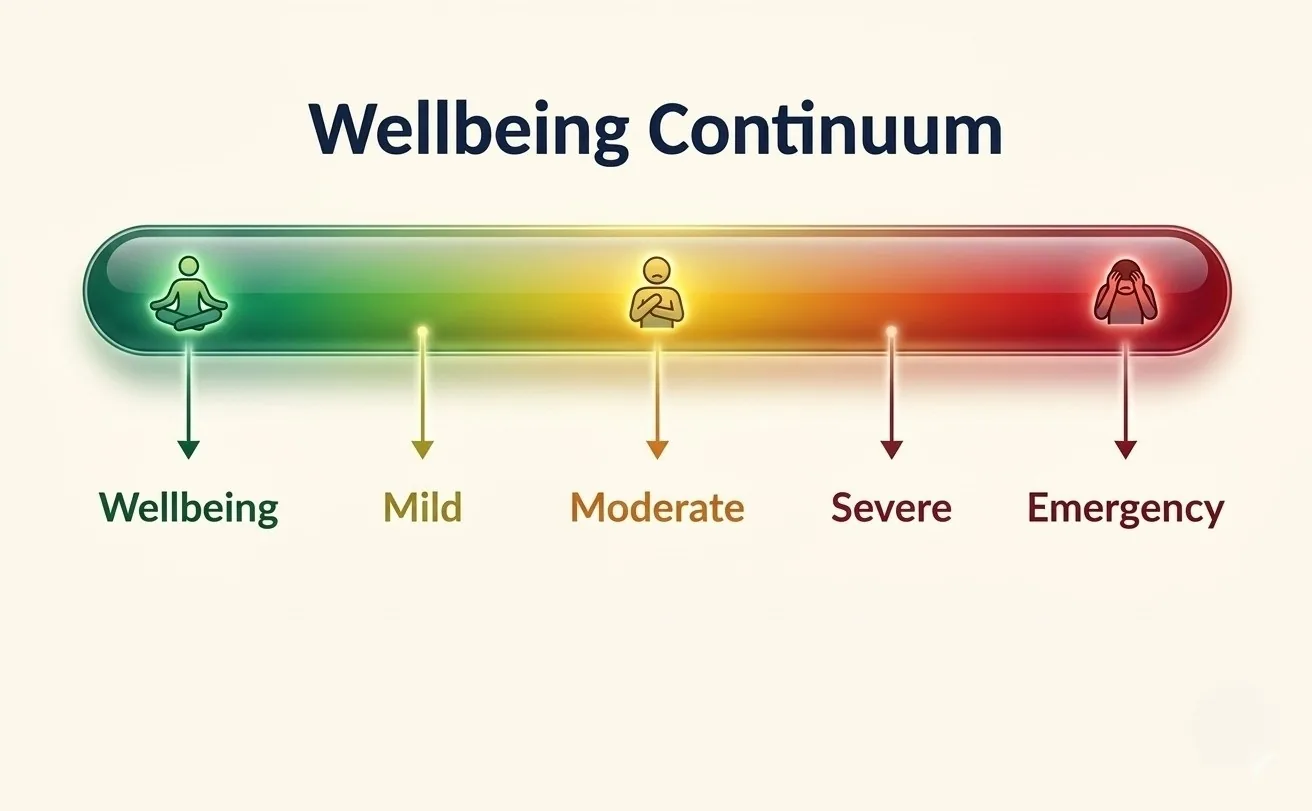
This book’s four levels drawn as a continuum. People move. A level describes how someone is today. It is not a permanent label.
| Level | What it looks like | What may help |
|---|---|---|
| Mild | Symptoms present; most daily tasks still possible | Family, friends, lifestyle changes, or brief counselling |
| Moderate | Work, study, relationships, or self-care clearly affected | Assessment by counsellor, psychologist, or psychiatrist; therapy; sometimes medicines |
| Severe | Major difficulty functioning; possible inability to work or study; strong distress; possible risk behaviours | Prompt psychiatric evaluation and structured treatment; family support; hospital-based care |
| Emergency | Immediate risk of self-harm, suicide, harm to others, or inability to meet basic needs (not eating, not drinking, not sleeping for days, severe confusion) | Urgent medical and psychiatric help, emergency services, or hospital care |
A worked example of the same person
Mental health struggles often deepen over time, and the care provided must match the level of the crisis.
Consider how this progression looks in daily life:
Mild: In January, Kavya is exhausted after a big project, but she still cooks and jokes with her family.
Moderate: By March, she misses two work deadlines and stops returning phone calls.
Severe: In May, she cannot get out of bed, and her mother finds her meals left uneaten.
Emergency: One night, she says she does not want to be alive tomorrow.
Kavya did not suddenly become a different person. The level of her condition simply deepened, and the help she receives must scale up to match it.
Ancient history as a map for modern care
We can see this exact same continuum of crisis in the historical battlefield of Kurukshetra. When Arjuna faces his breakdown, it also escalates through levels until it becomes a full emergency:
Mild to Moderate: Arjuna asks to place his chariot between the two armies to observe. He is highly stressed and conflicted, but still functioning and communicating his plans.
Severe: As he looks at his relatives and teachers, deep sorrow and confusion completely take over his mind.
Emergency: His body physically shuts down from the mental overload. He experiences trembling, his mouth goes dry, and he drops his weapon. This is recorded in the Bhagavad Gita (1.28–1.30):
सीदन्ति मम गात्राणि मुखं च परिशुष्यति ।
गाण्डीवं स्रंसते हस्तात् ॥
(Sidanti mama gatrani, mukham cha parishushyati, gandivam sramsate hastat)
Meaning: My limbs fail, my mouth is dry, the bow slips from my hand.
Notice how Krishna responds to this emergency level. He does not mock Arjuna or tell him to simply "snap out of it." The actual teaching and philosophical framework only begin later, starting from chapter 2.11, once the immediate physical and emotional shock is acknowledged.
This sequence shows the right duty (dharma) during a mental crisis: offer your supportive presence first, give advice second, and never use mockery.
If someone today is facing a modern emergency—such as a risk of suicide or going four days without food or sleep—the first "Krishna" they need in the room might be an emergency doctor. The Bhagavad Gita can go with you into the hospital ward for strength and guidance, but it should never keep you from going to the ward in the first place.
1.8 Factors that influence mental health
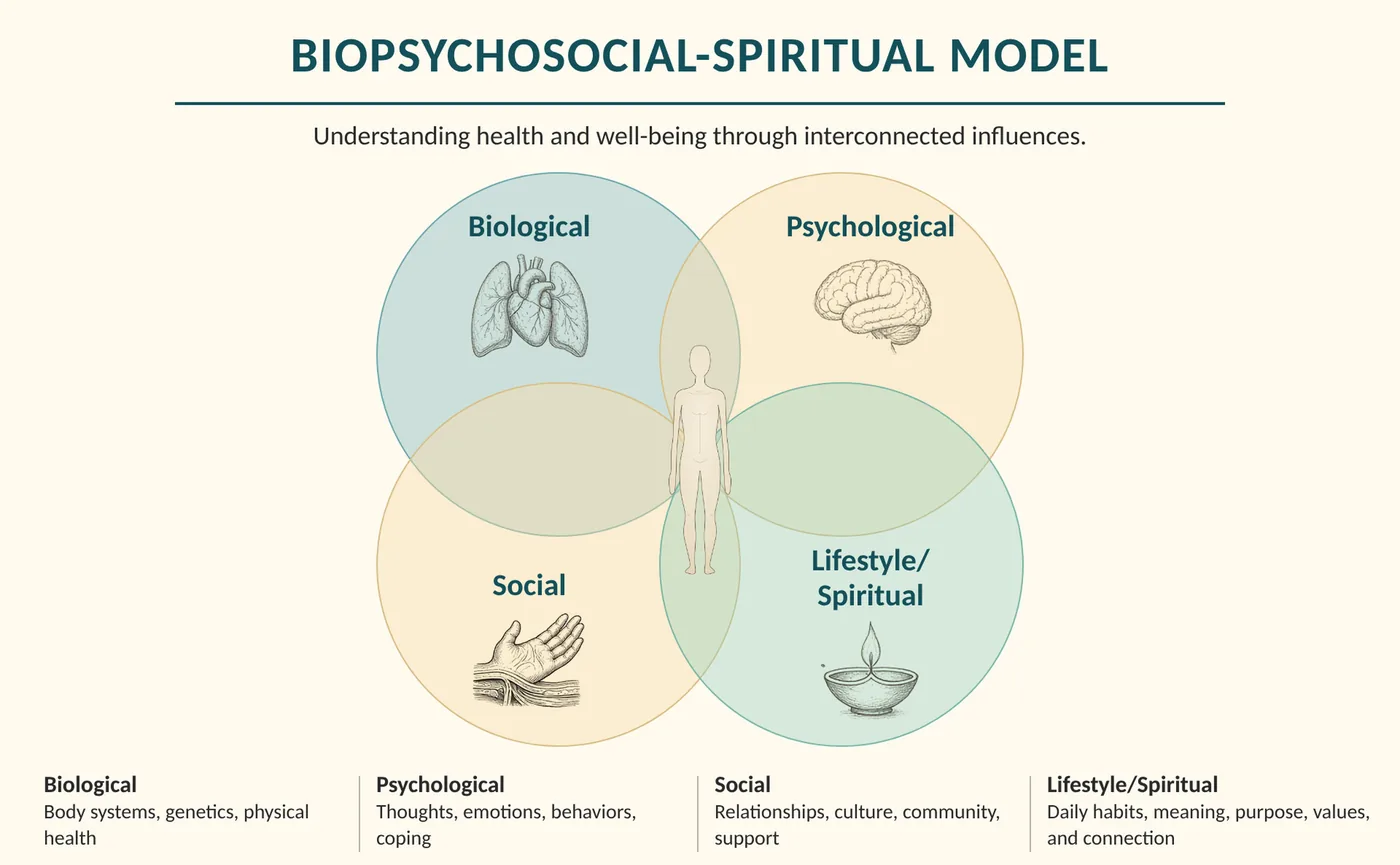
The four factor groups — biological, psychological, social-environmental, lifestyle — drawn so they cannot be separated.
Figure 1.1 The biopsychosocial-spiritual model: body, mind, relationships and daily life work together.
| Factor group | Your list | More detail |
|---|---|---|
| Biological | Genes, brain structure, brain chemicals, hormones, physical illnesses, injuries, substance use | Also thyroid, anaemia, B12, sleep debt, inflammation, head injury, some medicines such as steroids |
| Psychological | Personality, coping styles, thinking patterns, past trauma, self-esteem, beliefs | Temperament, attachment style, cognitive distortions (unhelpful thinking habits), meaning |
| Social and environmental | Family, friendships, school or work, poverty, discrimination, violence, displacement, disasters, war | Caste and gender violence, migration, social media, overcrowding, unemployment |
| Lifestyle | Sleep, food, physical activity, routine, screen time, substance use, spiritual or community practices | Daylight, caffeine timing, isolation versus Satsang (Religious gathering for Wisdom) — practices help; they do not replace acute care |
Mental health is shaped by many factors. No single factor alone decides it. It is usually a combination.
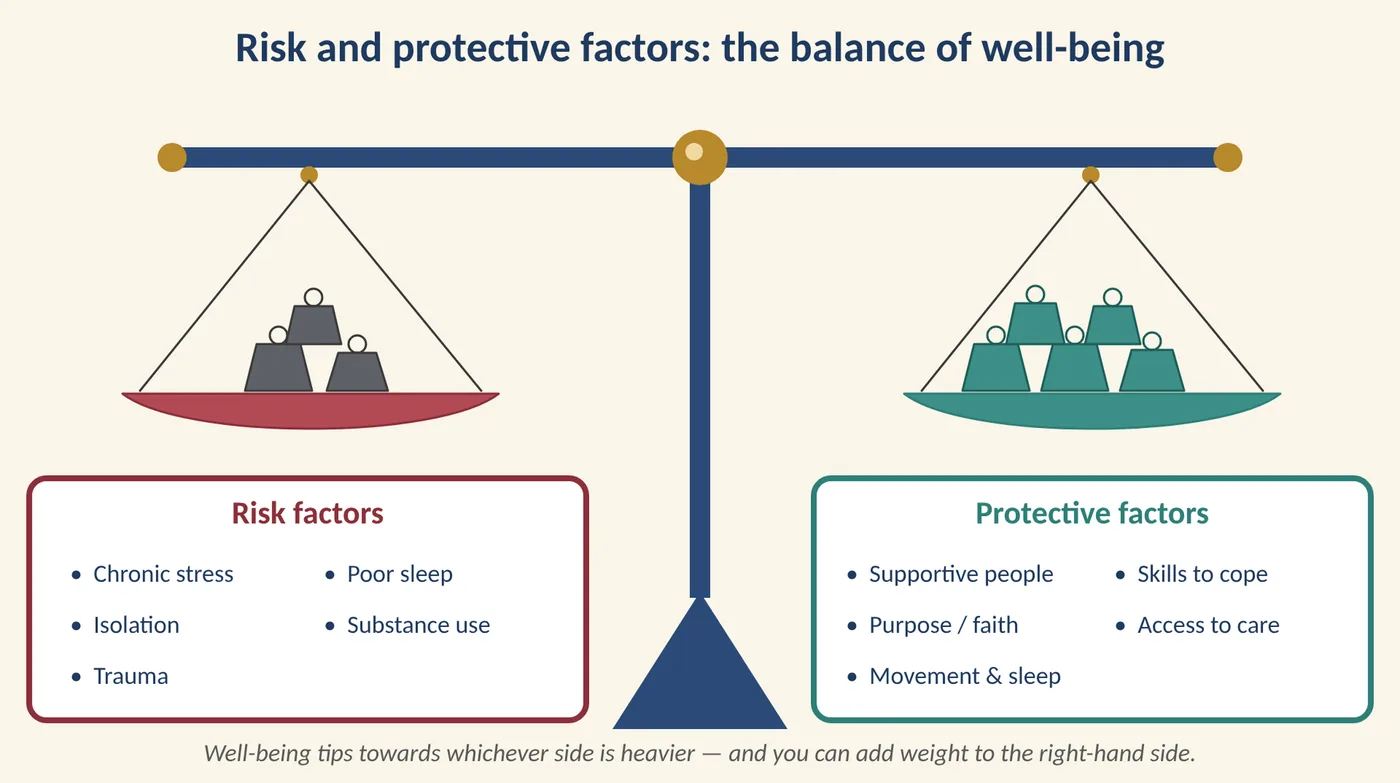
Figure 1.2 Risk and protective factors: well-being tips towards the heavier side.
1.9 Mental health across life stages
In childhood, early problems in mental health may show as excessive fear, behaviour change, play that stalls, friendship trouble, aggression, withdrawal, or developmental delays. Childhood mental health affects learning, behaviour, play, friendships, and family life.
Adolescents (Teenagers)
The teenage years bring rapid physical and emotional changes. During this time, peer pressure, intense school stress, big questions about who they are, and the constant noise of social media can deeply affect a young person's mental health.
Because so much is shifting at once, adolescence is a critical window for action. It is the absolute best time to step in with early support and prevent small struggles from turning into severe, lifelong crises.
Adults
In adulthood, work stress, relationships, parenting, financial pressures and health issues play a major role.
Older Adults
Loneliness, chronic illness, loss of loved ones, cognitive decline, and dependence can affect mental health. Dementia and depression are important concerns.
Each stage needs age-appropriate understanding and support.
Hindu social teaching already thinks in stages, The Four Ashramas (Stages of Life) Ancient Indian philosophy traditionally divides a human lifespan into four distinct phases, each lasting about 25 years. Every stage has its own unique goals and pressures.
1. Brahmacharya (The Student Stage)
Age: Childhood to roughly 25 years old.
Meaning: A time of focused learning, discipline, and building a foundation for life.
Duties: The main job here is education. A student is expected to build their character, learn life skills, and practice self-discipline. They are meant to be free from the heavy burdens of family and financial stress so they can focus entirely on their personal growth.
2. Grihastha (The Householder Stage)
Age: Roughly 25 to 50 years old.
Meaning: The active years of family life, building a career, and engaging with the world.
Duties: This is considered the engine of society. The duties include working, earning a living honestly, getting married, raising children, and taking care of both the younger (students) and older (retired) generations. The mental and financial pressures here are the highest, as everyone else depends on the householder.
3. Vanaprastha (The Retiree or "Forest-Dweller" Stage)
Age: Roughly 50 to 75 years old.
Meaning: A gradual stepping back from heavy worldly ambitions and family control.
Duties: It is time to hand over the heavy responsibilities and decision-making to the next generation. The focus shifts away from making money and running the household toward community service, mentoring, and spiritual reading. You act as an advisor, but you let the younger householders lead.
4. Sannyasa (The Renunciant Stage)
Age: 75 years and beyond.
Meaning: Complete withdrawal from material attachments and social expectations.
Duties: Letting go of property, complex relationships, and the need for societal status. The only focus is inner peace, spiritual freedom, and accepting the final phase of life with grace and detachment.
Why this matters for mental health: Understanding these stages helps us see that psychological stress is normal but changes over time. You cannot expect a teenager (student) to have the emotional stability of a 60-year-old (retiree), and you should not judge a 40-year-old (householder) for feeling completely overwhelmed by daily survival. Care and expectations must match the stage.
One picture per age
A seven-year-old with stomach-aches every Monday may be anxious, not “dramatic.” A sixteen-year-old whose grades collapse and who lives online at 3 a.m. may be depressed, not “lazy.” A forty-year-old who drinks to sleep may be treating insomnia and shame at once. A seventy-year-old who stops eating after a spouse’s death may have grief and depression together. Same continuum. Different doors.
1.10 Culture, faith and mental health
Culture and faith deeply shape how we make sense of our emotions, our suffering, and how we heal. In ancient Indian traditions, the inner world is broken down into very specific parts to help us understand ourselves better:
Manas (Mind): The everyday mind and its changing moods or thoughts.
Buddhi (Intellect): The deeper intellect and decision-making ability.
Ahamkara (Ego): The ego, or our sense of "I" and personal identity.
Atman (Soul): The core soul or true self.
Sanskrit Text:
मन एव मनुष्याणां कारणं बन्धमोक्षयोः ।
बन्धाय विषयासक्तं मुक्त्यै निर्विषयं स्मृतम् ॥
Pronunciation:
mana eva manusyanam karanam bandha-moksayoh |
bandhaya visayasaktam muktyai nirvisayam smrtam ||
Translation: The mind alone is the cause of bondage and of freedom for human beings. Attached to objects it binds; free of objects it is remembered as liberation.
Practical Meaning for Daily Health: This verse offers deep spiritual meaning, but it is not a medical protocol. If a mind is suffering from a severe illness, reading a verse alone is not enough to heal it. Instead, this ancient wisdom is meant to walk side-by-side with modern medicine, professional therapy, proper sleep, and a supportive community. It gives you the "why" for healing, while medicine gives you the "how."
Reference — Amrtabindu Upanisad, verse 2 (Krsna-Yajurveda minor Upanisad)
Because of this deep connection between the mind and the spirit, traditional practices can be very helpful for everyday well-being, alongside medical care when it is needed. Things like prayer, meditation, chanting, seva (selfless service to others), satsang (gathering with a supportive community), and living an honest life bring immense comfort and stability to millions of people.
Sanskrit Text:
बुद्धियुक्तो जहातीह उभे सुकृतदुष्कृते ।
तस्माद्योगाय युज्यस्व योगः कर्मसु कौशलम् ॥
Pronunciation:
buddhi-yukto jahatiha ubhe sukrta-duskrte |
tasmat yogaya yujyasva yogah karmasu kausalam ||
Translation: The one joined to wisdom leaves behind both good and bad results here. Therefore, take up yoga. Yoga is skill in action
Practical Meaning for Daily Health: In a mental health crisis, the wise step may be to light a lamp for prayer and, on the same day, book an appointment at a clinic. Practices such as puja (ritual prayer), japa (repeating a mantra) and satsang (a supportive community) give real comfort alongside professional care. Wisdom is knowing how to use both.
Reference — Bhagavad Gita 2.50
Where spirituality meets the clinic However, there must be a clear boundary. Serious mental health conditions still require modern medical and psychological care. Spiritual practices are a wonderful, necessary part of the healing journey, but they should never replace professional, science-based medical treatment when a person is truly sick. You can pray for peace, but you must still see a doctor for an emergency.
Morning namaskar (Traditional Greeting) as a body-and-breath start;
a short Gita reading with an elder and understanding the meaning;
offering food before eating as a pause that slows the rush;
walking a temple courtyard as movement and daylight;
In modern psychology, there is a treatment for depression called "behavioural activation." It simply means helping a person get out of bed to do a structured, meaningful activity. By forcing the body to move and engage with the world, the mind slowly breaks out of its heavy, dark cycle.
Ancient Indian traditions have practiced this exact psychological tool for thousands of years under the name seva (selfless service).
When a person's mind is stuck in heavy exhaustion (tamas), one of the best ways to heal is to serve others without expecting any money, reward, or even a "thank you."
In the Hindu tradition, this looks like:
Annadana (Feeding others): Serving prasadam (blessed food) to hundreds of visitors at a local temple.
Temple maintenance: Waking up early to sweep the stone courtyard of a temple or seva in lunger, serving food in social gathering lunch, quietly sitting with others to string fresh flower garlands for the morning prayers.
Go-seva (Caring for animals): Feeding, brushing, and caring for cows at a local shelter.
Getting out of bed to serve food to strangers or wash temple floors forces the mind to shift. It completely breaks the cycle of isolation. You realise you are needed, you are moving your body, and you are contributing to your community. It is modern behavioural activation, built naturally into ancient daily devotion.
1.11 When to seek help
Seek professional help if:
-
Symptoms last more than two weeks and affect daily life.
-
Relationships, work, or studies are clearly suffering.
-
There is heavy reliance on alcohol, drugs, or other substances to cope.
-
There are thoughts of self-harm, suicide, or harming others.
-
Family or friends express serious concern.
-
The person feels stuck, hopeless, or unable to cope.
Help can come from: counsellors, clinical psychologists, psychiatrists, primary-care doctors, school counsellors, community health workers, and trusted elders or spiritual guides alongside professional care.
Sanskrit Text:
तद्विद्धि प्रणिपातेन परिप्रश्नेन सेवया ।
उपदेक्ष्यन्ति ते ज्ञानं ज्ञानिनस्तत्त्वदर्शिनः ॥
Pronunciation:
tad viddhi pranipatena pariprasnena sevaya |
upadeksyanti te jnanam jnaninas tattva-darsinah ||
Translation: Know that by approaching with respect, by questioning, and by service. Those who see reality will teach you that knowledge.
Practical Meaning for Daily Health: Healing and understanding require your active participation. Whether you are speaking to a spiritual guide, a therapist, or a medical doctor, you must approach the process with an open mind (respect), ask honest questions about your condition (inquiry), and be willing to do the practical work of recovery (seva or service). A wise counsellor or trained doctor (one who "sees reality") will guide you, but you must take the first step to ask for their help and actively engage in your own treatment.
Reference — Bhagavad Gita 4.34
More signs that it is time to seek help
-
Persistent sadness or anxiety lasting two or more weeks.
-
Difficulty functioning at work or school.
-
Relationship problems that do not improve.
-
Substance abuse or dependence.
-
Thoughts of self-harm or suicide.
-
Major life transitions causing distress.
-
Sleep or appetite changes.
-
Loss of interest in activities you used to enjoy.
1.12 The three parts of well-being
Researchers often describe well-being as having three connected parts.
-
Emotional well-being: how you feel. This includes your ability to experience joy, to calm yourself when upset, and to recover from disappointment.
-
Psychological well-being: how you think and see yourself. This includes self-respect, a sense of purpose, personal growth, and the feeling that you have some control over your life.
-
Social well-being: how you connect with others. This includes friendships, family bonds, a sense of belonging, and the ability to give and receive support.
These three parts influence each other. Someone who feels lonely (social) may begin to think badly of themselves (psychological) and feel low most days (emotional). In the same way, one small improvement, such as joining a walking group, can lift all three at once.
1.13 Risk factors and protective factors
Think of your mental health as a balance. On one side are things that add weight; on the other are things that give strength.
| Risk factors (add weight) | Protective factors (add strength) |
|---|---|
| Long-term stress or overwork | Supportive family and friends |
| Trauma, abuse, or neglect | Feeling safe and valued |
| Loneliness and isolation | Regular sleep and exercise |
| Alcohol or drug misuse | Skills for managing emotions |
| Serious or chronic illness | Hobbies and a sense of purpose |
| Money worries, unemployment | Access to help when needed |
| Family history of mental illness | Optimism and flexible thinking |
You cannot remove every risk, but you can often add protection. A big part of this book is about how.
TRY THIS: A ONE-MINUTE CHECK-IN
Once a day, pause and ask yourself three questions. First: “How is my body feeling?” Second: “What emotion is strongest right now?” Third: “What do I need in the next hour?” Write one word for each answer. After a week, look back at your notes. Patterns often appear that you did not notice before.
A one-minute check-in
1.14 Simple stories
Riya used to enjoy college and friends. Over three months, she began sleeping late, skipping meals, and missing classes. She felt tired, irritable, and “empty.” She told herself, “I am just lazy.” Her marks dropped. Friends said, “You have changed.”
At first, Riya avoided talking. Then one friend listened without judging and suggested she speak to the college counsellor. The counsellor explained that prolonged low mood, loss of interest, and sleep changes can be signs of depression, not laziness. With counselling, support from family, a better sleep routine, and later a psychiatrist’s advice, Riya slowly improved. She learned that asking for help was a sign of strength, not weakness.
This story shows how early recognition, support, and professional care can change the course of mental distress.
Uncle Sharma retired, lost two friends, sat facing a television he did not watch, ate less, and snapped at his wife. Relatives said he was getting old. His daughter booked a physician visit for sugar, thyroid, and sleep rather than arguing the English word depression. Labs were not dramatic. The physician named low mood as treatable. Uncle Sharma refused “psychology” and accepted “talking to the doctor about sleep.” Six weeks later he walked to the park. He never used the word depression. He used the word better. Use words the person can accept. If "depression" frightens them, talk about sleep or feeling better.
Leela’s mother believed that if the Tuesday fast was kept and Hanuman Chalisa recited, the daughter’s voices would leave. The voices stayed. Sleep left. An aunt said the sentence that saved the week: “We will do the Calisa in the auto on the way to the hospital. God is not waiting outside the gate.” The psychiatrist did not mock the fast. He said keep whatever gives her courage, add medicine, review in three days. Leela’s recovery was not a miracle that cancelled science, and not a science that cancelled the lamp. It was a house that refused the false choice.
Arjun, nine, had Monday stomach-aches and tears at the gate. Adults said he was stubborn. A school counsellor asked about sleep, bullying, and a grandfather’s recent death. The stomach was a messenger. Play, a predictable morning, and one teacher he trusted did more than a lecture on courage. Child mental health often speaks in the body first. That point from your life-stage section is the whole story.
1.15 Indian traditions on mind, sorrow and help
No single book holds all of Hindu wisdom. It lives in many kinds of texts (scriptures, epics, old stories and teaching verses) and in all of India's languages, from Tamil to Assamese. All of them speak about the human mind and heart.
They extensively discuss manas (the mind), duhkha (sorrow or suffering), krodha (anger), bhaya (fear), lajja (shame or stigma), and the kind of company that steadies a person's life.
This section cannot quote every line in existence. Instead, it gathers verses and historical situations that belong exactly to the topic of this chapter: what mental health is, what stigma does, why the body and the mind travel together, and why asking for professional help is never a failure of dharma (right duty).
Original Text: தீயினாற் சுட்டபுண் உள்ளாறும் ஆறாதே நாவினாற் சுட்ட வடு.
Pronunciation: tiyinal sutta pun ullarum arate / navinal sutta vadu
Translation: The wound burnt by fire will heal inside. The scar burnt by the tongue will not.
Practical Meaning for Daily Health: The way a family talks can protect or harm mental health. Shame-sentences leave marks that outlast a fever. This is why stigma is not a small social habit.
Reference — Tirukkural 129 (chapter on sweet speech / inoffensive words, Adhikaram 13)
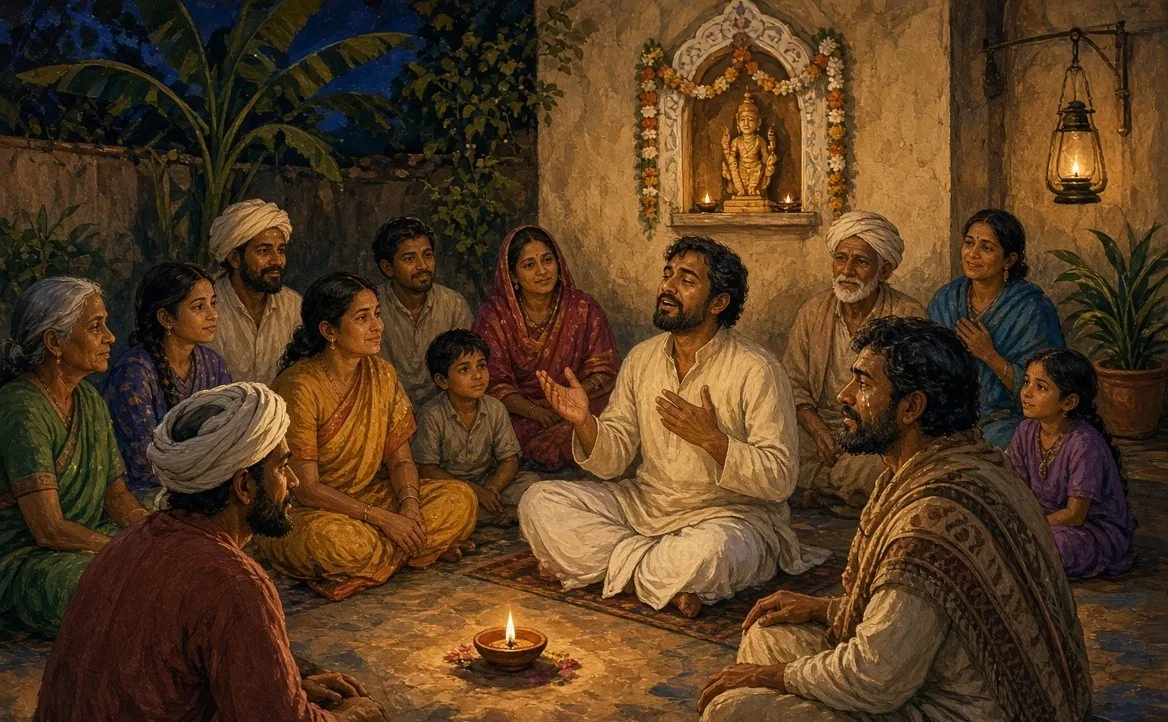
In most homes, healing comes not from rare texts but from simple things: a lamp, a song, a wise elder and people who do not shame.
Reflection activity — Chapter 1
-
On a scale of 0–10, where is your mental health most days? (0 = very poor, 10 = very strong)
-
Name two things that usually support your mental health (for example: sleep, friends, prayer, walk, music, study, work).
-
Name one situation that often disturbs your mental peace. What is one small step you can take next time it happens?
-
What helps you feel balanced and well?
-
What drains your energy or causes stress?
-
Who supports you during difficult times?
-
What coping strategies work best for you?