
Living texts beside a clinic, never instead of one
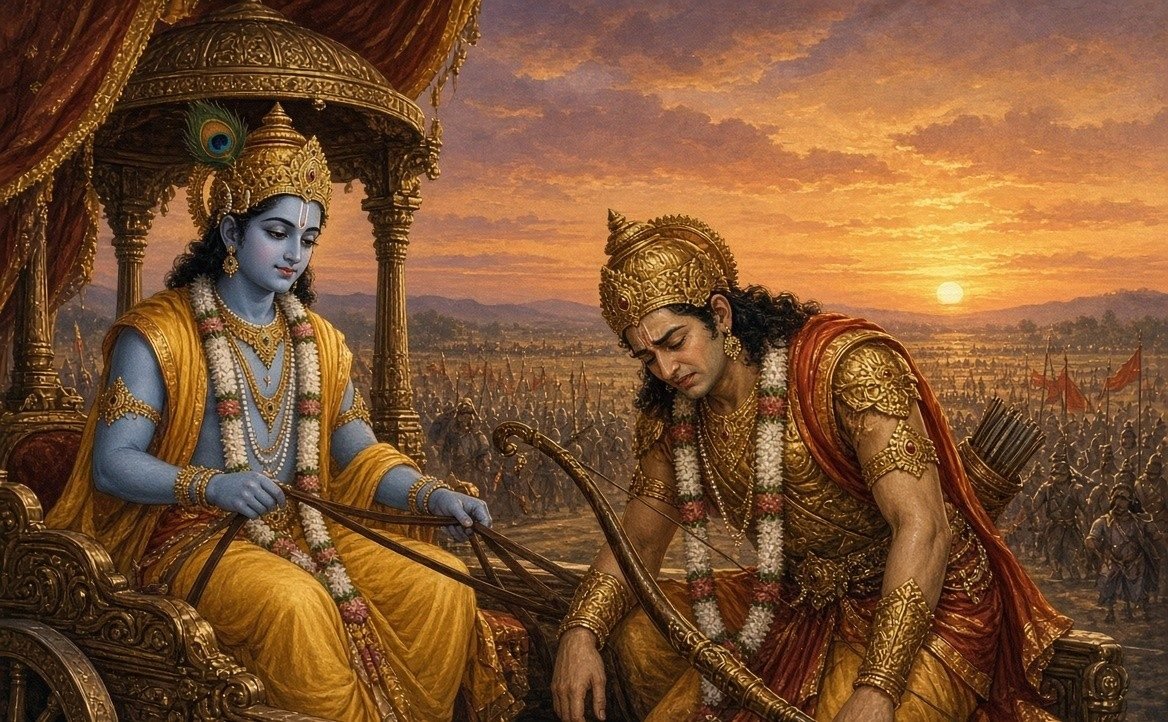
Krishna does not mock Arjuna. He listens, then guides. That is still the first clinical move.
24.1 Why look at Hindu scriptures for mental health?
Hindu religious and philosophical texts are not psychology textbooks in the modern sense, but they deeply explore: the nature of the mind (manas), intellect (buddhi), ego (ahamkara), and self (atman); emotions like grief, fear, anger, desire, jealousy, devotion, and compassion; behaviour patterns, duty (dharma), attachment, and detachment; suffering (duhkha) and paths to relief and meaning.
For many people in India and across the world, these texts are living guides. They offer language, stories, and practices that help make sense of mental struggles and support healing.
All Sanskrit verses are quoted from standard public-domain editions. Translations are given in simple English. Hindu dharma is a civilisation of argument. Psychology can listen without annexing. Karma is action and residue. Dharma is duty-in-context. Clinically this maps to values, generativity, and the superego — not to a sentence of fate.
24.2 The Bhagavad Gita: a dialogue on crisis, duty and the mind
The Bhagavad Gita is part of the Mahabharata (Bhishma Parva). It is a conversation between Arjuna and Krishna on the battlefield of Kurukshetra.
Psychologically, Arjuna is in a moral and emotional crisis: overwhelmed by grief and confusion; unable to fight, though it is his duty as a warrior; experiencing physical symptoms of stress (trembling, dry mouth, dropping his bow). Krishna's teachings address duty, wisdom, devotion, and self-mastery, offering a framework for mental balance.
Arjuna's breakdown — a psychological view
At the start of the Gita (Chapter 1), Arjuna shows signs of acute stress and moral conflict.
|
Domain |
From this book |
|---|---|
|
Physical |
Limbs giving way, dry mouth, trembling, bow slipping from the hand |
|
Emotional |
Deep compassion mixed with confusion and despair; inability to see any good in killing teachers and relatives |
|
Cognitive |
Confusion about dharma; catastrophic thinking ("It would be better if I were killed unarmed") |
Modern terms might describe this as a crisis of conscience with an acute stress reaction, not cowardice. Krishna does not mock him; he listens, then guides.
24.3 Key Gita teachings on the mind
The mind as friend or enemy — Gita 6.5
The restless mind and practice — Gita 6.34–6.36
Equanimity is yoga — Gita 2.48
The ladder of disturbance — Gita 2.62–2.63
The person of steady wisdom (sthitaprajña) — Gita Chapter 2
Krishna describes a person of steady wisdom: not shaken by adversity; free from excessive attachment, fear, and anger; balanced in pleasure and pain; able to withdraw the senses like a tortoise drawing in its limbs.
this is an ideal of emotional resilience and self-mastery, not emotional numbness. Feel emotions without being enslaved by them. Act from clarity and values, not compulsion. Therapeutic goals it can inspire: emotion regulation, distress tolerance, values-based living.
Two more Gita lines that sit beside the clinic
24.4 The Ramayana: grief, duty, and relational psychology
The Ramayana, attributed to Valmiki, explores family dynamics and duty; grief and loss; loyalty, betrayal, and honour; leadership under pressure. Many episodes show intense emotional states that resemble modern psychological patterns. Episode citations below follow this book's reading of Ayodhya Kanda and later books. Exact verse numbers vary by recension; the psychology is in the scene.
Dasharatha's grief and attachment
When Rama is exiled, King Dasharatha is overwhelmed. He cannot accept separation. His past karma (the accidental killing of Shravana Kumar) and his attachment to Kaikeyi contribute to the crisis. In Ayodhya Kanda his sorrow is described vividly: he cannot rest, constantly remembers Rama, and eventually dies from heartbreak.
Psychological themes: complicated grief; attachment and dependency (identity and happiness overly tied to one relationship); guilt and regret. The text portrays how unprocessed grief and guilt can destroy health and judgement.
Rama's response to loss and duty
When told of his father's death, Rama faints from shock, then regains consciousness; performs funeral rites with composure; continues to uphold dharma despite personal pain.
Themes: acute grief reaction followed by ritualised mourning; duty as structure — rituals contain overwhelming emotion; resilience — feeling pain and still fulfilling responsibilities. Rama is not unfeeling. He channels grief through dharma, ritual, and service (meaning-focused coping).
Sita's trials and trauma
Sita's life includes abduction and captivity in Lanka; public doubt and questioning of her purity; exile while pregnant; a final choice to return to the earth.
Through a trauma lens: violation and loss of safety; social stigma and humiliation; repeated separations; extreme stress and isolation. Her responses show strength and clarity in speech, endurance, and assertion of autonomy. For many readers the story validates the pain of women facing injustice and highlights the need for social support, justice, and respect for survivors. A verse is not a reason to return a person to harm.
Bharata, Lakshmana, and family systems
Bharata refuses to usurp the throne and places Rama's sandals on it. Lakshmana's devotion is fierce and sometimes impulsive. Kaikeyi's fear and manipulation, driven by insecurity and past promises, ruptures the family. Kausalya bears loss with restraint.
This maps to family systems theory: one person's choices affect the whole; roles shape behaviour; unresolved fears and secrets create generational pain. Loyalty, duty, and fear can create both nobility and tragedy.
24.5 Upanishads: self-knowledge and freedom from fear
The Upanishads explore atman and brahman; liberation (moksha) from ignorance (avidya) and fear. Much suffering comes from misidentification (with body, roles, or ego). Self-knowledge reduces existential anxiety and fear of death. Shravana, manana, and nididhyasana are forms of cognitive and contemplative training.
The Katha Upanishad chariot: body = chariot; senses = horses; mind = reins; intellect = charioteer; self = rider. A well-guided chariot reaches the goal; an uncontrolled one leads to danger. This is a model of self-regulation.
24.6 Yoga Sutras of Patanjali
Kleśa 1 — Avidyā (ignorance)
Kleśa 2 — Asmitā (I-making)
Kleśa 3 — Rāga (attachment / clinging)
Kleśa 4 — Dveṣa (aversion)
Kleśa 5 — Abhiniveśa (clinging to life / fear of ending)
YS 2.10–2.11: the subtle ones are resolved as they reverse; the active ones by dhyāna (meditation that is chosen, not forced). YS 2.12: kleśas seed karma and its fruit in seen and unseen births — read clinically as: an affliction that is fed becomes a pattern that returns. Gītā 2.62–2.63 is the same chain in narrative form.
The eight limbs (yama, niyama, asana, pranayama, pratyahara, dharana, dhyana, samadhi) are a lifestyle and mental-training system that overlaps with modern biopsychosocial approaches. They do not replace ERP, DBT, or a mood stabiliser.
Yoga psychology — the working model
Citta is the mind-field (manas + buddhi + ahamkara in lived use). Vrittis are its waves. Yoga is not emptying a life. It is reducing the waves that steal the rider (Katha chariot; YS 1.2–1.4). When waves rule, you take their shape. When they still, the seer can rest in its own form.
Eight limbs as a nervous-system curriculum: yama/niyama = relational and self ethics (mental hygiene from Chapter 24); asana = a body that can stay; pranayama = voluntary brake on arousal; pratyahara = turning down input (digital balance in Chapter 16); dharana = one-point hold; dhyana = that hold becoming a flow; samadhi = collectedness. Climb only as far as this week's window of tolerance.
24.7 Bhagavata Purana and devotional psychology
The Bhagavata Purana emphasises bhakti as love, surrender, and relationship with the divine. Psychological themes: emotional channelling (love, longing, grief directed toward Krishna); community and kirtan as regulation and bonding; stories of devotees (Prahlada, Draupadi, Mirabai) showing resilience under persecution and loss. For many, bhakti functions like emotion-focused coping — comfort, meaning, belonging.
24.8 Regional traditions across India
Hinduism is not monolithic. Several regional expressions that add psychological richness and provide culturally embedded narratives and rituals for grief, fear, hope, and joy.
Tamil — Alvars and Nayanars
raw expressions of longing, guilt, surrender, and divine love. They validate intense emotion as part of spiritual life.
Marathi — Dnyaneshwar, Tukaram, Eknath
humility, acceptance, seeing God in ordinary life; support for common people facing poverty, caste oppression, and personal suffering.
Bengali — Chaitanya and kirtan
ecstatic devotion, kirtan, and community as healing spaces. Group rhythm plus belonging is a social-regulation technology.
Kannada — Basava
Telugu and Malayalam bhakti
Annamacharya's keertanas and Malayalam works such as Poonthanam's Jnanappana place the restless mind before a name of Krishna. Use them as this book uses Gita 6.34: name restlessness without shame, then practise.
Gujarati
Gujarati, Rajasthani, Punjabi, Kashmiri, Northeast
local deities, festivals, and stories addressing fertility, protection, harvest, war, and loss. In Assam, Sankardev's kirtan-ghar tradition works like satsanga — company that regulates. In Kashmir Shaiva language, awareness itself is trained. Use the local form you already trust. Do not import a verse to win an argument at a funeral.
24.9 Hindu practices as mental-health supports
Mantra, chanting and prayer
can function like focused-attention meditation; breathing regulation; reduced rumination and anxiety; increased connection and meaning; structured time for reflection.
Rituals, puja and festivals
Daily puja, aarti, lamps, offering food. Routine and structure; meaning-making; social support that reduces isolation. Ritualised processing: Durga Puja as victory over inner demons (anger, greed, ego); Diwali as light after difficulty; Shraddha as structured grieving and remembrance.
Pilgrimage
Break from routine; physical effort and discipline; shared identity; a narrative of purification and renewal.
Ethics as mental hygiene
Satya, ahimsa, brahmacharya as moderation, asteya, aparigraha. Living in line with these can reduce guilt and shame from harmful actions; conflict in relationships; inner fragmentation ("I say one thing, do another"). Integrity and self-respect are protective.
Techniques used for healing
- Asana, pranayama, dhyana, yoga nidra.
- Mantra / japa, bhakti, seva, satsanga, svadhyaya.
- Yama / niyama; Ayurvedic dinacarya; panca kosa (five sheaths) as a layered model of a person.
- Kleshas; abhyasa and vairagya.
These are supports. They sit beside Chapters 13–16 and 23. They do not close a psychiatry OPD.
24.10 Ancient Indian medical texts on mind
Ayurveda, the classical medicine of India, already names the mind as a clinical object, and its daily-routine texts (*dinacaryā*) and the five-sheath model (*pañca kośa*) speak directly to wellbeing. These books are not DSM, and they are not a licence to skip a psychiatrist. Read them as an older language for the same house.
Caraka Samhita — what unmada is
Sattvavajaya — definition
The five tools — technique by technique
Jnana — insight. "I am the panic" becomes "a wave is passing through a person who also slept and was loved." Kin: psychoeducation, decentering. Not spiritual bypassing. In psychosis, the clinic comes first.
Vijnana — skilled, testable knowing. Name the condition, the sleep debt, the thyroid, the thought error. Teach the maps from Chapters 8–15. Kin: collaborative empiricism in CBT. Know kula, kala, desha, bala — family, time, place, strength — before advising.
Dhairya — courage that stays. Capacity to remain while a feeling peaks and falls (Gita 2.14). Kin: distress tolerance, ERP's sitting with uncertainty, a friend who does not flee. Ashvasana and santvana: assurance and consolation by a trusted person, not slogans.
Smriti — memory used as medicine. Recall what helped last time, who you are besides the episode, the values anger wiped (Gita 2.63). Kin: a coping card, a safety plan, a grandmother's voice. It is not "delete trauma and paste joy."
Samadhi — collected attention. Turn the mind from the unwholesome object and rest it: one chosen breath, a name, a walk. Kin: attention training, MBCT. Not dissociation dressed as peace. If trauma is active, keep section 24.11 rules.
Inner sequence of the mind
Objects of manas in the texts: chintya, vicharya, uhya, dhyeya, sankalpa. Sattvavajaya walks that sequence on purpose.
- Chintya: notice the thought without becoming it.
- Vicharya: examine — fact, fear, or habit?
- Uhya: test a kinder, truer hypothesis.
- Dhyeya: hold one aim (sleep, one meal, one call).
- Sankalpa: decide one next act. Fruit is not guaranteed (Gita 2.47).
Asatmyendriyartha-samyoga — unwholesome sense-object contact — is a named cause: too much, too little, or the wrong input. Changing the feed is already Chapters 6, 13 and 16.
Pratidvanda — pairing an opposite
Some emotion-born states are met by a counter-move: consolation after loss; a safe small joy after frozen grief; cooling after rage. Kin: behavioural activation, DBT opposite action. Titration, not "be happy." Do not pair trauma with a surprise.
What the physician and the family actually do
- Ashvasana / santvana: a trusted person speaks slowly, names the real, stays.
- Trivarga-anveshana: dharma, artha, kama as a life larger than the episode.
- Tadvidya-seva: go to people trained in this illness.
- Atma-jnana: self-knowledge at a pace the nervous system can hold.
Ashtanga Hridaya — medicine for mental doshas
Sushruta Samhita (Uttara Tantra, unmada chapters) places manas at the hridaya and describes similar derangements. Use these books as maps of observation. Prescriptions, shodhana lists, and collyriums belong with a qualified Vaidya plus a modern physician — not with a downloaded verse.
24.11 Trauma-informed yoga
Chapter 10 already named trauma-informed care. Chapter 23 named yoga as a mind-body practice. This section is the missing join: yoga after trauma is not "stretch until you surrender." Trauma Center Trauma-Sensitive Yoga (TCTSY; Emerson, Turner, and colleagues at the Trauma Center associated with van der Kolk) adapts hatha so choice and interoception come before form.
Why ordinary class cues can harm
Trauma often took away choice over the body. A command ("Raise your left arm. Close your eyes. I will adjust you.") can replay that loss. Bound or inverted poses, heat, darkness, forced silence, or a teacher who cannot be refused can push a person out of the window of tolerance into freeze or panic.
Principles (SAMHSA care + TCTSY)
- Safety: predictable room, lights that stay on if needed, exits visible, no surprise touch.
- Choice and agency: invitational language — "You might…" / "If you like…" / "You can stop." Opting out is success, not failure.
- Interoception over appearance: notice weight in the feet, not whether the pose looks correct.
- Present moment: no forced recall of the event. Sensation now, then a choice.
- Effective action: if a sensation is too much, change the shape, open the eyes, stand, leave.
- Collaboration and trust: teacher is not a guru-controller. Preview what comes next.
- Cultural, historical, and gender respect: no spiritual bypassing; no claiming the pose will "release stored trauma" as a guarantee.
A cautious practice menu (not a class plan to force)
- Sit or stand with both feet or sit-bones finding the floor. Notice contact. Leave if noticing floods you.
- Unforced breath: longer out-breath only if it stays kind. Do not hold the breath as a test.
- Slow walk or mountain shape. Look around the room. Orientation is regulation.
- Hand on the chest or belly if that is chosen — same grounding already named in Chapter 6.
- Duration: minutes, not a heroic hour. Stop while still inside the window of tolerance.
Pair this with a trauma-trained therapist when PTSD, dissociation, or self-harm is active. Yoga is an adjunct. It is not ERP, not EMDR, and not a ward.
24.12 More bhakti voices
This section names Ālvārs, Nāyanārs, Varkari saints, Chaitanya, Mira and regional festivals. These extra lines stay inside that frame: longing, surrender and company as emotion regulation, never as a test of faith.
Ramprasad Sen (Bengali) speaks to the mind as a farm that will not be tilled; Chaitanya's kirtan uses group voice as a nervous-system event. Keep the local form you already trust.
24.13 Integrating scripture with modern care
Hold both perspectives respectfully.
|
Scriptures offer |
Modern psychology and psychiatry offer |
|---|---|
|
Meaning, values, identity, practices |
Evidence-based therapies and medicines |
|
Language for suffering and growth |
Diagnostic frameworks and safety protocols |
|
Community and ritual support |
Research on brain, behaviour, and treatment |
They can work together: a person with depression can benefit from antidepressants and therapy, and also from prayer, satsang, and Gita study. A trauma survivor can benefit from trauma-focused therapy, and also from rituals, pilgrimage, or bhakti. A family in conflict can benefit from family therapy, and also from shared puja, festivals, and ethical reflection on dharma.
Problems arise when severe mental illness is treated only as lack of faith or possession, delaying medical care — or when spiritual practices are dismissed as superstition, ignoring their real psychosocial benefits. A balanced approach respects both science and tradition.
24.14 Across the Hindu world — mind, sorrow, company, and help
Translations below are working English for a reader, not a claim to be the only scholarly rendering. Where a line is famous in several wordings, the meaning is what this chapter needs.
Śruti, smṛti, sūtra, saṃhitā, purāṇa — the classical shelf
The Upaniṣads already refuse the idea that a person is only today’s mood. The Katha Upaniṣad’s chariot — body as chariot, senses as horses, mind as reins, intellect as driver, the self as rider — is Katha Upaniṣad 1.3.3–1.3.9 (some editions mark the same block as 3.3–3.9 of the first adhyāya’s third vallī). The Taittirīya Upaniṣad’s five sheaths (anna, prāṇa, manas, vijñāna, ānanda) are Taittirīya 2.1–2.5 (Brahmānanda Vallī). When food and breath collapse, the mind sheath cannot be lectured into sattva.
Yoga Vāsiṣṭha (the Laghu and the larger Yoga Vāsiṣṭha / Mokṣopāya tradition) treats the mind as the workshop of bondage and freedom. Verse numbers jump by recension; the teaching that bondage and freedom are of the mind is repeated in the Utpatti and Nirvāṇa prakaraṇas (see especially the Vasiṣṭha–Rāma dialogues collected in Book 3 Utpatti and Book 6 Nirvāṇa). Aṣṭāvakra Gītā 1.4–1.13 speaks more sharply: you are awareness, not the passing storm. Neither book asks a person in psychosis to “realize” their way out of danger. They ask a recovering person not to fuse identity with a bad month.
Patañjali’s Yoga Sūtra 1.2 defines yoga as citta-vṛtti-nirodhaḥ. The kleśas — avidyā, asmitā, rāga, dveṣa, abhiniveśa — are Yoga Sūtra 2.3, unfolded in 2.4–2.9. That list is older than a CBT worksheet and rhymes with it. Nārada Bhakti Sūtra 1–2 calls bhakti parama-prema-rūpā; psychologically it is attachment given a safe object and a community, which is why kīrtana often lowers a pulse before any theory arrives.
Āyurvedic saṃhitās treat unmāda and daily rhythm by named chapters: Caraka Saṃhitā, Cikitsāsthāna 9 (unmāda); Caraka, Sūtrasthāna 5 and 7 (dinacaryā and prevention); Aṣṭāṅga Hṛdaya, Sūtrasthāna 2 (dinacaryā); Suśruta, Sūtrasthāna 15.41 (svastha). Caraka Saṃhitā, Sūtrasthāna 1.42–43 and 11.3–5 discuss the purpose of Āyurveda as protecting health and treating disease; the compact svastha verse itself is Suśruta, Sūtrasthāna 15.41. Neither text means “always happy.” Both mean balanced doṣa and agni plus a mind, senses, and self that can still function. That is the medical cousin of Chapter 1’s continuum.
Smṛti literature warns that rage and grasping ruin a life. Manusmṛti 7.45–52 lists the vyasanas (destructive addictions and passions) of a ruler, including mṛgayā, dyūta, and the cluster around krodha and indriya-loss; Manusmṛti 2.88 and 2.96–2.100 treat restraint of the senses; Manusmṛti 4.138 asks for truth without cruelty (satyaṃ brūyāt priyaṃ brūyāt). Those lines neighbour emotion dysregulation and integrity. This chapter does not import smṛti’s social hierarchies as health rules. A patient does not owe a caste verse their dignity. Take the inner discipline; leave the cage.
Purāṇas give situations, not codes. Gajendra’s cry when strength fails is Bhāgavata Purāṇa 8.2–8.4 (the stotra itself is 8.3.2–8.3.29 in the common vulgate). Prahlāda is Bhāgavata Purāṇa 7.5–7.9. Devī Māhātmya is Mārkaṇḍeya Purāṇa 81–93 (three caritas: Madhu-Kaiṭabha, Mahiṣa, Śumbha-Niśumbha). It has long been read as a war on inner panic, rage, and greed — useful as image, dangerous if a family treats a panic attack as a demon and delays a clinic. Tīrtha as structured pause appears throughout Skanda Purāṇa (for example Kāśī Khaṇḍa) and in the Mahābhārata’s Tīrthayātrā Parva (Vana Parva). That can reset a strained mind. It is not ECT, and it is not nothing.
Tamil — Caṅkam ethic, Tirukkuṟaḷ, Śaiva and Vaiṣṇava bhakti
Tirukkuṟaḷ treats a governed inner life as public health for a household and a kingdom. Numbered lines: Kuṟaḷ 121–130 (adakkam, self-restraint); Kuṟaḷ 129 (the wound of fire may heal, the wound of the tongue does not); Kuṟaḷ 160 (not harming); Kuṟaḷ 310 (anger as a weapon that wounds the angry); Kuṟaḷ 422 and 480 (a composed, discerning mind). Kaniyan Pūngundranar’s Caṅkam line yādum ūrē yāvarum kēḷir is Puranānūṟu 192 — not the Kuṟaḷ — and stands against the isolation that stigma loves.
Tirukkuṟaḷ 129 is given in full in Chapter 1, section 1.16.
Tirumandiram (Tirumūlar; 3,000 verses in the standard Tamil Shaiva numbering) and the Tēvāram of Appar (Tirunāvukkarasar), Sundarar, and Campantar speak of a mind that can be made a temple. Appar’s hymns are Tēvāram, Fourth to Sixth Tirumuṟai. Māṇikkavācakar’s Tiruvācakam (Eighth Tirumuṟai) lets the devotee cry and still address Śiva as beloved — feeling is allowed. Āṇṭāḷ’s Tiruppāvai has 30 pāsurams; the dawn communal vow is pāsuram 1 (mārkaḻi-t-tiṅgaḷ) through the month-long vow. Nammāḻvār’s Tiruvāymozhi (part of the 4,000 Divya Prabandham) holds both soaring joy and viraha — a classical language for longing that modern clinics sometimes only call anxiety.
Telugu and Kannada — Vemana, Pōtana, Annamayya, Tyāgarāja, vacanas
Vemana’s padyams (printed as Vēmana Śatakam / Vēmana Padyaalu; numbering differs by compiler) return to the same point: the outer mark is cheap; the mind is the real field. Pōtana’s Bhāgavatamu retells Bhāgavata Purāṇa 8.3 in Telugu for Gajendra’s cry: when your strength ends, calling is still dharma. Annamayya’s saṅkīrtanas are catalogued in the TTD / Annamacharya corpus by first line, not by a single universal verse number. Tyāgarāja’s kriti “Manasa sancharare” (rāga Śyāmā / Śyāmāḷi traditions vary; often listed in the Utsava-sampradāya / miscellaneous kritis) addresses the mind directly. “Dudukugala nannē dora koduku” is Tyāgarāja, Ghana-rāga-pañcaratna, rāga Gauḷa — a confession of inner faults without collapsing into worthlessness.
In Kannada, Basavaṇṇa’s kāyakavē kailāsa is a vacana cited by that first phrase in the vacana-saṅgraha (numbers differ by editor; some school editions list it among the kāyaka vacanas). Akka Mahādevī’s vacanas to Cenna Mallikārjuna are likewise cited by first line. Allama Prabhu’s vacanas cut identification with a restless mind. These are not licences to abandon a frightened person. They are licences to stop calling a woman’s distress “family honour.”
Malayalam — Ezhuttacchan, Pūntānam, Nārāyaṇa Guru
Ezhuttacchan’s Adhyātma Rāmāyaṇam (Kilippāṭṭu; Bālakāṇḍam through Uttarakāṇḍam) brought Rāma’s restraint and grief into the Malayalam house. Pūntānam’s Jñānappāna is a single poem of 360 couplets in common printed texts (line numbering 1–360). Nārāyaṇa Guru’s “one caste, one religion, one God” is the inscription-teaching associated with the Āṟuvippuram / later motto oru jāti oru matam oru daivam manuṣyanu; compassion as essence is unfolded in Ātmopadeśa Śatakam (100 verses) and in Jāti-nirṇayam. Humiliation makes people ill; dignity is preventive care.
Marathi — Jñāneśvar, Nāmdev, Eknāth, Tukārām, the Vārkarī road
Jñāneśvar’s Pasayadān is the closing prayer of Jñāneśvarī (Bhāvārtha-dīpikā) adhyāya 18, concluding ovis (commonly printed as 18.1794–18.1802, numbering varies by edition). Eknāth’s Eknāthī Bhāgavat on the eleventh skandha is cited by adhyāya. The Vārkarī pilgrimage to Paṇḍharpūr follows the seasonal wārī custom rather than a single verse number. A depressed person may not be able to walk 200 kilometres. They may be able to sit for one bhajan without being told they have failed God.
Gujarati, Rajasthani, Hindi–Awadhi — Narsinh, Mīrā, Tulsī, Sūr, Kabīr
Narsinh Mehta’s Vaiṣṇava jana to is given in full in Chapter 1, section 1.16.
Mīrā Bai was mocked, poisoned in story, and still sang “mere to Giridhar Gopāl, dūsarō na koī” (Mīrā Padāvalī; pad cited by first line, as critical numbers vary). For this chapter she is the patron of people whose families use honour to erase their inner life. That witness does not forbid a woman today from also seeing a counsellor.
Tulsīdās named his epic Rāmcaritmānas — a mānasa, a lake for the mind. The title-frame is Bālakāṇḍa, opening dohas; Hanumān’s ocean-crossing is Sundarakāṇḍa, from the first doha of that kāṇḍa through the Laṅkā landing (common vulgate Sundarakāṇḍa doha/chaupai sequence beginning “jāmavanta ke bacana suhāe”). Use it as courage, not as a demand that a panic attack “jump.” Sūrdās’s pads are Sūrsāgar, numbered differently by edition; cite by first line. Kabīr’s sākhī on the mind is given in full below; mann ke hāre hār hai, mann ke jīte jīt is a sākhī in the oral/printed Sākhī collections (Bijak and Guru Granth traditions preserve related Kabīr lines under different numbers — cite by first line). The companion sākhī dukh meṃ sumiran sab kare, sukh meṃ kare na koya is the same Sākhī corpus. Rahīm’s dohas are Rahīm Dohāvalī, commonly numbered in school editions (for example the doha on trouble revealing friends). Ravidās pads are cited by first line in the Ravidās Padāvalī.
Bengali — Caitanya, Rāmprasād, Caṇḍī, Rāmakṛṣṇa
Caitanya’s public nāma-saṅkīrtana is narrated in Kṛṣṇadāsa Kavirāja’s Caitanya-caritāmṛta, Ādi-līlā 7 and Madhya-līlā 7–13 (among other chapters). His later frailty is in Antya-līlā. Rāmprasād Sen’s song “Mon re krishi-kāj jano nā” is cited by first line in the Rāmprasādī padāvalī. Śrī Rāmakṛṣṇa’s Mother-teaching is recorded in Mahendranath Gupta’s Śrī-Śrī-Rāmakṛṣṇa-Kathāmṛta (the Gospel), diary conversations rather than śloka numbers. Kālī here is not a reason to refuse a ward. She is a reason not to hate the frightened part of yourself.
Devī Māhātmya (Mārkaṇḍeya Purāṇa 81–93) and Bengali Caṇḍī-pāṭh in Navarātri give families a yearly language for fighting inner asuras. Keep the theatre. Add the appointment if the asura is not leaving after the ninth night.
Odia, Assamese, Manipuri, and the Northeast
Jagannātha of Puri is the living cult of the Skanda Purāṇa / Purūṣottama-māhātmya layer and of Odia tradition; the Lord’s “unfinished” form is liturgical fact, not a verse number. Mahimā poet Bhīma Bhoi’s Stuti Chautisa and Stuti recited in Mahimā gatherings include the compassion line cited by first phrase prāṇīṅka ārata duḥkha (Odia padāvalī; line numbers differ by booklet).
In Assam, Śaṅkaradeva’s Kīrtan Ghoṣā is arranged in khaṇḍas / chapters by episode (for example the Adi Daśama material and the nāma-dharma sections); Mādhavadeva’s Nām Ghoṣā is printed as 1,000 ghara / verses in common editions (verse numbers 1–1000). The nām-ghar is the architectural form of that corpus. Manipuri Vaiṣṇava rāsa follows the Gauḍīya–Manipur liturgical calendar rather than a single śloka index.
Kashmir and the far north
Lal Ded (Lalleśvarī) — vākh beginning śiv chuy thali thali rozaan (printed in Lallā-vākh collections; numbering differs: Grierson–Barnett and later Kashmiri editions do not share one scheme, so cite by first line). Kashmir Śaiva recognition is Utpaladeva, Īśvara-pratyabhijñā-kārikā 1.1.1 and following, with Abhinavagupta’s Īśvara-pratyabhijñā-vimarśinī. Use that after safety is established. Do not use it to talk someone out of an emergency.
A map you can actually use
|
Region or shelf |
Voice |
Use |
|---|---|---|
|
Upaniṣad / Yoga Vāsiṣṭha |
Chariot, sheaths, mind as workshop |
You are more than this week’s mood; still feed the body |
|
Yoga Sūtra / Āyurveda |
Kleśas, svastha, dinacaryā |
Affliction has structure; rhythm is treatment |
|
Smṛti |
Anger and greed ruin a life |
Take discipline; do not take humiliation as dharma |
|
Bhāgavata / Devī |
Gajendra’s cry; inner asuras |
Calling for help is allowed; demons are not a delay tactic |
|
Tamil |
Kuṟaḷ, Āṇṭāḷ, Appar, Nammāḻvār |
Shared dawn practice; tears allowed; isolation is not holiness |
|
Telugu / Kannada |
Vemana, Tyāgarāja, Basava, Akka |
Speak to the mind; work as worship; shame is not care |
|
Malayalam |
Pūntānam, Nārāyaṇa Guru |
Mercy over pride; dignity as prevention |
|
Marathi |
Tukārām, Vārkarī walk |
The wounded are our own; walking and singing as company |
|
West and North |
Narsinh, Mīrā, Tulsī, Kabīr |
Empathy defines the devotee; honour must not erase a woman |
|
Bengal |
Caitanya, Rāmprasād, Rāmakṛṣṇa |
Circle, song, Mother; the mind as a field to till |
|
Odia / Northeast |
Jagannātha, Bhīma Bhoi, nām-ghar |
Unfinished forms can be holy; a house of the Name against loneliness |
|
Kashmir |
Lal Ded, recognition |
Śiva in the tired body; insight after safety |
If your own language is missing a line here — Maithili, Konkani, Tulu, Bodo, Nepali, Santali, or a grandmother’s unwritten song — add it in the margin with book, chapter, and verse if it has them. The test is the same: does the line reduce shame, tell the truth about sorrow, and leave the hospital door open? If yes, it belongs in this book.
Reference register — every religious line used in this section
Where a tradition numbers verses, the number is given. Where bhakti songs are catalogued by first line, that is stated. Recensions differ; this is a working register for the reader, not a claim that every manuscript agrees.
|
Line or teaching |
Book |
Place |
|---|---|---|
|
Pleasure–pain, gain–loss |
Bhagavad Gītā |
2.38 |
|
Arjuna’s trembling, dry mouth, slipping bow |
Bhagavad Gītā |
1.28–1.30 |
|
Teaching begins |
Bhagavad Gītā |
2.11 |
|
Sthita-prajña under sorrow |
Bhagavad Gītā |
2.56 |
|
Yogaḥ karmasu kauśalam |
Bhagavad Gītā |
2.50 |
|
Approach by respect, question, service |
Bhagavad Gītā |
4.34 |
|
Sama-darśana |
Bhagavad Gītā |
5.18 |
|
Self as friend or enemy |
Bhagavad Gītā |
6.5 |
|
Food and sleep in measure |
Bhagavad Gītā |
6.16–17 |
|
Sattva, rajas, tamas bind |
Bhagavad Gītā |
14.5 |
|
Mind as bondage and freedom |
Amṛtabindu Upaniṣad |
verse 2 |
|
Chariot of body, mind, buddhi |
Katha Upaniṣad |
1.3.3–1.3.9 |
|
Five sheaths |
Taittirīya Upaniṣad |
2.1–2.5 |
|
Yoga = stilling of mind-turnings |
Patañjali Yoga Sūtra |
1.2 |
|
Five kleśas |
Patañjali Yoga Sūtra |
2.3 (2.4–2.9) |
|
Bhakti as highest love |
Nārada Bhakti Sūtra |
1–2 |
|
You are not the passing storm |
Aṣṭāvakra Gītā |
1.4–1.13 |
|
Mind as workshop of bondage |
Yoga Vāsiṣṭha / Mokṣopāya |
Utpatti & Nirvāṇa prakaraṇas; numbers vary |
|
Svastha definition |
Suśruta Saṃhitā |
Sūtrasthāna 15.41 (15.48 in some prints) |
|
Purpose of Āyurveda |
Caraka Saṃhitā |
Sūtrasthāna 1.42–43; 11.3–5 |
|
Unmāda treatment |
Caraka Saṃhitā |
Cikitsāsthāna 9 |
|
Dinacaryā |
Aṣṭāṅga Hṛdaya; Caraka |
AH Sūtrasthāna 2; Caraka Sūtrasthāna 5, 7 |
|
Vices, anger, sense-restraint, truthful speech |
Manusmṛti |
7.45–52; 2.88; 2.96–100; 4.138 |
|
Gajendra’s cry |
Bhāgavata Purāṇa |
8.2–8.4; stotra 8.3.2–8.3.29 |
|
Prahlāda |
Bhāgavata Purāṇa |
7.5–7.9 |
|
Devī Māhātmya / Caṇḍī |
Mārkaṇḍeya Purāṇa |
81–93 |
|
Tīrtha journeys |
Skanda Purāṇa; Mahābhārata |
Kāśī Khaṇḍa; Vana Parva tīrthayātrā |
|
Daśaratha’s grief and death |
Vālmīki Rāmāyaṇa |
Ayodhyā Kāṇḍa, sargas ~40–42 and 64 (recensions differ) |
|
Self-restraint, speech-wound, anger, composure |
Tirukkuṟaḷ |
121–130; 129; 160; 310; 422; 480 |
|
Yādum ūrē yāvarum kēḷir |
Puranānūṟu |
192 |
|
Dawn communal vow |
Āṇṭāḷ, Tiruppāvai |
pāsurams 1–30 |
|
Śaiva hymns |
Tēvāram; Tiruvācakam; Tirumandiram |
Tirumuṟai 4–6; 8; 3,000 verses |
|
Viraha and praise |
Nammāḻvār, Tiruvāymozhi |
Nālāyira Divya Prabandham |
|
Manasa sancharare; Dudukugala |
Tyāgarāja |
kritis cited by title; Dudukugala = Gauḷa pañcaratna |
|
Gajendra in Telugu |
Pōtana, Bhāgavatamu |
retelling of BhP 8.3 |
|
Kāyakavē kailāsa |
Basava vacana |
cite by first line |
|
Jñānappāna |
Pūntānam |
couplets 1–360 in common prints |
|
One caste, one God; 100 verses |
Nārāyaṇa Guru |
motto; Ātmopadeśa Śatakam 1–100 |
|
Pasayadān |
Jñāneśvarī |
adhyāya 18, closing ovis |
|
Je kā rañjale gāñjale |
Tukārām Gāthā |
cite by first line |
|
Vaiṣṇava jana to |
Narsinh Mehta |
bhajan, line 1 |
|
Mere to Giridhar Gopāl |
Mīrā Padāvalī |
cite by first line |
|
Hanumān crosses the ocean |
Rāmcaritmānas |
Sundarakāṇḍa opening sequence |
|
Mann ke hāre hār hai |
Kabīr Sākhī / Bijak tradition |
cite by first line |
|
Mon re krishi-kāj jano nā |
Rāmprasād Sen |
padāvalī, cite by first line |
|
Caitanya’s kīrtana and frailty |
Caitanya-caritāmṛta |
Ādi 7; Madhya 7–13; Antya-līlā |
|
Mother-teaching |
Rāmakṛṣṇa-Kathāmṛta |
diary conversations, not śloka numbers |
|
Nām Ghoṣā |
Mādhavadeva |
verses 1–1000 in common prints |
|
Kīrtan Ghoṣā |
Śaṅkaradeva |
khaṇḍas by episode |
|
Śiv chuy thali thali |
Lal Ded, Lallā-vākh |
cite by first line |
|
Recognition |
Utpaladeva |
Īśvara-pratyabhijñā-kārikā 1.1.1 ff. |
Rule used in this book: if a corpus numbers verses, print book + chapter + verse. If it is a song tradition, print author + work + first line. If recensions disagree, say so. Never invent a number.
24.15 A simple story
Reflection
- Which verse or story from this chapter named a state you already know in your body?
- Where has "lack of faith" delayed care in a family you know?
- What is one practice (reading, silence, seva, satsanga) you could add beside — not instead of — the care you already use?
This book is for education and general awareness. It does not replace diagnosis or treatment by a qualified professional. If anyone is in danger, contact your local emergency services.